Beschreibung
Produktdetails
Einband
Taschenbuch
Erscheinungsdatum
29.09.2026
Abbildungen
schwarz-weiss Illustrationen, Raster,schwarz-weiss, Zeichnungen, schwarz-weiss, Tabellen, schwarz-weiss
Verlag
Taylor and FrancisSeitenzahl
410
Maße (L/B/H)
23,4/15,6/2,2 cm
Gewicht
590 g
Auflage
2nd edition
Sprache
Englisch
ISBN
978-1-03-293837-0
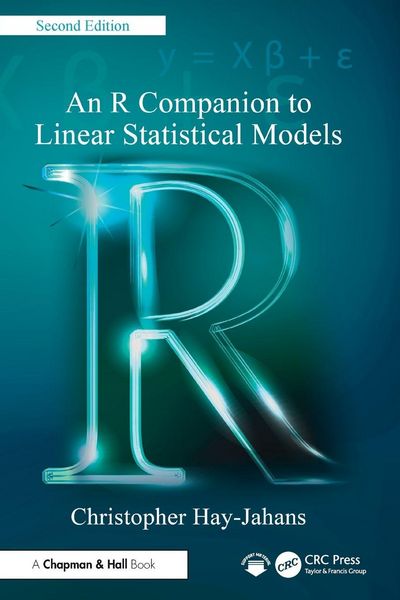
Taking advantage of both user-developed code and specialized functions, this second edition of An R Companion to Linear Statistical Models again targets two primary audiences: Those who are familiar with the introductory theory and applications of linear statistical models and who wish to learn how to use R in this area, or explore further ideas that might appear in this Companion; and those who are enrolled in an intermediate to advanced level course on linear statistical models for which R is the computational platform.
This Companion includes accessible introductions to writing R code as well as making use of functions through relevant examples. These examples cover methods used for linear regression and designed experiments with up to two fixed-effects factors, including blocking variables and covariates. Also included in this edition is a new part containing chapters that revisit the one-factor fixed-effects model from alternative points of view, and provide introductions to applying R to nonstandard linear contrasts, one-factor random-effects and repeated-measures designs, weighted least squares, and modelling with binary response data.
Key Features
- Demonstrates how to create user-defined functions, and how to use pre-packaged functions from the Comprehensive R Archive Network (CRAN) as well as functions prepared specifically for this Companion.
- Has carefully documented accompanying R script files that follow along with the discussions in the book, and also contain additional exploratory code.
- Makes use of a relevant collection of examples to demonstrate both the statistical methods being discussed, as well as the R code used implement the methods.
- Provides detailed interpretations and explanations of graphical tools used, computed model parameter estimates, associated tests, and common "rules of thumb" used in interpreting graphs and computational output.
- Limits statistical and mathematical background theory to that which aids in following computational methods.
Noch keine Bewertungen vorhanden
Verfassen Sie die erste Bewertung zu diesem Artikel
Helfen Sie anderen Kundinnen und Kunden durch Ihre Meinung.
Kurze Frage zu unserer Seite
Vielen Dank für Ihr Feedback
Wir nutzen Ihr Feedback, um unsere Produktseiten zu verbessern. Bitte haben Sie Verständnis, dass wir Ihnen keine Rückmeldung geben können. Falls Sie Kontakt mit uns aufnehmen möchten, können Sie sich aber gerne an unseren Kund*innenservice wenden.
zum Kundenservice