Gutscheinbedingungen

**Gültig von 22.06.2026 ab 19 Uhr bis 23.06.2026 24 Uhr auf Spielzeug, Schreibwaren, Filme, Geschenke & Trends, Musik, tolino eReader & Zubehör, Hörbücher und Hörbuch-Downloads (außer Abo), nicht preisgebundene Bücher und Kalender online auf thalia.at und in der Thalia App. Einzelne Artikel können ausgeschlossen sein. Aufgrund der Buchpreisbindung sind deutschsprachige Bücher und eBooks ausgenommen. Zusätzlich ausgenommen sind preisgebundene Artikel, Abos & Flatrates, eBooks, Games, Geschenkkarten/-boxen, Shelfies, Software, Zeitschriften sowie einzelne Artikel von tonies®. Pro Einkauf einmal einlösbar. Click & Collect nur bei Onlinevorabzahlung möglich. Keine Barauszahlung. Nicht kombinierbar mit anderen Aktionen und Gutscheinen. Gutschein wird auf max. 500€ Bestellwert angerechnet. Nicht gültig für Versandkosten und Services.

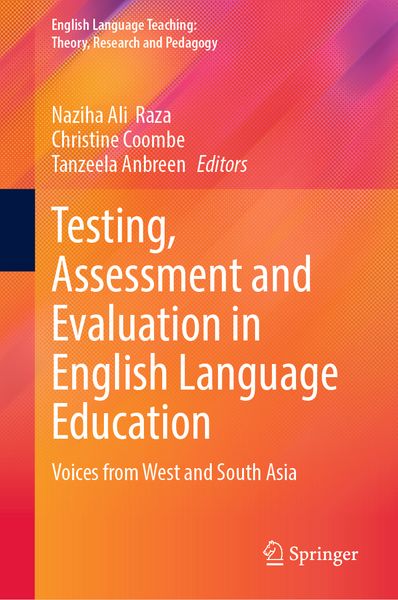
Produktbild: Testing, Assessment and Evaluation in English Language Education
Neu

Testing, Assessment and Evaluation in English Language Education Voices from West and South Asia

169,99 €

inkl. gesetzl. MwSt., Versandkostenfrei


Beschreibung

Produktdetails

Einband

Gebundene Ausgabe

Erscheinungsdatum

15.07.2026

Abbildungen

XIV, 27 illus., schwarz-weiss Illustrationen

Herausgeber

Naziha Ali Raza + weitere

Verlag

Springer Singapore

Seitenzahl

489

Maße (L/B)

23,5/15,5 cm

Auflage

1. Auflage

Sprache

Englisch

ISBN

978-981-9598-04-5

Beschreibung

Portrait

Naziha Ali Raza has a Professional Doctorate (EdD) in TESOL from the University of Exeter and is a Senior Learning and Development Consultant at the General Civil Aviation Authority in Dubai, UAE. She has publlished work on CPD, teacher research, assessment and translingual pedagogy. Her last co-edited volume is English Language Teaching in Pakistan (Springer Nature, 2022) and her professional interests include teacher development, translingual pedagogy, program evaluation and training policy development. Naziha has served as the President of TESOL Arabia, now TESOL Conferences (2016); as a member of the TESOL International Association’s Affiliate Network Professional Council (2016-19) and the Nominating Committee (2020-21). She is now in the leadership committee of TESOL International Association’s Global Education Professional Network. Since 2010, Naziha has facillitated outreach teacher development in rural Pakistan as part of her commnity development intitiatives. She founded the Extensive Reading Foundation Pakistan (2010) and reaches out to teachers through her YouTube channel.

Christine Coombe has a Ph.D in Foreign/Second Language Education from The Ohio State University and is an Associate Professor at the Higher Colleges of Technology in Dubai. Christine has co-authored/edited 60+ volumes on assessment/testing, research, teacher effectiveness, leadership and task-based teaching and learning. Dr Coombe served as TESOL International Association President (2011-2012) and as a member of the Board of Directors (2005-2007; 2010-2013). Christine received the British Council’s International Assessment Award for 2013. Her most recent honors were being named to TESOL’s 50@50 which “recognizes professionals who have made significant contributions to the TESOL profession within the past 50 years.” In 2018 she received the Alatis Award for exemplary service to TESOL. She was named to the US Department of State’s 30@30 list which recognizes the top 30 English Language Specialists over the past 30 years. Most recently, Christine was elected to serve on the Board of Trustees of TIRF and is now Immediate Past President of the English Language Testing Society.

Tanzeela Anbreen is a researcher and educator in the field of language testing and assessment, with a particular focus on multilingual contexts in South Asia. She holds a PhD in Applied Linguistics from the University of Bedfordshire, UK, where her doctoral research investigated L2 writers’ revisions in academic English writing using keystroke logging. She has taught at six UK universities and has supervised postgraduate research, including language assessment, academic literacy, and corpus-based analysis. Her research interests span academic writing assessment, digital literacies, corpus linguistics, and the sociopolitical dimensions of testing in postcolonial contexts. She has been involved in British Council-funded projects and is currently working on studies exploring assessment fairness, metadiscourse in speaking tests, and language assessment literacy. In addition to her teaching and research in the UK, she actively collaborates with higher education institutions worldwide, including those in Vietnam, Sri Lanka, Pakistan, Nepal, Egypt, the Maldives, Oman, Myanmar, Jordan, China, Hong Kong, and Trinidad and Tobago.

Produktdetails

Einband

Gebundene Ausgabe

Erscheinungsdatum

15.07.2026

Abbildungen

XIV, 27 illus., schwarz-weiss Illustrationen

Herausgeber

Verlag

Springer Singapore

Seitenzahl

489

Maße (L/B)

23,5/15,5 cm

Auflage

1. Auflage

Sprache

Englisch

ISBN

978-981-9598-04-5

Herstelleradresse

Springer Nature Customer Service Center GmbH
Europaplatz 3
69115 Heidelberg
DE
ProductSafety@springernature.com

Kundinnen und Kunden meinen

0 Bewertungen

Informationen zu Bewertungen

Zur Abgabe einer Bewertung ist eine Anmeldung im Konto notwendig. Die Authentizität der Bewertungen wird von uns nicht überprüft. Wir behalten uns vor, Bewertungstexte, die unseren Richtlinien widersprechen, entsprechend zu kürzen oder zu löschen.

Die Bewertungen sind nach Format, Anzahl Sterne und Datum sortiert.

Verfassen Sie die erste Bewertung zu diesem Artikel

Helfen Sie anderen Kund*innen durch Ihre Meinung

Kundinnen und Kunden meinen

0 Bewertungen filtern

Weitere Artikel finden Sie in

  • Produktbild: Testing, Assessment and Evaluation in English Language Education
  • Chapter 1: Testing, Assessment and Evaluation in English Language Education: Voices from West and South Asia.- Chapter 2: “I went through a range of emotions when I took my IELTS exam”: A Qualitative Inquiry into Iranian Test-Takers’ Emotionality.- Chapter 3: The Impact of Assessment Literacy of Teachers’ in Designing Test Items in English as a Second Language Classroom in Sri Lanka.- Chapter 4: Navigating Teacher Assessment Identity Landscape: A Journey Through Teacher Experience.- Chapter 5: Developing English Teachers’ Writing Assessment Literacy through Professional Development: A Case Study.- Chapter 6: Engagement in Structured Reflective Practices as a Catalyst for Iranian EFL Teachers' Perceptions of Language Assessment Literacy.- Chapter 7: EFL Teachers’ Speaking Assessment Literacy: Strategy Development, Challenges, and Needs in Focus.- Chapter 8: Mapping Task Sequencing, Anxiety and Enjoyment in Assignment-based Writing Assessment.- Chapter 9: Assessing Young English Language Learners in Instructional Settings in Iran.- Chapter 10: The Emotional Toll of Language Policy and Assessment Planning on Nepali English Language Teachers.- Chapter 11: Testing, Assessment, and Evaluation Practices in Pakistani HEIs: English Language Teachers’ Insights and Perspectives.- Chapter 12: Monitoring Emotional Labor and Assessment Practices: The Effects of Sociocultural Setting on Iranian English Language Teachers.- Chapter 13: Exploring Inclusive Assessment Policies and Practices for Visually Impaired Students at a Pakistani HEI.- Chapter 14: Classroom Assessment Fairness in Iranian EFL Context: A Meta-Analysis.- Chapter 15: Assessment of Language Aptitude of Pakistani University Students Towards Learning the Chinese and Turkish Languages.- Chapter 16: An Evaluation of the Implementation of School Based Assessments in English Language Teaching in Sri Lanka.- Chapter 17: Examining Self-assessment in Teacher Education: A Case Study of Pre-service English Teachers in an Iranian University Context.- Chapter 18: Experience Matters? A Comparative Study of Novice and Veteran EFL Teachers’ Views on Student Self-Assessment.- Chapter 19: Assignment Component in Continuous Internal Assessment: Challenges and Remedies.- Chapter 20: Assessing the Outcomes of Critical Thinking Skills Instruction at Pakistani Undergraduate Engineering Programs.- Chapter 21: Promoting Oracy Assessment Among Young English Language Learners in Asian Countries: A Key to Successful Language Learning.- Chapter 22: Dynamic Assessment of EFL Learners’ Writing: Revealing Hidden Developmental Differences.- Chapter 23: Vocabulary Knowledge and Task Types in a Sample of IELTS Reading Subtest.- Chapter 24: Role of AI in Reviewing Writing Assessment in India.- Chapter 25: Evaluating the efficiency of AI versus Human Assessment for Writing evaluation in Higher Education institutions in Pakistan.- Chapter 26: Digital Transformation in English Education: Exploring Online Assessment Strategies in Pakistan.- Chapter 27: Emotional dynamics in Technology Integration: A Deep Dive into the Experiences of EFL Teachers.- Chapter 28: AI-Based Language Assessment in Low-Resourced Settings: Iranian Teachers’ Practices, Challenges, and Solutions.- Chapter 29: Emerging patterns and evolving perspectives in language assessment.