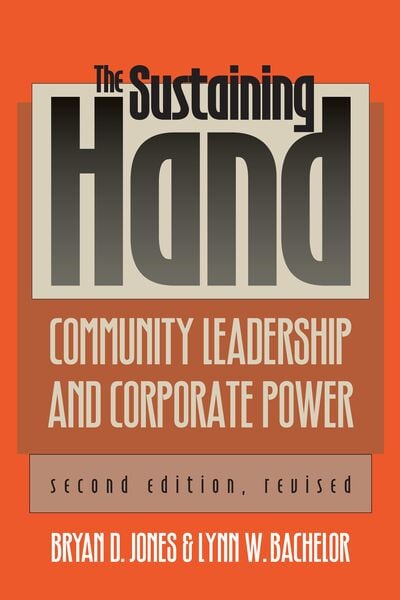
The Sustaining Hand Community Leadership and Corporate Power
-
- Einzelkauf Download ausgewählt
-
Sprache:Englisch
31,40 €
inkl. gesetzl. MwSt.Beschreibung
Produktdetails
Format
ePUB
Kopierschutz
Nein
Family Sharing
Nein
Text-to-Speech
Ja
Erscheinungsdatum
15.06.1993
Verlag
University Press Of KansasSeitenzahl
296 (Printausgabe)
Dateigröße
3021 KB
Auflage
2. Auflage
Sprache
Englisch
EAN
9780700639717
As the recent shake-up at GM underscores, the new global economy has widened the cracks and stresses in the American auto industry. But, as this new edition of the highly regarded Sustaining Hand reminds us, the auto industry remains a central if volatile player in American urban politics.
In this significantly revised update, Bryan Jones and Lynn Bachelor have extended and refined their analysis of Detroit-area automakers and political leaders negotiating the selection of new factory sites (and thus the addition of thousands of jobs to the local economy). Their thorough revision develops a crucial new conceptsolution setsupdates all plant location decisions reported in the first edition, and adds an instructive new case studythe Chrysler Jefferson Avenue plant in Detroit.
This book seeks to uncover the linkages between business leaders(motivated by profit) and political decision makers (motivated by electoral gain) by examining the responses of public officials in three Michigan auto citiesDetroit, Flint, and Pontiacto plant-location choices made by General Motors and Chrysler. Throughout, the authors focus on three issues-the relationship between the local industrial economy and the local political system, the structure of urban politics, and the degree of independence of political decision makers in urban affairs.
As Jones and Bachelor show, urban regimes, in their efforts to shore up sagging economies, develop characteristic solution-sets that are applied almost routinely to superficially similar situations. In fact, they contend, it's rare for a regime to start with a problem and search for a policy solution. Instead, through a pattern of interactions among politicians, business executives, labor unions, and other interested parties, a package of problem-definitions and preferred solutions emerges. But if applied indiscriminately, these solutions can become dysfunctional, which in turn may attract new participants to the policy process and ultimately alter the regime's character.
Noch keine Bewertungen vorhanden
Verfassen Sie die erste Bewertung zu diesem Artikel
Helfen Sie anderen Kundinnen und Kunden durch Ihre Meinung.
Kurze Frage zu unserer Seite
Vielen Dank für Ihr Feedback
Wir nutzen Ihr Feedback, um unsere Produktseiten zu verbessern. Bitte haben Sie Verständnis, dass wir Ihnen keine Rückmeldung geben können. Falls Sie Kontakt mit uns aufnehmen möchten, können Sie sich aber gerne an unseren Kund*innenservice wenden.
zum Kundenservice