KI-Beratung Beta

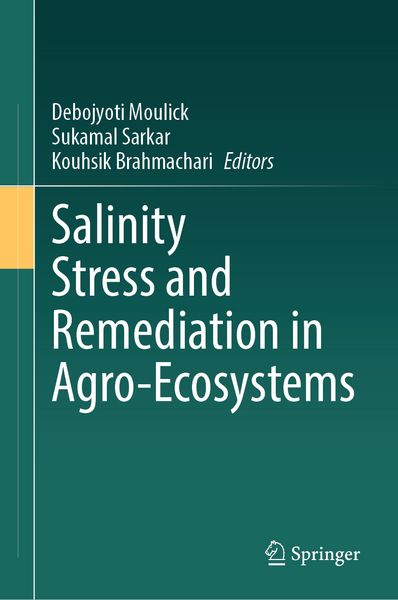
Produktbild: Salinity Stress and Remediation in Agro-Ecosystems
- 10%

Salinity Stress and Remediation in Agro-Ecosystems

10% sparen

196,99 € UVP 219,99 €

inkl. gesetzl. MwSt., Versandkostenfrei


Beschreibung

Produktdetails

Einband

Gebundene Ausgabe

Erscheinungsdatum

02.05.2026

Abbildungen

XIV, 501 p. 52 illus., 51 illus. in color.

Herausgeber

Debojyoti Moulick + weitere

Verlag

Springer

Seitenzahl

501

Maße (L/B/H)

24,1/16/3,4 cm

Gewicht

932 g

Sprache

Englisch

ISBN

978-3-032-24000-2

Beschreibung

Portrait


Dr. Debojyoti Moulick is a highly distinguished scientist recognized in the 2025 Stanford University/Elsevier list of the world’s top 2% most influential scientists. With a multidisciplinary background in Microbiology and Biotechnology, he earned his M.Phil. and Ph.D. in Environmental Science from the University of Kalyani. His career is marked by significant academic milestones, including a Research Associateship (DBT-RA) from the Indian Institute of Science (IISc), Bangalore, and impactful research at ONGC’s Geochemistry Division. Dr. Moulick is widely acclaimed for his breakthrough in developing affordable, farmer-friendly mitigation strategies for arsenic-induced phytotoxicity in rice, alongside his extensive expertise in biomonitoring, seed priming technology, and grain quality analysis within soil-water-crop agroecosystems. A prolific scholar and editor, Dr. Moulick has published several edited volumes with leading houses. Having reviewed over 350 international papers, his research footprint is profound, with more than 2,570 citations and an h-index of 30 as of late 2025. Dr. Moulick continues to contribute to the global scientific community through his ongoing work in sustainable agricultural intensification and environmental resilience. 


Dr. Sukamal Sarkar is an agricultural scientist and Assistant Professor of Agronomy at Ramakrishna Mission Vivekananda Educational and Research Institute. A distinguished researcher, he is ranked among the Top 2% Scientists Worldwide (2025) by Stanford University and Elsevier, a testament to his global impact and citation influence. Dr. Sarkar specializes in cropping systems modelling, agro-meteorology, and climate-smart agriculture. His expertise lies in integrating long-term field experimentation with process-based simulation models, particularly the APSIM framework, to optimize decision support for coastal and dryland agro-ecosystems. Dr. Sarkar’s collaborative work with international partners like CSIRO and IRRI has led to significant advances in greenhouse gas mitigation and nutrient management. Before his academic tenure, he served as Assistant Director of Agriculture for the Government of West Bengal, bridging the gap between high-level research and large-scale extension programs. A prolific author with over 100 peer-reviewed publications, his work has garnered more than 3,700 citations (h-index 29). Currently, he leads multidisciplinary projects funded by international agencies (ACIAR, DFAT, SWISSAID, IRRI) aimed at strengthening climate resilience and sustainable livelihoods in vulnerable farming communities.


Dr. Koushik Brahmachari serves as a Professor at the Department of Agronomy at Bidhan Chandra Krishi Viswavidyalaya (BCKV) and Former Registrar and Former Director of Extension Education, Bidhan Chandra Krishi Viswavidyalaya in West Bengal, India. With a prolific academic background, Dr. Brahmachari has contributed significantly to the field, boasting a publication record of over 125 scientific articles across esteemed national and international journals. His expertise extends beyond scholarly pursuits, as evidenced by his involvement in sixteen national and international research projects. These initiatives span various aspects of agricultural innovation, encompassing the development, testing, and widespread implementation of novel agricultural technologies and proven practices. Notably, Dr. Brahmachari has played a pivotal role in advancing agricultural sustainability in the Indian Sundarbans region of West Bengal, India. Over the course of more than a decade, he has been actively engaged in the dissemination of innovative technologies tailored to thrive in coastal saline environments. These efforts have been conducted under the auspices of ACIAR-supported research projects, further underscoring his commitment to impactful agricultural development.

Produktdetails

Einband

Gebundene Ausgabe

Erscheinungsdatum

02.05.2026

Abbildungen

XIV, 501 p. 52 illus., 51 illus. in color.

Herausgeber

Verlag

Springer

Seitenzahl

501

Maße (L/B/H)

24,1/16/3,4 cm

Gewicht

932 g

Sprache

Englisch

ISBN

978-3-032-24000-2

Herstelleradresse

Springer-Verlag KG
Sachsenplatz 4-6
1201 Wien
AT

Email: ProductSafety@springernature.com

Noch keine Bewertungen vorhanden

Verfassen Sie die erste Bewertung zu diesem Artikel

Helfen Sie anderen Kundinnen und Kunden durch Ihre Meinung.

Kundinnen und Kunden meinen

Bewertungen (0)

  • Produktbild: Salinity Stress and Remediation in Agro-Ecosystems

  • Nitric oxide reactive oxygen species and reactive sulphur species interplay in salinity exposed crops.-   Interaction of various soil amendments on salinity levels.- Secondary metabolite dynamics in crops under salinity stress.- Applications of bioactive compounds in salinity stress management.- Pgpr-mediated salinity stress tolerance.- M
    odulation of photosynthesis under salinity.-
    Impact of salinity stress on field crops/cropping systems.- Effectiveness of foliar spray of stress-mitigating chemicals in salinity stress management.- Advances and challenges in breeding salinity-tolerant crops: a path toward sustainable agriculture.- Prospects of biochar and nano-biochar in ameliorating salinity stress.- Potentials and challenges of crispr/cas9 technique for salinity stress management.- Salinity stress affecting organelles responses & modified gene expression in plants: an assessment.- Repercussions of salinity on field crops and achieving sustainable development goals.- Npk fertilization and salinity stress resilience.-Seed priming and salinity stress regulation in crops.- Molecular physiology and signalling of salinity stress in higher plants.