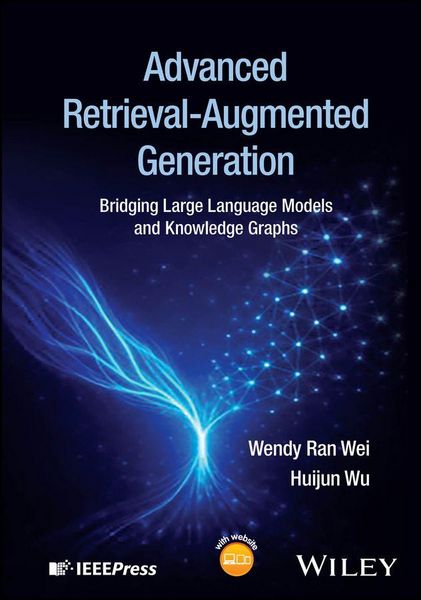
Advanced Retrieval-Augmented Generation Bridging Large Language Models and Knowledge Graphs
-
- Englisch ausgewählt
162,99 €
inkl. gesetzl. MwSt.,
Beschreibung
Produktdetails
Einband
Gebundene Ausgabe
Erscheinungsdatum
27.07.2026
Verlag
WileySeitenzahl
560
Maße (L/B/H)
25,9/18,4/3,8 cm
Gewicht
1125 g
Auflage
1
Sprache
Englisch
ISBN
978-1-394-37468-7
Build Accurate, Grounded, and Trustworthy AI Systems with Retrieval-Augmented Generation
Large language models are powerful-but they hallucinate. Advanced Retrieval-Augmented Generation offers a complete guide from the foundations of information retrieval (IR) to the cutting-edge frontiers of RAG. Bridging large language models (LLMs) and knowledge graphs (KGs), this book provides the theoretical principles, practical techniques, and hands-on frameworks needed to build reliable AI systems that minimize hallucinations and improve factual correctness. The book covers core concepts of Graph-RAG with applications across search, recommendation, and enterprise AI. Practical chapters demonstrate implementations using LlamaIndex, Neo4j, and leading Graph-RAG frameworks.
Readers will learn:
- IR and LLM fundamentals - model paradigms, transformer architecture, model families, training techniques, prompt engineering, applications, and limitations
- RAG pipeline engineering - chunking, indexing, retrieval, ranking, and generation
- KG construction and analytics - schema design, extraction techniques, graph algorithms, embeddings, and GNNs
- Graph-RAG architectures and evaluation - graph-based retrieval, graph-assisted generation, hybrid LLM-KG workflows, frameworks, benchmarks, and metrics
- Emerging directions - multimodal KGs, dynamic graphs, explainable RAG, RL-based traversal, and enterprise-scale implementations
With extensive hands-on examples and production-ready patterns, Advanced Retrieval-Augmented Generation is an indispensable resource for AI practitioners, ML engineers, researchers, and architects building the next generation of reliable, knowledge-grounded AI systems.
Noch keine Bewertungen vorhanden
Verfassen Sie die erste Bewertung zu diesem Artikel
Helfen Sie anderen Kundinnen und Kunden durch Ihre Meinung.
Kurze Frage zu unserer Seite
Vielen Dank für Ihr Feedback
Wir nutzen Ihr Feedback, um unsere Produktseiten zu verbessern. Bitte haben Sie Verständnis, dass wir Ihnen keine Rückmeldung geben können. Falls Sie Kontakt mit uns aufnehmen möchten, können Sie sich aber gerne an unseren Kund*innenservice wenden.
zum Kundenservice