KI-Beratung Beta

Produktbild: The White Ribbon Army Reconsidered

The White Ribbon Army Reconsidered The Woman's Christian Temperance Union After 150 Years

39,99 €

inkl. gesetzl. MwSt., Versandkostenfrei


Beschreibung

In honor of the WCTU’s 150th anniversary, Reassessing the White Ribbon Army provides a much-needed reflection on what was once the largest and most influential women’s political organization in the United States.

Originating as a series of local temperance crusades in 1873, the Woman’s Christian Temperance...

Beschreibung

In honor of the WCTU’s 150th anniversary, Reassessing the White Ribbon Army provides a much-needed reflection on what was once the largest and most influential women’s political organization in the United States.

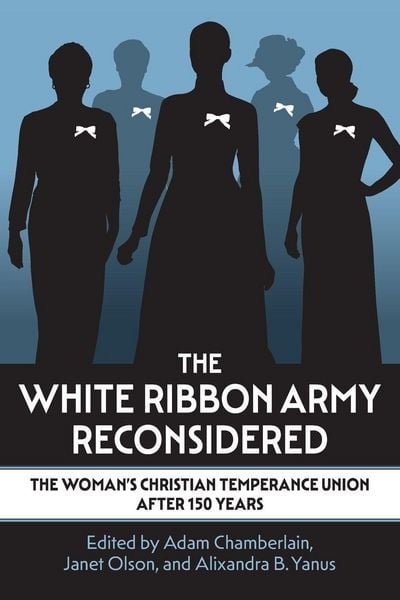
Originating as a series of local temperance crusades in 1873, the Woman’s Christian Temperance Union (WCTU) coalesced in November 1874 and soon became the largest women’s political organization in the United States. As champions of social reform, members identified themselves by the white ribbon bows they pinned to their dresses, a symbol of purity and commitment to the temperance cause, inspiring the nickname “the White Ribbon Army.”

Following president Frances Willard’s command to “Do Everything,” the WCTU developed a wide sphere of influence in social reform circles—well beyond Prohibition, and well beyond the United States. The WCTU’s global agenda included other reforms related to women’s traditional role as the center of the home and family, including suffrage, prison reform, and education. In the twentieth century, its message and methods inspired and mobilized not only white evangelical Protestant women but also those from other Christian denominations, racial and ethnic minorities, and their husbands and children who joined auxiliary organizations.

But what was once a powerful, organized global force has become an amorphous and contradictory caricature. The WCTU has been portrayed as socialist and ultra-conservative, ineffectual and powerful, inclusive and divisive. Its long-term legacy as an influential women’s network has been left underexamined, and there is a need for a reevaluation of the organization.

Marking the WCTU’s 150th anniversary, Reassessing the White Ribbon Army brings together scholars from women’s and public history, political science, rhetoric, and religious studies. Its twelve essays explore the WCTU’s broad impact on politics, society, and culture, acknowledging the WCTU’s complexities and contradictions to provide a fresh reassessment of this once-powerful organization and to inspire further research.

Portrait

Adam Chamberlain is professor of political science at Coastal Carolina University.

Janet Olson is the former archivist at the Frances Willard House Museum and WCTU Archives in Evanston, IL.

Alixandra B. Yanus is professor of political science at High Point University and the former Daniel German Visiting Distinguished Professor of Political Science at Appalachian State University.

Produktdetails

Einband

Taschenbuch

Erscheinungsdatum

14.08.2026

Herausgeber Adam Chamberlain + weitere
Verlag University Press of Kansas

Produktdetails

Einband

Taschenbuch

Erscheinungsdatum

14.08.2026

Herausgeber
Verlag University Press of Kansas
Seitenzahl

336

Maße (L/B/H)

22,9/15,2/2,2 cm

Gewicht

538 g

Sprache

Englisch

ISBN

978-0-7006-4275-5

Herstelleradresse

Libri GmbH
Europaallee 1
36244 Bad Hersfeld
DE

Email: gpsr@libri.de

Noch keine Bewertungen vorhanden

Verfassen Sie die erste Bewertung zu diesem Artikel

Helfen Sie anderen Kundinnen und Kunden durch Ihre Meinung.

Kundinnen und Kunden meinen

Bewertungen (0)

Die Leseprobe wird geladen.
  • Produktbild: The White Ribbon Army Reconsidered
  • Acknowledgments

    Introduction: “Everything is Not in the Temperance Reform, but the Temperance Reform Should Be in Everything”, Adam Chamberlain, Janet Olson, and Alixandra B. Yanus

    Part One: WCTU Methods

    1. “We Believe in the Coming of His Kingdom”: The WCTU in American Protestantism, Christopher H. Evans

    2. Intertwined Ribbons: The WCTU and the Equal Suffrace Association Fight for Woman Suffrage in Kansas, 1880–1890, Carolyn De Swarte Gifford

    3. Imagining a Police-Free Nation: The Radicalism of the WCTU’s Political Vision

    4. “In Their Youthful Simplicity”: Performing Political Childhoods in the WCTU, Fiona Maxwell

    5. “Two Coutries Divided by a Common Language”: Reassessing the Relationship between the WCTU and British National Women’s Temperance Movements, Annemarie McAllister

    6. The Japanese WCTU’s Focus on “Purity,” 1880s–1940s, Rui Kohiyama

    Part Two: WCTU Audiences

    7. Allies, Antagonists, and Indifference: Frances Ellen Watkins Harper’s Analysis of White Women in the WCTU, 1873–1898, Leslie K. Dunlap

    8. The Greeting of the Saloon: the WCTU Approaches Immigrants, 1874–1900, Ella F. Wagner

    9. Black Women’s Mobilization of the WCTU for Suffrage and Civil Rights in Springfield, Illinois, 1907–1914, Rachel E. Bohlmann

    10. Indigenous Christianity and Social Reform: Native American Women in the WCTU, 1879–1916, Thomas J. Lappas

    11. New Zealand, Biculturalism, and the WCTU NZ, 1885–192s, Randolph Hollingsworth

    12. From “Global Sisterhood” to “International Feminism”: The WCTU in India, 1900–1939, Lori Osborne

    Conclusion: “Moving Upward All the Time”?, Adam Chamberlain, Janet Olson, and Alixandra B. Yanus

    Glossary

    List of Contributors

    Index