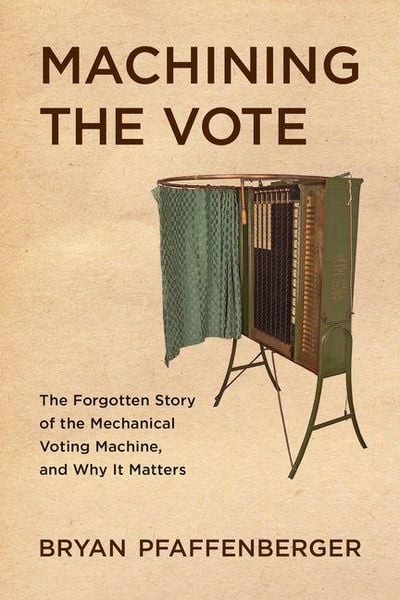
Machining the Vote The Forgotten Story of the Mechanical Voting Machine, and Why It Matters
-
- Englisch ausgewählt
54,99 €
inkl. gesetzl. MwSt.,
Beschreibung
Produktdetails
Einband
Taschenbuch
Erscheinungsdatum
27.10.2026
Abbildungen
schwarz-weiss Illustrationen
Verlag
University PressesSeitenzahl
320
Maße (L/B/H)
22,9/15,2/1,9 cm
Sprache
Englisch
ISBN
978-1-4214-5599-0
How a hulking machine helped build and sustain American democracy in the mid-twentieth century.
For more than a century, the mechanical lever voting machine stood in polling places across the United States. Unwieldy, unloved, and eventually discarded, it rarely attracted admiration. Yet as Bryan Pfaffenberger shows, this "lowly lever" shaped American democracy in profound ways.
Machining the Vote traces the lever machine's rise from the contested elections of the late nineteenth century through its dominance in the twentieth century and its eventual demise in the era of digital voting. Pfaffenberger begins with the political crises that prompted inventors such as bank safe maker Jacob Myers to design a new system combining mechanical innovation with new election laws. He follows the fierce patent battles, corporate struggles, and legal fights that turned the lever machine into a near-national infrastructure, closely intertwined with New York election law and urban machine politics. Voting machines, Pfaffenberger argues, are political artifacts: they embody legal assumptions, administrative procedures, and cultural values. Lever machines promised to eliminate fraud, prevent overvoting, and enforce uniform procedures, because the machines were so transparent; technicians and precinct officials could easily recognize tampering. A former designer of bank vaults during the heyday of daring bank robberies, Myers understood the need to develop a security process capable of identifying exploits. Their gradual replacement by electronic systems--often without equivalent legal and procedural safeguards--set the stage for new controversies, culminating in the turmoil of the 2000 presidential election.
Bringing together political history and science and technology studies, Machining the Vote offers a cultural analysis of how technologies are selected, stabilized, and abandoned. At a moment when election integrity is fiercely debated, this book provides essential historical perspective on how machines--and the laws surrounding them--shape the practice of democracy.
Kundinnen und Kunden meinen
Verfassen Sie die erste Bewertung zu diesem Artikel
Helfen Sie anderen Kund*innen durch Ihre Meinung
Kurze Frage zu unserer Seite
Vielen Dank für Ihr Feedback
Wir nutzen Ihr Feedback, um unsere Produktseiten zu verbessern. Bitte haben Sie Verständnis, dass wir Ihnen keine Rückmeldung geben können. Falls Sie Kontakt mit uns aufnehmen möchten, können Sie sich aber gerne an unseren Kund*innenservice wenden.
zum Kundenservice