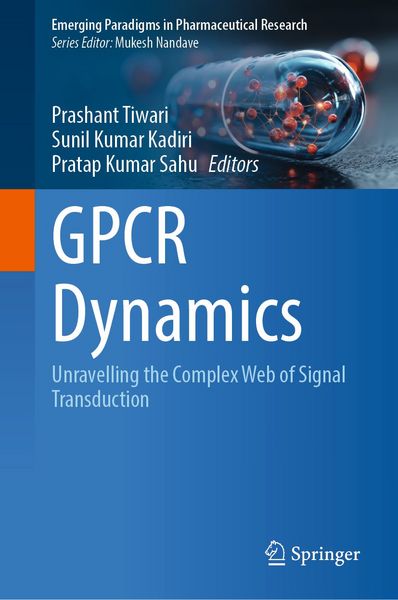
Produktbild: GPCR Dynamics
- 10%

GPCR Dynamics Unravelling the Complex Web of Signal Transduction

10% sparen

166,99 € UVP 186,99 €

inkl. gesetzl. MwSt., Versandkostenfrei


Beschreibung

Produktdetails

Einband

Gebundene Ausgabe

Erscheinungsdatum

19.05.2026

Abbildungen

XVI, 49 illus., 46 illus. in color., farbige Illustrationen, schwarz-weiss Illustrationen

Herausgeber

Prashant Tiwari + weitere

Verlag

Springer Singapore

Seitenzahl

402

Maße (L/B/H)

24,1/16/2,9 cm

Gewicht

791 g

Auflage

1. Auflage

Sprache

Englisch

ISBN

978-981-9590-80-3

Beschreibung

Portrait

Dr. Prashant Tiwari is a distinguished academician and researcher in pharmaceutical sciences with over 15 years of teaching and research experience across reputed institutions in India. He is currently serving as an Associate Professor at Dayananda Sagar University, Bengaluru, Karnataka. His inventive research is reflected in multiple national and international patents. These include microencapsulation of Celecoxib to improve solubility for Alzheimer’s therapy, AI‑driven strategies for cancer drug analysis, a smart IV fluid controller with advanced locking mechanisms. He has been awarded grants from the Department of Biotechnology, Government of India, along with seed project funding from DSU. He has authored and edited more than 30 scholarly books and chapters with leading publishers and Nirali Prakashan Notable works include The 3R’s Approach in Preclinical Pharmacology (2025), Enzymatic Targets for Drug Discovery Against Alzheimer’s Disease (2024) and Brain Tumor Drug Development (2024). He has organized national conferences, delivered lectures and chaired sessions internationally. His achievements have earned prestigious honors, including the SPSR Excellence Award (2025), Dr. P.D. Patil National Award (2022), Young Scientist Award (2023), IPES Fellowship (2021), and the ICMR Senior Research Fellowship (2016–2019). His pursues research in neurodegenerative diseases, drug interactions, pharmacokinetics/pharmacodynamics and metabolic disorders.

Dr. K. Sunil Kumar is an Associate Professor at the College of Pharmaceutical Sciences, Dayananda Sagar University, Bengaluru, with over 16 years of teaching and research experience. He earned his PhD in Pharmaceutical Sciences from JNTU Hyderabad and has established himself as a dedicated academician in pharmacology. His research spans neuropharmacology, metabolic disorders, organ‑protective activities and drug interactions, reflecting a multidisciplinary approach. He has authored 65 research and review articles in reputed journals, five books and four book chapters, alongside six patents showcasing his innovative contributions to drug development. An active member of the Association of Pharmaceutical Teachers of India, he engages deeply with the academic community. His recent work highlights clinically relevant drug interactions, including Alprazolam with Pomegranate, Carbamazepine with Losartan and Naproxen with St. John’s Wort, as well as the antiparkinsonian potential of traditional formulations like Zinda Tilismath, inspiring students and researchers alike.

Dr. Pratap Kumar Sahu is actively engaged in advanced research in neuropharmacology, with a particular focus on Alzheimer’s disease and related cognitive disorders at the School of Pharmaceutical Sciences, Siksha O Anusandhan University. His recent work centers on the interplay between diabetes mellitus and neurodegeneration, exploring how metabolic dysfunction contributes to cognitive decline. He extensively investigates the repurposing of antidiabetic agents and evaluates their neuroprotective mechanisms using well‐established experimental models of AD and diabetes-induced cognitive impairment. A major component of his research involves nanotechnology-enabled drug delivery systems, including solid lipid nanoparticles, metal-based nanoformulations (AuNPs, SeNPs) and lipid nanocarriers designed to improve brain bioavailability and therapeutic efficacy of neuroprotective drugs. His publications highlight innovative approaches to enhance cognitive outcomes through nanoformulated antidiabetic compounds, paving the way for translational applications in neurodegenerative disease management. He also plays a major role in sponsored research, serving as Co-Principal Investigator in projects funded by LSRB-DRDO, ICMR and DBT BUILDER, and as Principal Investigator on an ICMR-funded project. He is a recipient of the UGC-GATE Scholarship (1999–2001), reflecting his longstanding academic excellence and deep commitment to research.

Produktdetails

Einband

Gebundene Ausgabe

Erscheinungsdatum

19.05.2026

Abbildungen

XVI, 49 illus., 46 illus. in color., farbige Illustrationen, schwarz-weiss Illustrationen

Herausgeber

Verlag

Springer Singapore

Seitenzahl

402

Maße (L/B/H)

24,1/16/2,9 cm

Gewicht

791 g

Auflage

1. Auflage

Sprache

Englisch

ISBN

978-981-9590-80-3

Herstelleradresse

Springer-Verlag GmbH
Tiergartenstr. 17
69121 Heidelberg
DE

Email: GPSR Kontakt

Noch keine Bewertungen vorhanden

Verfassen Sie die erste Bewertung zu diesem Artikel

Helfen Sie anderen Kundinnen und Kunden durch Ihre Meinung.

Kundinnen und Kunden meinen

Bewertungen (0)

  • Produktbild: GPCR Dynamics
  • Chapter 1. Introduction to G protein-coupled receptors (GPCRs): Structure and Function.- Chapter 2. Ligand-induced Allosteric Changes: Mechanisms of GPCR Activation.- Chapter 3. Unravelling the Complexity: GPCR Signaling Networks.- Chapter 4. Targeting Desensitized GPCRs: Therapeutic Opportunities and Challenges.- Chapter 5. Breaking Barriers: Latest Frontiers in GPCR Structural Analysis.- Chapter 6. Strategies for GPCR-directed Disease Management.- Chapter 7. Revolutionizing GPCR Studies: Cutting-edge Technologies.- Chapter 8. Translating GPCR Movements into Therapeutic Innovations.- Chapter 9. Advanced Concepts in GPCR Allosterism and Biased Signaling.- Chapter 10. Exploring GPCR Functions through Systems Biology.- Chapter 11. Strategic Pathways for Future GPCR Research and Development.- Chapter 12. Molecular Mechanisms Underlying GPCR-Associated Pathologies.- Chapter 13. Ligand-based and structure-based drug design for GPCRs.- Chapter 14. Exploring GPCR-Mediated Cellular Toxicity: Mechanisms and Implications.- Chapter 15. GPCR Drug Development from Preclinical Insights to Clinical Applications.