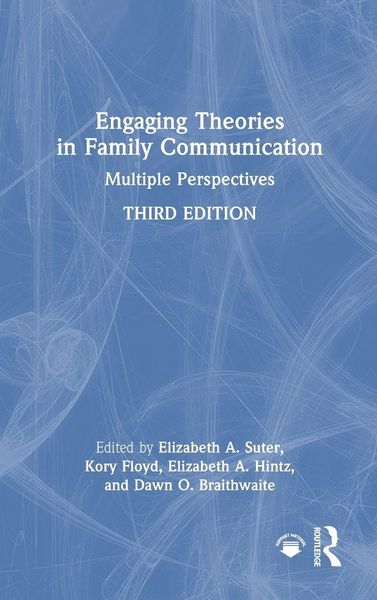
Engaging Theories in Family Communication Multiple Perspectives
-
- Hardcover ausgewählt
- Taschenbuch
- eBook
-
Sprache:Englisch
-
Verlag:Taylor & Francis
-
Auflage:3rd edition
- 2. Auflage 434,99 €
- 3rd edition 259,99 € ausgewählt
259,99 €
inkl. gesetzl. MwSt.,
Beschreibung
Produktdetails
Einband
Gebundene Ausgabe
Erscheinungsdatum
07.08.2026
Abbildungen
schwarz-weiss Illustrationen, Zeichnungen, schwarz-weiss, Tabellen, schwarz-weiss
Herausgeber
Elizabeth A. Suter + weitereVerlag
Taylor & FrancisSeitenzahl
404
Maße (L/B/H)
22,9/15,2/2,5 cm
Gewicht
757 g
Auflage
3rd edition
Sprache
Englisch
ISBN
978-1-04-101319-8
Bringing together the work of 60 contributors who represent both leading voices in family communication scholarship and an inspiring new generation of scholars shaping the field's future, this third edition is a comprehensive and accessible overview of the theories that form the foundation of the family communication field.
The book begins with an overview chapter including an updated empirical analysis of family communication research from 1990 to 2024. Twenty-seven theory chapters follow. Each chapter is dedicated to a single theory and follows a consistent structure, allowing readers to engage deeply with individual theories and draw comparisons between multiple theories. The third edition offers two new sections. (Meta)Theoretical Perspectives includes critical feminism, discourse dependence, systems theory, social constructionism, and natural selection. Looking Ahead features a multi-authored chapter that addresses emerging developments in the study of Black families, Indigenous perspectives, the Global South, Latina/o/x perspectives, and quantitative criticalism. This third edition features ten theories new to this edition, six of which were developed within the discipline of communication studies.
Ideal for advanced undergraduate and graduate students studying family communication, this text is also relevant for scholars and students of personal relationships, interpersonal communication, and family studies.
Noch keine Bewertungen vorhanden
Verfassen Sie die erste Bewertung zu diesem Artikel
Helfen Sie anderen Kundinnen und Kunden durch Ihre Meinung.
Kurze Frage zu unserer Seite
Vielen Dank für Ihr Feedback
Wir nutzen Ihr Feedback, um unsere Produktseiten zu verbessern. Bitte haben Sie Verständnis, dass wir Ihnen keine Rückmeldung geben können. Falls Sie Kontakt mit uns aufnehmen möchten, können Sie sich aber gerne an unseren Kund*innenservice wenden.
zum Kundenservice