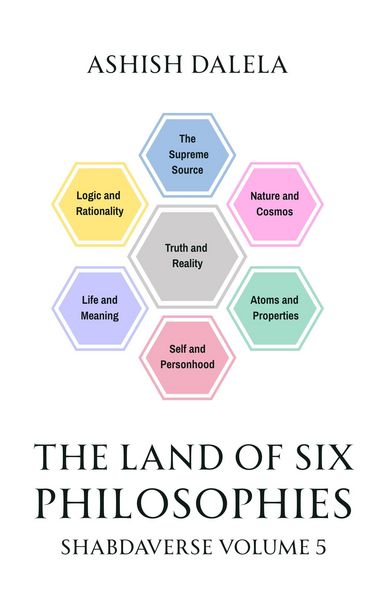
The Land of Six Philosophies SHABDAVERSE, #5
-
- Einzelkauf Download ausgewählt
-
Sprache:Englisch
2,99 €
inkl. gesetzl. MwSt.Beschreibung
Produktdetails
Format
ePUB
Kopierschutz
Ja
Family Sharing
Ja
Text-to-Speech
Ja
Erscheinungsdatum
11.02.2026
Verlag
Shabda PressSeitenzahl
(Printausgabe)
Dateigröße
243 KB
Sprache
Englisch
EAN
9789385384530
There is a widespread misconception at present that the Vedic tradition comprises many incompatible or discordant ideas, that evolved in time as the proclamations of different ideologues. This misconception has a long history that began with the false idea that "truth is one" so multiple descriptions truth must either be redundant or false. In contrast, the Rig Veda states, ekaṃ sat vipra bahudha vadanti, which means "the truth is one, but the knowers describe it in many ways". So, why do the knowers describe the one truth in many ways? The answer is that the truth is personal. Quite like there is an elephant with five parts of trunk, tail, stomach, ears, and legs, the whole truth is one, but it has multiple parts. The whole is not known unless all of its parts are known, and the parts are not understood without the whole.
Without knowing the elephant, a blind man calls the tail a binding rope, the legs a tree trunk, the trunk a fat pipe, the ears a winnowing fan, and the stomach a giant ball. After knowing the elephant, the trunk, tail, stomach, ears, and legs are described correctly. The whole and part are known interdependently. Any attempt to know them in isolation, or in disregard of other parts, produces misconceptions.
This is also the case with the Six Systems of Vedic Darsana, in which Vedanta constitutes the whole, and Sañkhya, Nyaya, Vaise?ika, Mimaṃsa, and Yoga are parts. All those who study Vedanta while rejecting the other five, or those who study these six systems independently, create falsehoods. These falsehoods are byproducts of depersonalization of reality and the adoption of universalism of "truth is one", which has existed in both Western and Indian thinking, but it is not Vedic thinking. This anthology of articles rejects depersonalization and universalism and discusses the personalist description of reality.
Noch keine Bewertungen vorhanden
Verfassen Sie die erste Bewertung zu diesem Artikel
Helfen Sie anderen Kundinnen und Kunden durch Ihre Meinung.
Kurze Frage zu unserer Seite
Vielen Dank für Ihr Feedback
Wir nutzen Ihr Feedback, um unsere Produktseiten zu verbessern. Bitte haben Sie Verständnis, dass wir Ihnen keine Rückmeldung geben können. Falls Sie Kontakt mit uns aufnehmen möchten, können Sie sich aber gerne an unseren Kund*innenservice wenden.
zum Kundenservice