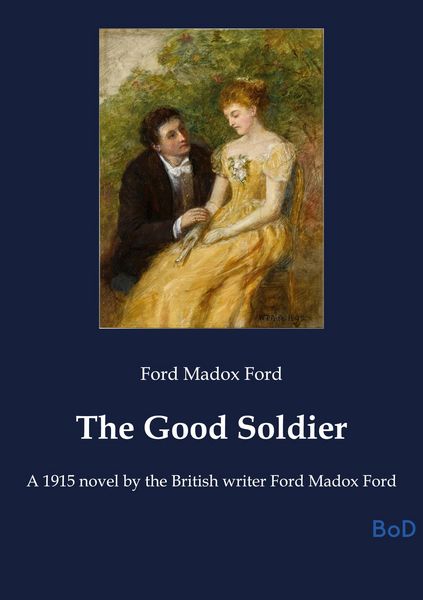
The Good Soldier A 1915 novel by the British writer Ford Madox Ford
-
- Hardcover
- Taschenbuch ausgewählt
- eBook
-
Sprache:Englisch
-
Verlag:Culturea
- External catalogues US 13,99 €
- Carcanet Press 17,99 €
- Arcturus Press 9,99 €
- Vintage Publishing 13,99 €
- Oxford University Press 8,99 €
- Bloomsbury Trade 8,99 €
- Natal Publishing, Llc 14,99 €
- Culturea 19,99 € ausgewählt
- Martino Fine Books 14,99 €
- Sanage Publishing House 21,99 €
- Digireads.com 13,99 €
- Smk Books 19,99 €
- Penguin Books UK 13,99 €
- Wtaw Press 8,99 €
- Wildside Press 19,99 €
- Bloomsbury Academic 13,99 €
- Good Press 8,99 €
- KNV Besorgung (alt) 7,99 €
-
Auflage:1. Tirage
- 1. Tirage 15,99 €
- 1. Tirage 19,99 € ausgewählt
19,99 €
inkl. gesetzl. MwSt.,
- Kostenlose Lieferung ab 30 € Einkaufswert
- Versandkostenfrei für Bonuscard-Kund*innen
Beschreibung
Produktdetails
Einband
Taschenbuch
Erscheinungsdatum
04.02.2026
Verlag
CultureaSeitenzahl
252
Maße (L/B/H)
21/14,8/1,4 cm
Gewicht
331 g
Auflage
1. Tirage
Sprache
Englisch
ISBN
979-10-431-2864-6
The narrator, an American named John Dowell, recounts his complex and tragic nine-year friendship with two English couples, the Ashburnhams (Edward and Leonora) and his wife Florence. Set largely in Nauheim, a German spa town, and various European and English locations, the story explores themes of love, infidelity, social conventions, and the hidden depths of human relationships. Dowell's retrospective narration attempts to understand the 'saddest story' he has ever heard, gradually revealing a complex web of adultery, deceit, and hidden emotions. Florence's manipulative nature, her feigned heart condition, and her affairs with Jimmy and Edward are exposed. Leonora, a devout Catholic, struggles stoically to manage Edward's philandering and their finances, enduring psychological deterioration. Edward, a sentimental but flawed man, finds solace in other women, including an unspoken love for Nancy Rufford. The narrative culminates in Florence's suicide (using prussic acid) triggered by the exposure of her past and Edward's growing affection for Nancy. Subsequently, Nancy descends into madness, symbolized by her repeating 'shuttlecocks.' The tragedy concludes with Edward's suicide by penknife, prompted by a telegram from Nancy. Dowell, a passive observer, reflects on moral dilemmas, societal norms, and the profound psychological impact of these events, questioning human nature and the facade of 'good people.'
Noch keine Bewertungen vorhanden
Verfassen Sie die erste Bewertung zu diesem Artikel
Helfen Sie anderen Kundinnen und Kunden durch Ihre Meinung.
Kurze Frage zu unserer Seite
Vielen Dank für Ihr Feedback
Wir nutzen Ihr Feedback, um unsere Produktseiten zu verbessern. Bitte haben Sie Verständnis, dass wir Ihnen keine Rückmeldung geben können. Falls Sie Kontakt mit uns aufnehmen möchten, können Sie sich aber gerne an unseren Kund*innenservice wenden.
zum Kundenservice