KI-Beratung Beta

Gutscheinbedingungen

**Gültig am 27.11.2026 auf Spielzeug, Schreibwaren, Filme, Geschenke & Trends, Musik, tolino eReader & Zubehör, Hörbücher und Hörbuch-Downloads, nicht preisgebundene Bücher und Kalender online auf thalia.at und in der Thalia App. Einzelne Artikel können ausgeschlossen sein. Aufgrund der Buchpreisbindung sind deutschsprachige Bücher und eBooks ausgenommen. Zusätzlich ausgenommen sind Abos & Flatrates, Games, Geschenkkarten/-boxen, Shelfies, Software, Zeitschriften sowie einzelne Artikel von tonies®. Pro Einkauf einmal einlösbar. Click & Collect nur bei Onlinevorabzahlung möglich. Keine Barauszahlung. Nicht kombinierbar mit anderen Aktionen und Gutscheinen. Gutschein wird auf max. 500€ Bestellwert angerechnet. Nicht gültig für Versandkosten und Services.

Produktbild: Ant Responses to Climate Change
Band 10

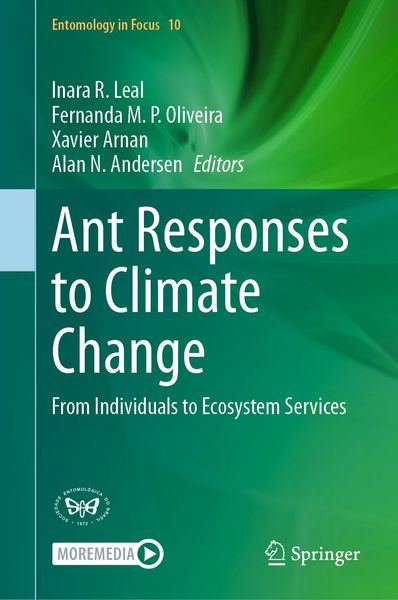
Ant Responses to Climate Change From Individuals to Ecosystem Services

Aus der Reihe Entomology in Focus

219,99 €

inkl. gesetzl. MwSt., Versandkostenfrei


Beschreibung

Ecosystems worldwide are facing increasing threats from climate change, and it is important to understand their impacts on key organisms. Ants are one of the most ubiquitous, widespread, and abundant groups of animals on earth, providing a variety of basic and vital ecological services.   Although there...

Beschreibung

Ecosystems worldwide are facing increasing threats from climate change, and it is important to understand their impacts on key organisms. Ants are one of the most ubiquitous, widespread, and abundant groups of animals on earth, providing a variety of basic and vital ecological services.
 
Although there is increasing knowledge about the effects of climate change on ants, this information is scattered and we are still far from a global understanding of its consequences for ant communities and their provision of ecosystem services. We have even less of a mechanistic understanding of how and why some species and communities are more vulnerable or resilient than others. This book synthesizes the latest findings about the effect of climate change on ants addressing different level of ecological organizations, from individuals to ecosystem services relating to interactions between ants and plants.

Portrait

Inara R. Leal - Graduated in Biology (1990) from the Federal University of Santa Catarina (Brazil), with an MSc (1994) and PhD (1998) in Ecology from the State University of Campinas (Brazil), and postdoctoral research at the Commonwealth Scientific and Industrial Research Organisation (Australia) in 2010 and 2014. Since 2002, has been a professor at the Federal University of Pernambuco (Brazil), advising undergraduate students in Biology and Environmental Sciences and postgraduate students in Plant Biology and Animal Biology. In the Atlantic Forest, she has investigated how habitat loss and fragmentation reshape insect communities (including ants, butterflies, dung beetles, and termites), lead to the proliferation of herbivores—particularly leaf-cutting ants—and simplify other plant-ant interactions. In the Caatinga, her work explores the effects of both acute (e.g., slash-and-burn agriculture) and chronic (e.g., livestock raising, firewood collection, and non-timber forest product exploitation) disturbances and climate change (e.g., increasing aridity) on the taxonomic, phylogenetic, and functional organization of plant and animal communities and on ecosystem services provided by ants. Professor Leal is the author or editor of 13 books, more than 50 book chapters, and over 170 scientific publications, with an h-index of 57 and approximately 12,000 career citations.

Fernanda M. P. Oliveira - Graduated in Biology (2010) from the State University of Ceará (Brazil), with an MSc in Animal Biology (2012) and a PhD in Plant Biology (2018) from the Federal University of Pernambuco (Brazil), including a research period at the Commonwealth Scientific and Industrial Research Organisation (CSIRO) – Tropical Ecosystems Research Centre (Australia). Since 2024, she has been a professor at the Federal University of Pernambuco (Brazil), advising undergraduate students in Biology and Environmental Sciences and postgraduate students in Plant Biology and Animal Biology. She also studies how these components recover over time through ecological succession. Professor Oliveira is the author/editor of three books, 23 book chapters, and 27 scientific publications, with an h-index of 10 and approximately 370 career citations.

Xavi Arnan - Graduated in Biology (2001), with an MSc in Biology (2004) and a PhD in Ecology (2006) from the Universitat Autònoma de Barcelona (UAB, Spain). He held postdoctoral positions in Spain (UAB and the Centre de Recerca Ecològica i Aplicacions Forestals – CREAF, 2006–2011), Australia (Commonwealth Scientific and Industrial Research Organisation, 2008 and 2009), Germany (Technical University of Darmstadt, 2012–2013), and Brazil (Federal University of Pernambuco, 2014–2017). From May 2017 to January 2020, he served as a Ramón y Cajal staff researcher at CREAF. Since January 2020, he has been a professor at the University of Pernambuco (Brazil). Professor Arnan is the author of 108 scientific publications, with an h-index of 33 and 3,568 career citations.

Alan N. Andersen - Graduated with a BSc (Hons) from Monash University in 1980, and PhD in ecology at the University of Melbourne in 1985. Currently Professor of Research Excellence and Impact in Charles Darwin University’s (CDU) Office of Research and Innovation, and Professor of Terrestrial Invertebrates in CDU’s Research Institute for the Environment and Livelihoods (Australia). Professor Andersen was previously a Chief Research Scientist with CSIRO Land & Water, and head of CSIRO’s Tropical Ecosystems Research Centre in Darwin from 1995 to 2016. Professor Andersen is the author of five books and 300 scientific publications, with an h-index of 80 and >23,000 career citations. He is a Fellow of the Australian Academy of Science.
Produktdetails

Einband

Gebundene Ausgabe

Erscheinungsdatum

03.08.2026

Abbildungen

XV, 401 p. 72 illus., 58 illus. in color.

Herausgeber Inara R. Leal + weitere

Produktdetails

Einband

Gebundene Ausgabe

Erscheinungsdatum

03.08.2026

Abbildungen

XV, 401 p. 72 illus., 58 illus. in color.

Herausgeber
Verlag Springer
Seitenzahl

401

Maße (L/B/H)

24,1/16/2,9 cm

Gewicht

741 g

Sprache

Englisch

ISBN

978-3-032-21126-2

Herstelleradresse

Springer-Verlag GmbH
Europaplatz 3
69115 Heidelberg
DE

Email: ProductSafety@springernature.com

Noch keine Bewertungen vorhanden

Verfassen Sie die erste Bewertung zu diesem Artikel

Helfen Sie anderen Kundinnen und Kunden durch Ihre Meinung.

Kundinnen und Kunden meinen

Bewertungen (0)

Weitere Artikel finden Sie in

  • Produktbild: Ant Responses to Climate Change
  • Ant responses to climate change: an introduction.- Behavioural adaptations of ants to stressful warming conditions.- A synthesis of ant morphological responses to climate change.- Ant responses to climate change: insights from critical thermal limits and thermal performance curves.- Ant desiccation resistance in the light of climate change.- Climate change and population-level responses in ants.- Ant invasions under climate change.- Using latitudinal climatic gradients to inform ant responses to climate change.- Elevation Gradients in Montane Ant Species.- Functional and phylogenetic change in ant communities across elevational gradients: informing impacts of climate change.- Effects of increased aridity on ant diversity in arid lands.- Ant responses to climate change: the importance of the vertical dimension.- Climate-change impacts on ant-plant mutualistic networks: insights from current studies and future prospects.- Ant-plant protection mutualisms mediated by extrafloral nectar: a macroecological analysis of outcomes in relation to precipitation.- Climate change and the provision of ant-mediated ecosystem services.- Climate change impacts on ant-mediated seed dispersal.- What future for ant-aphid mutualism under climate change?.- Carbon and nitrogen fluxes in leaf-cutter ant sites in a changing climate.- Ant responses to climate change: a synthesis.