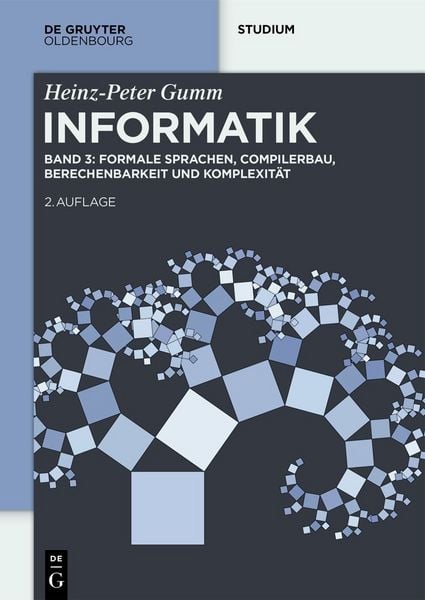
Informatik Formale Sprachen, Compilerbau, Berechenbarkeit und Komplexität
-
- Deutsch ausgewählt
-
Verlag:De Gruyter
- De Gruyter 50,50 € ausgewählt
- De Gruyter Oldenbourg 65,50 €
-
Auflage:2., aktualisierte und erweiterte Auflage
50,50 €
inkl. gesetzl. MwSt.,
Beschreibung
Produktdetails
Einband
Taschenbuch
Erscheinungsdatum
22.06.2026
Abbildungen
57 b/w ill., 5 b/w tbl.
Verlag
De GruyterSeitenzahl
287
Maße (L/B/H)
23,9/16,8/2,1 cm
Gewicht
506 g
Auflage
2., aktualisierte und erweiterte Auflage
Sprache
Deutsch
ISBN
978-3-11-163484-5
Following a general discussion of formal languages, their descriptions, and borderline cases of recognizability, the chapter covers regular languages—which find their most important application in the lexical definition of programming languages—as well as context-free languages, which are used to define the syntax of programming languages. From a theoretical perspective, the clear correspondence between language description and language recognition is satisfying—finite automata correspond to regular languages, and pushdown automata correspond to context-free languages. Further levels of the Chomsky hierarchy are only briefly covered, as they are of lesser practical importance. Instead, a separate chapter on compiler design highlights additional techniques for deriving a parser—that is, the complete "front end" of a compiler—from a language description. The concept of an "algorithm" is explained using various machine models, and Church’s thesis—that every reasonable definition of "computability" leads to the same class of functions—is also confirmed. The limits of what is algorithmically feasible are clearly delineated using the halting problem and Rice’s theorem. The concluding chapter on complexity theory explores, among solvable problems, the boundary between those that can be solved with reasonable (polynomial) effort and those whose solution is not significantly more efficient than systematically trying out candidate solutions. This chapter leads the reader to the most famous unsolved problem in theoretical computer science: P = NP?
The first volume of Computer Science explains the fundamental concepts: programming, algorithms, and data structures. The second volume is devoted to technical topics—in particular, computer architecture, operating systems, computer networks, and specifically the Internet.
The book is intended for all beginners who wish to seriously engage with computer science, whether for self-study or to accompany lectures. The subsequent volumes of this book explore the topics of computer architecture, operating systems, computer networks, the Internet, compiler design, and theoretical computer science in greater depth.
Prof. Dr. Heinz-Peter Gumm
is a professor of theoretical computer science in Marburg. After completing his studies in Darmstadt and Winnipeg (Canada) from 1970 to 1975 and earning his habilitation in 1981, he held professorships in Hawaii, California, and New York. His research areas include formal methods, general algebras, and coalgebras.
Prof. Dr. Manfred Sommer
is Professor Emeritus of Practical Computer Science in Marburg. After completing his studies in Göttingen and Munich from 1964 to 1969, he served as an assistant at Germany’s first computer science institute at the Technical University of Munich. This was followed by ten years at Siemens in Munich, and from 1984 to 2014 he was a professor of computer science in Marburg.
Noch keine Bewertungen vorhanden
Verfassen Sie die erste Bewertung zu diesem Artikel
Helfen Sie anderen Kundinnen und Kunden durch Ihre Meinung.
Kurze Frage zu unserer Seite
Vielen Dank für Ihr Feedback
Wir nutzen Ihr Feedback, um unsere Produktseiten zu verbessern. Bitte haben Sie Verständnis, dass wir Ihnen keine Rückmeldung geben können. Falls Sie Kontakt mit uns aufnehmen möchten, können Sie sich aber gerne an unseren Kund*innenservice wenden.
zum Kundenservice