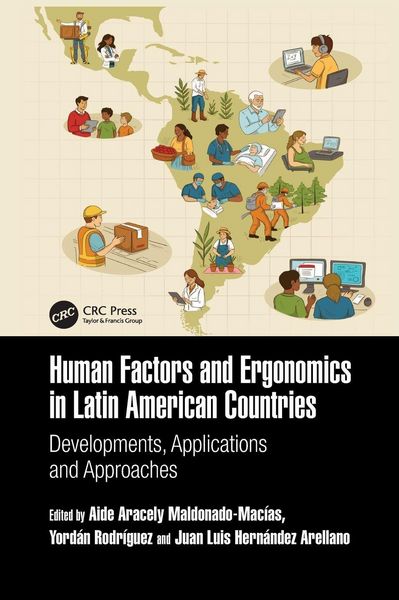
Human Factors and Ergonomics in Latin American Countries Developments, Applications and Approaches
147,99 €
inkl. gesetzl. MwSt.,
Beschreibung
Produktdetails
Einband
Gebundene Ausgabe
Erscheinungsdatum
26.07.2026
Abbildungen
schwarz-weiss Illustrationen, Raster,schwarz-weiss, Zeichnungen, schwarz-weiss, Tabellen, schwarz-weiss
Herausgeber
Aide Aracely Maldonado-Macías + weitereVerlag
Taylor & FrancisSeitenzahl
352
Maße (L/B/H)
25,4/17,8/2,2 cm
Gewicht
862 g
Sprache
Englisch
ISBN
978-1-03-294772-3
While the discipline of Human Factors and Ergonomics (HFE) has expanded globally, the specific sociotechnical realities of developing nations have long remained underrepresented in scientific literature. Human Factors and Ergonomics in Latin American Countries: Developments, Applications and Approaches bridges this gap, offering the first authoritative synthesis of research, applications, and legal frameworks dedicated entirely to the region.
Featuring a foreword by the Presidents of the International Ergonomics Association (IEA), this volume presents Latin America not merely as a site for applying existing theories, but as a "living laboratory" for generating context-sensitive solutions. The book curates 24 chapters that traverse the full spectrum of the discipline-from the high-tech challenges of Industry 4.0 and passive exoskeletons to the critical social issues of the informal economy and inclusive design.
Readers will explore how HFE principles are adapted to diverse sectors, including healthcare, where system dynamics are used to manage ICU nursing workloads; manufacturing; addressing "quiet quitting" and burnout in export industries; public safety; and analyzing coordination in forest fire control centers. Uniquely, the text also examines ergonomics for vulnerable populations, presenting studies on indigenous women involved in street vending, pregnant workers, and the elderly in digital banking.
This book is an essential resource for researchers, practitioners, and policymakers. It moves beyond diagnosis to offer actionable strategies for improving productivity, safety, and well-being in one of the world's most dynamic emerging markets.
Noch keine Bewertungen vorhanden
Verfassen Sie die erste Bewertung zu diesem Artikel
Helfen Sie anderen Kundinnen und Kunden durch Ihre Meinung.
Kurze Frage zu unserer Seite
Vielen Dank für Ihr Feedback
Wir nutzen Ihr Feedback, um unsere Produktseiten zu verbessern. Bitte haben Sie Verständnis, dass wir Ihnen keine Rückmeldung geben können. Falls Sie Kontakt mit uns aufnehmen möchten, können Sie sich aber gerne an unseren Kund*innenservice wenden.
zum Kundenservice