Gutscheinbedingungen

**Gültig bis 17.08.2026 auf Schreibwaren & Office-Artikel online auf thalia.at, in der Thalia App und in teilnehmenden Thalia Buchhandlungen in Österreich mit Schulsortiment. In den Buchhandlungen nur gültig auf lagernde Ware. Einzelne Artikel können ausgeschlossen sein. Ausgenommen sind preisgebundene Artikel. Pro Einkauf einmal einlösbar. Nur gültig gegen Vorlage oder im Onlineshop hinterlegter Bonuscard. Infos zur Einlösung in der Buchhandlung sind auf der Bonuscard-Vorteilspreisseite zu finden. Click & Collect nur bei Onlinevorabzahlung möglich. Keine Einlösung bei Scan & Go-Bezahlung. Keine Barauszahlung. Nicht kombinierbar mit anderen Aktionen und Gutscheinen. Gutschein wird auf max. 500€ Bestellwert angerechnet. Nicht gültig für Geschenkkarten, Versandkosten und Services.

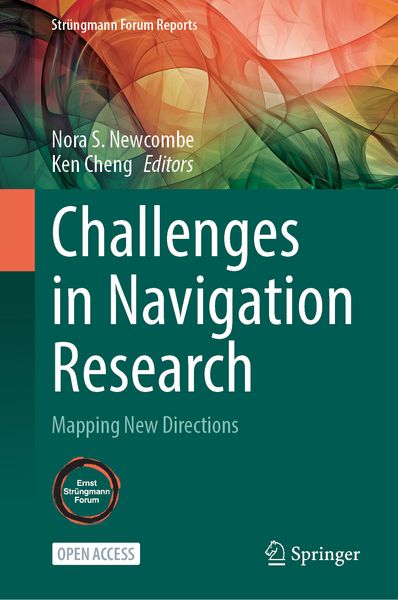
Produktbild: Challenges in Navigation Research

Challenges in Navigation Research Mapping New Directions

51,99 €

inkl. gesetzl. MwSt., Versandkostenfrei


Beschreibung

Produktdetails

Einband

Gebundene Ausgabe

Erscheinungsdatum

02.04.2026

Herausgeber

Nora S. Newcombe + weitere

Verlag

Springer

Seitenzahl

481

Maße (L/B/H)

24,1/16/3,3 cm

Gewicht

902 g

Sprache

Englisch

ISBN

978-3-032-20562-9

Beschreibung

Portrait

Nora S. Newcombe received a PhD from the Department of Psychology at Harvard University. She was a faculty member at Pennsylvania State University before moving to Temple University, where she is now Laura H. Carnell Professor. Her research in cognition and cognitive development centers on spatial cognition and episodic memory, along with translational work on STEM education. She is a member of the National Academy of Sciences, the American Academy of Arts and Sciences, and the Society of Experimental Psychologists. Honors include the Rumelhart Prize from the Cognitive Science Society, the Distinguished Scientific Contributions Award from the Society for Research in Child Development, the William James Fellow Award from the Association for Psychological Science, and the Howard Crosby Warren Medal from the Society of Experimental Psychologists.

Ken Cheng received a PhD from the Department of Psychology and Social Relations at the University of Pennsylvania. He did postdoctoral work at the University of Sussex and at Western University of Canada (previously called the University of Western Ontario in London, Ontario), before accepting a University Research Fellowship at the University of Toronto. In 1995, he joined Macquarie University, Sydney, Australia, where he is currently Professor in the School of Natural Sciences. Cheng’s research has focused on functional as well as mechanistic questions in animal navigation across diverse species. Over 40 years, study animals have featured rats, pigeons, black-capped chickadees, humans, honey bees, and a number of species of ants, including desert ants in Australia and Tunisia. A key topic has been how animals use visual information in their surroundings to navigate. Cheng has served a long stint as an editor of the journal Animal Cognition , receiving both an Author Service Award and an Editorial Contribution Award from Springer Nature in 2025. Cheng has published a reference book on animal cognition for a general audience, How Animals Think and Feel (ABC-CLIO, 2016) and two short books on academic writing. In 2023, Cheng was given the career Research Award by the Comparative Cognition Society “in Honor of Outstanding Contributions to the Study of Cognitive Processes in Animals.”

Produktdetails

Einband

Gebundene Ausgabe

Erscheinungsdatum

02.04.2026

Herausgeber

Verlag

Springer

Seitenzahl

481

Maße (L/B/H)

24,1/16/3,3 cm

Gewicht

902 g

Sprache

Englisch

ISBN

978-3-032-20562-9

Herstelleradresse

Springer-Verlag KG
Sachsenplatz 4-6
1201 Wien
AT

Email: GPSR Kontakt

Noch keine Bewertungen vorhanden

Verfassen Sie die erste Bewertung zu diesem Artikel

Helfen Sie anderen Kundinnen und Kunden durch Ihre Meinung.

Kundinnen und Kunden meinen

Bewertungen (0)

  • Produktbild: Challenges in Navigation Research
  • 1.Addressing the Challenges of Navigational Research.- 2. Taking a Functional Look at Bird Navigation.- 3. How Roboticists Think about Navigation and Major Unsolved Challenges.- 4. Universal Principles of Navigation across Species and Spatial Scales.- 5. What Are the Contributions of Modeling to Bridging the Gaps between Methods and across Species?.- 6. Do Data from Intracranial Techniques Align (or Not) with What We Have Learned about Human Navigation from fMRI?.- 7. What Do We Know about Navigation Development from the Perspective of Cognitive Neuroscience in Humans?.- 8. How Can Development Inform Us about the Neural Mechanisms of Navigation in Rats?.- 9. Spatial Navigation: From Cells to Behavior.- 10. Planning and Imagination in the Navigational Domain: The Role of the Hippocampus and Prefrontal Cortex.- 11. The Role of Motivation and Emotion in the Hippocampal Navigation System.- 12. The Future of Navigation: Moving Beyond Static Representations to Dynamic Cognitive Maps.- 13. How Does Aging Impact the Structure and Function of Parallel Navigation Circuits Across Mammals?.- 14. How Do Aging and Neurodegenerative Diseases Affect Spatial Navigation at the Behavioral Level?.- 15. Designing Effective Clinical Tools for Measuring Navigation Deficits Associated with Cognitive Impairment: Insights from Human-Computer Interaction Research.- 16. From Fundamental Science to the Clinic (and Back Again): A Translational Framework for Navigation and Aging.