KI-Beratung Beta

Gutscheinbedingungen

**Gültig bis 11.11.2026 auf Spielzeug, Schreibwaren, Filme, Geschenke & Trends, Musik, tolino eReader & Zubehör, Hörbücher und Hörbuch-Downloads, nicht preisgebundene Bücher und Kalender online auf thalia.at und in der Thalia App. Einzelne Artikel können ausgeschlossen sein. Aufgrund der Buchpreisbindung sind deutschsprachige Bücher und eBooks ausgenommen. Zusätzlich ausgenommen sind Abos & Flatrates, Games, Geschenkkarten/-boxen, Shelfies, Software, Zeitschriften sowie einzelne Artikel von tonies®. Pro Einkauf einmal einlösbar. Click & Collect nur bei Onlinevorabzahlung möglich. Keine Barauszahlung. Nicht kombinierbar mit anderen Aktionen und Gutscheinen. Gutschein wird auf max. 500€ Bestellwert angerechnet. Nicht gültig für Versandkosten und Services.

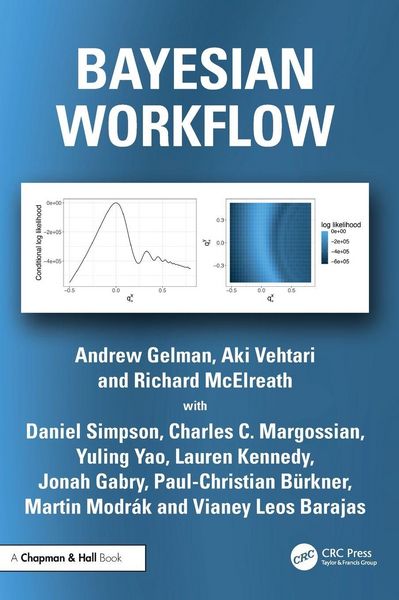
Produktbild: Bayesian Workflow

Bayesian Workflow

259,99 €

inkl. gesetzl. MwSt., Versandkostenfrei


Beschreibung

Produktdetails

Einband

Gebundene Ausgabe

Erscheinungsdatum

26.06.2026

Abbildungen

schwarz-weiss Illustrationen, farbige Illustrationen, Zeichnungen, schwarz-weiss, Zeichnungen, farbig

Verlag

Taylor and Francis

Seitenzahl

554

Maße (L/B/H)

26/18,3/3,4 cm

Gewicht

1162 g

Sprache

Englisch

ISBN

978-0-367-49018-8

Herstelleradresse

Libri GmbH
Europaallee 1
36244 Bad Hersfeld
DE

Email: gpsr@libri.de

Noch keine Bewertungen vorhanden

Verfassen Sie die erste Bewertung zu diesem Artikel

Helfen Sie anderen Kundinnen und Kunden durch Ihre Meinung.

Kundinnen und Kunden meinen

Bewertungen (0)

  • Produktbild: Bayesian Workflow
  • Part 1: From Bayesian inference to Bayesian workflow. 1 Bayesian theory and Bayesian practice. 2 Statistical modeling and workflow. 3 Computational tools. 4 Introduction to workflow: Modeling performance on a multiple choice exam. Part 2: Statistical workflow. 5 Building statistical models. 6 Using simulations to capture uncertainty. 7 Prediction, generalization, and causal inference/ 8 Visualizing and checking fitted models. 9 Comparing and improving models. 10 Statistical inference and scientific inference. Part 3: Computational workflow. 11 Fitting statistical models. 12 Diagnosing and fixing problems with fitting. 13 Approximate algorithms and approximate models. 14 Simulation-based calibration checking. 15 Statistical modeling as software development. Part 4: Case studies. 16 Coding a series of models: Simulated data of movie ratings. 17 Prior specification for regression models: Reanalysis of a sleep study.18 Predictive model checking and comparison: Clinical trial. 19 Building up to a hierarchical model: Coronavirus testing. 20 Using a fitted model for decision analysis: Mixture model for time series competition. 21 Posterior predictive checking: Stochastic learning in dogs. 22 Incremental development and testing: Black cat adoptions. 23 Debugging a model: World Cup football. 24 Leave-one-out cross validation model checking and comparison: Roaches. 25 Model building and expansion: Golf putting. 26 Model building with latent variables: Markov models for animal movement. 27 Model building: Time-series decomposition for birthdays. 28 Models for regression coefficients and variable selection: Student grades. 29 Funnel problem with latent variables: No vehicles in the park. 30 Computational challenge of multimodality: Differential equation for planetary motion. 31 Simulation-based calibration checking in model development workflow.