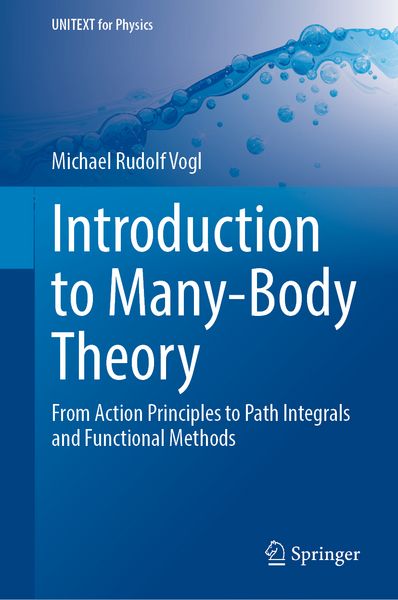
Introduction to Many-Body Theory From Action Principles to Path Integrals and Functional Methods
-
- Englisch ausgewählt
67,99 €
inkl. gesetzl. MwSt.,
Beschreibung
Produktdetails
Einband
Gebundene Ausgabe
Erscheinungsdatum
22.01.2027
Abbildungen
XII, 269 p. 81 illus., 42 illus. in color.
Verlag
SpringerSeitenzahl
269
Maße (L/B)
23,5/15,5 cm
Sprache
Englisch
ISBN
978-3-032-19765-8
This textbook provides a self-contained introduction to many-body theory that bridges the gap between the standard graduate curriculum and more research-oriented courses in many-body theory. The author systematically constructs the basic formalism of many-body theory, starting from Newton's second law, and subsequently develops action principles and symmetry-based techniques. Upon switching to quantum theory, second quantization and the Feynman path integral are introduced. After a treatment of statistical mechanics from an information-entropy perspective, which allows for a simple understanding of temperature dependent variational principles, the book switches to a coherent state path-integral formulation. This approach makes diagrammatic perturbation theory, linear response techniques, and renormalization group methods, which are treated in later parts of the book, accessible to a broad audience.
The content of the book is based on a set of lectures on the Quantum Theory of Solids that the author has taught at King Fahd University of Petroleum and Minerals (KFUPM) every year since 2022. With detailed, explicit computations and exercises at various difficulty levels, the book serves as a valuable resource for talented undergraduate students, graduate students, beginning researchers and instructors. While familiarity with variational calculus and functional integration is advantageous, the book systematically constructs the necessary tools as needed, making it self-contained, and mastery of the skills is not considered a prerequisite.
Each chapter of the book also includes a summary and a set of problems, separated into introductory and advanced levels. This setup allows readers to master concepts efficiently and helps develop their skills up to an advanced level.
Noch keine Bewertungen vorhanden
Verfassen Sie die erste Bewertung zu diesem Artikel
Helfen Sie anderen Kundinnen und Kunden durch Ihre Meinung.
Kurze Frage zu unserer Seite
Vielen Dank für Ihr Feedback
Wir nutzen Ihr Feedback, um unsere Produktseiten zu verbessern. Bitte haben Sie Verständnis, dass wir Ihnen keine Rückmeldung geben können. Falls Sie Kontakt mit uns aufnehmen möchten, können Sie sich aber gerne an unseren Kund*innenservice wenden.
zum Kundenservice