Gutscheinbedingungen

**Gültig am 28.06.2026 auf Spielzeug, Schreibwaren, Filme, Geschenke & Trends, Musik, tolino eReader & Zubehör, Hörbücher und Hörbuch-Downloads (außer Abo), nicht preisgebundene Bücher und Kalender online auf thalia.at und in der Thalia App. Einzelne Artikel können ausgeschlossen sein. Aufgrund der Buchpreisbindung sind deutschsprachige Bücher und eBooks ausgenommen. Zusätzlich ausgenommen sind preisgebundene Artikel, Abos & Flatrates, eBooks, Games, Geschenkkarten/-boxen, Shelfies, Software, Zeitschriften sowie einzelne Artikel von tonies®. Pro Einkauf einmal einlösbar. Click & Collect nur bei Onlinevorabzahlung möglich. Keine Barauszahlung. Nicht kombinierbar mit anderen Aktionen und Gutscheinen. Gutschein wird auf max. 500€ Bestellwert angerechnet. Nicht gültig für Versandkosten und Services.

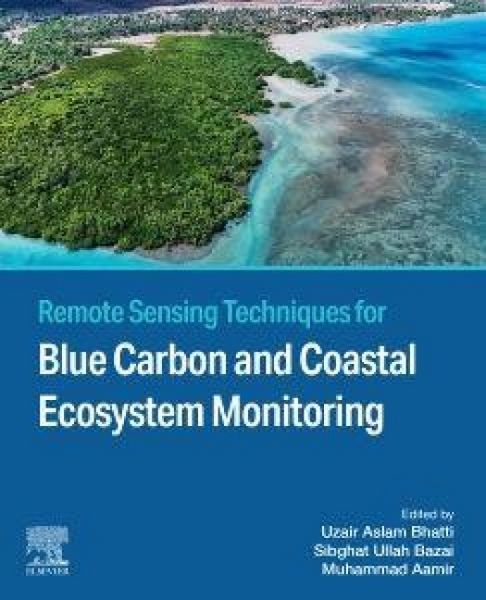
Produktbild: Remote Sensing Techniques for Blue Carbon and Coastal Ecosystem Monitoring
Vorbesteller Neu

Remote Sensing Techniques for Blue Carbon and Coastal Ecosystem Monitoring

184,99 €

inkl. gesetzl. MwSt., Versandkostenfrei


Beschreibung

Produktdetails

Einband

Taschenbuch

Erscheinungsdatum

01.11.2026

Herausgeber

Uzair Aslam Bhatti + weitere

Verlag

Elsevier

Seitenzahl

450

Maße (L/B)

23,5/19,1 cm

Sprache

Englisch

ISBN

978-0-443-45887-3

Beschreibung

Portrait

Uzair Aslam Bhatti has focused his research on applying machine learning to medical and signal processing problems, with a strong interest in the broader applications of artificial intelligence. He has published nearly 60 academic papers, more than 50 of which are indexed in SCI and EI. During his PhD at Hainan University, he received two Best Research Paper Awards and a Chinese Government Scholarship.

As a Postdoctoral Researcher at the School of Geography (Remote Sensing and Signal Processing), Nanjing Normal University, he published 11 papers in two years as first author (9 SCI journals and 2 conference papers), including articles in leading SCI journals such as IEEE Transactions on Geoscience and Remote Sensing (IF 8.1) and Chemosphere (IF 9.1). His contributions, including 10 SCI papers and two CCF B-level conference papers as first author, earned him recognition as an Excellent Postdoctoral Candidate by Nanjing Normal University.

He has also participated in major projects funded by the National Natural Science Foundation of China, the National Key R&D Program, and the Hainan Provincial Major Science and Technology Program.

Sibghat Ullah Bazai received the Ph.D. degree in information technology with a specialization in cyber security from Massey University, Auckland, New Zealand. Currently, he is an Assistant Professor with the Department of Computer Engineering, Faculty of Information and Communication Technology, Balochistan University of Information Technology, Engineering, and Management Sciences (BUITEMS). His research interests include the application of cybersecurity and privacy in computer-aided diagnosis, disease identification using deep learning, local language sentiment corpus design, and smart city planning. He also serves as a Guest Editor and a Reviewer for special issues in journals, such as MDPI, Hindawi, CMC, PLOS One, and Frontier. He was a recipient of the HEC HRDI-UESTP Faculty Ph.D. Scholarship

Muhammad Aamir received the Bachelor of Engineering degree in computer systems engineering from the Mehran University of Engineering and Technology Jamshoro, Sindh, Pakistan, in 2008, the Master of Engineering degree in software engineering from Chongqing University, Chongqing, China, in 2014, and the Ph.D. degree in computer science and technology from Sichuan University, Chengdu, China, in 2019.,He is currently an Associate Professor with the Department of Computer Science, Huanggang Normal University, Huanggang, China. His research interests include pattern recognition, computer vision, image processing, deep learning, and fractional calculus

Produktdetails

Einband

Taschenbuch

Erscheinungsdatum

01.11.2026

Herausgeber

Verlag

Elsevier

Seitenzahl

450

Maße (L/B)

23,5/19,1 cm

Sprache

Englisch

ISBN

978-0-443-45887-3

Herstelleradresse

Libri GmbH
Europaallee 1
36244 Bad Hersfeld
DE

Email: gpsr@libri.de

Kundinnen und Kunden meinen

0 Bewertungen

Informationen zu Bewertungen

Zur Abgabe einer Bewertung ist eine Anmeldung im Konto notwendig. Die Authentizität der Bewertungen wird von uns nicht überprüft. Wir behalten uns vor, Bewertungstexte, die unseren Richtlinien widersprechen, entsprechend zu kürzen oder zu löschen.

Die Bewertungen sind nach Format, Anzahl Sterne und Datum sortiert.

Verfassen Sie die erste Bewertung zu diesem Artikel

Helfen Sie anderen Kund*innen durch Ihre Meinung

Kundinnen und Kunden meinen

0 Bewertungen filtern

  • Produktbild: Remote Sensing Techniques for Blue Carbon and Coastal Ecosystem Monitoring
  • Part I: Basics of Blue Carbon and Remote Sensing
    1. Introduction to Blue Carbon Ecosystems
    2. Emerging Contaminants in Coastal Ecosystems
    3. Foundations of Remote Sensing for Coastal Ecosystem
    4. Monitoring Geographic Ecological Land Processing

    Part II: Mapping and Monitoring Blue Carbon Ecosystems
    5. UAV and Drone-Based Remote Sensing for Coastal Contaminant Monitoring
    6. Remote Sensing Data Collection Methods in Mangrove Ecosystems
    7. Remote Sensing Applications in Mangrove & Blue Carbon Monitoring
    8. Environmental Monitoring Using Spatio-temporal Patterns of Contaminants
    9. Impact of Emerging Contaminants on Mangrove Ecosystems
    10. Intelligent Deep Learning Methods for Ecological Land-change Monitoring
    11. Segmentation Models in Agricultural Image Classification
    12. Geospatial Data Integration for Coastal Ecosystems
    13. Case Studies in Mangrove Monitoring Using Remote Sensing
    14. Monitoring Coastal Ecosystem Health with UAVs & Drones
    15. Challenges in Remote Sensing of Coastal Ecosystems

    Part III: Quantifying Carbon and Verifying Impact
    16. Blue Carbon Sequestration in Mangroves
    Part IV: Future Horizons and Global Impact
    17. Emerging Trends & Technologies in Remote Sensing
    18. Future Directions in Mangrove & Blue Carbon Monitoring