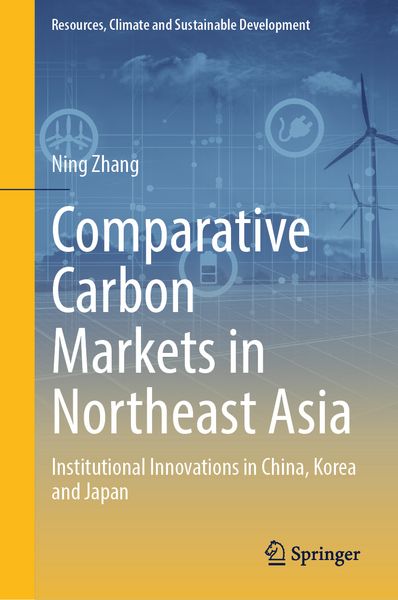
Comparative Carbon Markets in Northeast Asia Institutional Innovations in China, Korea and Japan
117,99 €
UVP
131,99 €
inkl. gesetzl. MwSt.,
Beschreibung
Produktdetails
Einband
Gebundene Ausgabe
Erscheinungsdatum
08.05.2026
Abbildungen
XX, 299 p. 25 illus., 23 illus. in color.
Verlag
Springer SingaporeSeitenzahl
299
Maße (L/B/H)
24,1/16/2,3 cm
Gewicht
645 g
Auflage
1. Auflage
Sprache
Englisch
ISBN
978-981-9578-31-3
This book offers a comprehensive framework for comparing Northeast Asia’s market-based climate and energy policies, integrating carbon market theories, empirical data from China, South Korea, Japan, and practical policy cases. It bridges theory and regional practice, analyzing how the three nations—at distinct development stages—design tools to balance emission cuts, energy security, and economic growth.
It covers core mechanisms: China’s national ETS (the world’s largest, covering 8 billion tons of emissions) and energy use rights trading; South Korea’s K-ETS (Asia’s first mandatory carbon market) with “auction + free allocation” and price stabilization tools (floor price, market reserve); Japan’s GX-ETS featuring central-local dual-track and voluntary-to-mandatory transition. Applying a four-dimensional framework (policy design, economic efficiency, innovation incentives, environmental effectiveness), it quantifies differences in quota allocation, carbon price volatility, green innovation, and emission reduction effects. Special focus is on heavy industries (steel, cement, aluminum), comparing technological routes (China’s electric arc furnace steel, South Korea’s hydrogen metallurgy, Japan’s CCUS) and carbon cost pass-through.
This book is a key resource for advanced students in environmental economics/climate policy, and researchers, policymakers, and industry leaders in Northeast Asia’s climate governance. Its empirical data (quota tables, carbon price trends, industrial metrics) and policy roadmaps add value, especially for new analysts.
Key features:
- Links global climate theories to Northeast Asia’s policy innovations.
- Specialized chapters on heavy industry decarbonization.
- Actionable roadmap for regional carbon market linkage (China-South Korea allowance mutual recognition, China-Japan offset alignment).
- Data from official sources (China’s MEE, South Korea’s MOE, Japan’s METI).
Readers gain theoretical insights into regional policy differences and practical tools for policy design, industrial decarbonization, and regional climate cooperation.
Noch keine Bewertungen vorhanden
Verfassen Sie die erste Bewertung zu diesem Artikel
Helfen Sie anderen Kundinnen und Kunden durch Ihre Meinung.
Kurze Frage zu unserer Seite
Vielen Dank für Ihr Feedback
Wir nutzen Ihr Feedback, um unsere Produktseiten zu verbessern. Bitte haben Sie Verständnis, dass wir Ihnen keine Rückmeldung geben können. Falls Sie Kontakt mit uns aufnehmen möchten, können Sie sich aber gerne an unseren Kund*innenservice wenden.
zum Kundenservice