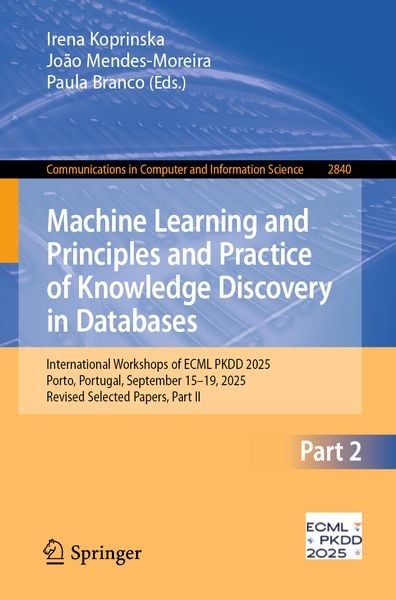
Machine Learning and Principles and Practice of Knowledge Discovery in Databases International Workshops of ECML PKDD 2025, Porto, Portugal, September 15–19, 2025, Revised Selected Papers, Part II
-
- Taschenbuch ausgewählt
- eBook
-
Sprache:Englisch
107,99 €
UVP
120,99 €
inkl. gesetzl. MwSt.,
Beschreibung
Produktdetails
Einband
Taschenbuch
Erscheinungsdatum
11.05.2026
Abbildungen
IX, 661 p. 225 illus., 203 illus. in color.
Herausgeber
Irena Koprinska + weitereVerlag
SpringerSeitenzahl
661
Maße (L/B/H)
23,5/15,5/3,7 cm
Gewicht
1007 g
Sprache
Englisch
ISBN
978-3-032-19098-7
The 5-volume set CCIS 2839 – 2843 constitutes the refereed proceedings of several workshops held in conjunction with the European Conference on Machine Learning and Principles and Practice of Knowledge Discovery in Databases, ECML PKDD 2025, which took place in Porto, Portugal, in September 2025.
The 236 full papers included in these proceedings were carefully reviewed and selected from 413 submissions. The papers were organized topical sections as follows:
Part I: Workshop on Data Science for Social Good SoGood 2025), Workshop on Bias and Fairness in AI (BIAS 2025), Workshop on New Frontiers in Mining Complex Patterns (NFMCP 2025), Human-Centered Data Mining Workshop (HuMine 2025) and Workshop on Data-Centric Artificial Intelligence (DEARING 2025).
Part II: Workshop on Hybrid Human-Machine Learning and Decision Making (HLDM 2025), Workshop on IoT, Edge, and Mobile for Embedded Machine Learning (ITEM 2025), Workshop on Machine Learning for Pharma and Healthcare Applications (PharML 2025),Workshop on Advances in Interpretable Machine Learning and Artificial Intelligence (AIMLAI 2025), Workshop on Deep Learning Meets Neuromorphic Hardware (DLmNH 2025), Machine Learning for Cybersecurity (MLCS 2025),AI for Safety-Critical Infrastructures (AI-SCI 2025) and Workshop on Innovations, Privacy-preservation, and Evaluations of Machine Unlearning Techniques (WIPE-OUT).
Part III: Workshop on Machine Learning for Sustainable Power Systems (ML4SPS 2025), Workshop on Synthetic Data for AI Trustworthiness and Evolution (SynDAiTE 2025), Workshop on MIning Data for Financial Applications (MIDAS 2025), Workshop on Advancements in Federated Learning (WAFL 2025) and Workshop on Mining and Learning with Graphs (MLG 2025).
Part IV: Workshop on Interactive Adaptive Learning (IAL 2025), Workshop on Machine Learning for Irregular Time Series (ML4ITS 2025), Interactive eXplainable AI, Theory and Practice (IXAIT 2025), Workshop on Learning on Real and Synthetic Medical Time Series Data (MED-TIME 2025), Workshop on Responsible Healthcare Using Machine Learning (RHCML 2025), Workshop for Explainable AI in Time Series and Data Streams (TempXAI 2025) and Workshop on Explainable Knowledge Discovery in Data Mining and Unlearning (XKDD 2025).
Part V: Workshop on Learning from Small Data (LFSD 2025), Workshop on Machine Learning for Earth Observation (MACLEAN 2025), Workshop on Artificial Intelligence, Data Analytics and Democracy (AIDEM 2025) and Discovery Challenges.
Noch keine Bewertungen vorhanden
Verfassen Sie die erste Bewertung zu diesem Artikel
Helfen Sie anderen Kundinnen und Kunden durch Ihre Meinung.
Kurze Frage zu unserer Seite
Vielen Dank für Ihr Feedback
Wir nutzen Ihr Feedback, um unsere Produktseiten zu verbessern. Bitte haben Sie Verständnis, dass wir Ihnen keine Rückmeldung geben können. Falls Sie Kontakt mit uns aufnehmen möchten, können Sie sich aber gerne an unseren Kund*innenservice wenden.
zum Kundenservice