Produktbild: Sustainable Management of Agricultural Traditional Systems

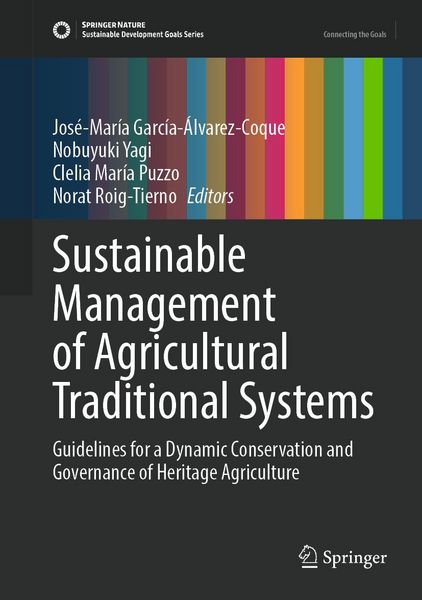
Sustainable Management of Agricultural Traditional Systems Guidelines for a Dynamic Conservation and Governance of Heritage Agriculture

173,99 €

inkl. gesetzl. MwSt., Versandkostenfrei


Beschreibung

Produktdetails

Einband

Gebundene Ausgabe

Erscheinungsdatum

07.06.2026

Abbildungen

XII, 112 illus., 110 illus. in color., schwarz-weiss Illustrationen, farbige Illustrationen

Herausgeber

José-María García-Álvarez-Coque + weitere

Verlag

Springer

Seitenzahl

327

Maße (L/B)

25,4/17,8 cm

Sprache

Englisch

ISBN

978-3-032-18999-8

Beschreibung

Portrait

José-María García-Alvarez-Coque  is a Professor of Applied Economics at the Universitat Politècnica de València-UPV, Spain. His research spans from conducting global-scale policy assessments to the local analysis of small-scale farmers’ socio-economic characteristics, and practices of collective farming. He is also interested in urban and peri-urban food systems. Between 2022 and 2025, he has been a member of the Scientific Advisory Group (SAG) of the Globally Important Agricultural Heritage System (GIAHS) Program of the Food and Agriculture Organization of the United Nations (FAO). García-Alvarez-Coque coordinated a project that led to the recognition of the irrigation system of La Huerta de Valencia as a GIAHS.

Nobuyuki Yagi  is a Professor at the Graduate School of Agricultural and Life Sciences, the University of Tokyo, Japan, and a Member of the Science Council of Japan. His research focuses on the socio-economic aspects of small-scale fishery and marketing analysis on food products. He was an expert member of the Intergovernmental Science-Policy Platform on Biodiversity and Ecosystem Services (IPBES) from 2014 to 2018. Yagi also served as a member of the Scientific Advisory Group (SAG) of the Globally Important Agricultural Heritage System (GIAHS) Program of the Food and Agriculture Organization of the United Nations (FAO) from 2019 to 2023, and as Chair of the GIAHS Scientific Advisory Group in 2022.

Clelia Maria Puzzo has occupied different positions at the Food and Agriculture Organization of the United Nations (FAO), acting between 2014 and 2024 as a Program Specialist at the Globally Important Agricultural Heritage System (GIAHS), Office of Climate Change, Biodiversity and Environment. She holds an MSc in International Relations focusing on rural development from the University of Rome “La Sapienza”, Italy.

Norat Roig-Tierno  is a Professor of Applied Economics at the Universitat Politècnica de València, Spain. He is also a Member of the International Economics and Development. Research Group (GEID), director of the Chair of Economic Model Transformation (Valencian Regional Government) and member of the Scientific Advisory Committee for the University-City partnership in the Valencia city council.

His research focuses on regional innovation, innovation systems, and agri-food systems. Furthermore, a part of his work focuses on the social project REDONA, an innovation project for the recovery of surplus food in agri-food markets for donation to social entities.


Produktdetails

Einband

Gebundene Ausgabe

Erscheinungsdatum

07.06.2026

Abbildungen

XII, 112 illus., 110 illus. in color., schwarz-weiss Illustrationen, farbige Illustrationen

Herausgeber

Verlag

Springer

Seitenzahl

327

Maße (L/B)

25,4/17,8 cm

Sprache

Englisch

ISBN

978-3-032-18999-8

Herstelleradresse

Springer International Publishing AG
Gewerbestr. 11
6330 Cham
Schweiz
Url: www.springer.com

Noch keine Bewertungen vorhanden

Verfassen Sie die erste Bewertung zu diesem Artikel

Helfen Sie anderen Kundinnen und Kunden durch Ihre Meinung.

Kundinnen und Kunden meinen

Bewertungen (0)

  • Produktbild: Sustainable Management of Agricultural Traditional Systems
  • Chapter 1. Introduction: Why Dynamic Conservation Matters.- Part I: Basic Concepts.- Chapter 2. Dynamic Conservation of Traditional Agroecosystems.- Chapter 3. Introducing the GIAHS Program: An Interdisciplinary Perspective.- Chapter 4. The Role of Commons in Agricultural Heritage Systems.- Chapter 5. Our Future Is in Our Past: Traditional Farming System.- Chapter 6. Globally Important Agricultural Heritage Systems in the Context of Other Global Systems for the Preservation of Agricultural Heritage.- Part II: Methods.- Chapter 7. Geographic Information Systems Applied to GIAHS: Concepts, Tools, and Open Data.- Chapter 8. Dynamic Conservation and Institutional Analysis and Development (IAD) Framework.- Chapter 9. Co-Designing Conservation Pathways: Participatory Approaches for the Future of GIAHS. The Case of Horta de València.- Chapter 10. Exploring Resilience in Agricultural Heritage Systems: A GIAHS Perspective.- Chapter 11. Rethinking GIAHS Monitoring: Insights From China’s Practice.- Chapter 12. Beyond GIAHS Recognition: Labeling and Branding Strategies as Tools for Sustainable Heritage and Agri-Food Systems Resilience.- Chapter 13. Nature-Based Solutions and Globally Important Agricultural Heritage Systems in Sustainable Tourism Research: A Bibliometric Approach.- Part III: Commented Case Studies.- Chapter 14. Gender Challenges in the Governance of the Chiloé GIAHS Site.- Chapter 15. How Industrial Integration Development (Iid) Improves Smallholder Farmers’ Livelihood and Food Security of GIAHS Sites in China?.- Chapter 16. The Sustainable Management and Efficient Operation of the Jeju Haenyeo Fishery Heritage System.- Chapter 17. Globally Important Agricultural Heritage Systems (GIAHS) in the Middle East and North Africa (Mena) Region: A Biodiversity Perspective.- Chapter 18. Dynamic Conservation of Maasai Pastoral Systems in Kenya Under the GIAHS Framework: Resilience in the Face of Climate Change.- Chapter 19. The Mountains of León GIAHS Site: A Model of Agro-Silvo-Pastoral Sustainability.- Chapter 20. Traditional Hay Milk Farming in the Austrian Alpine Range.