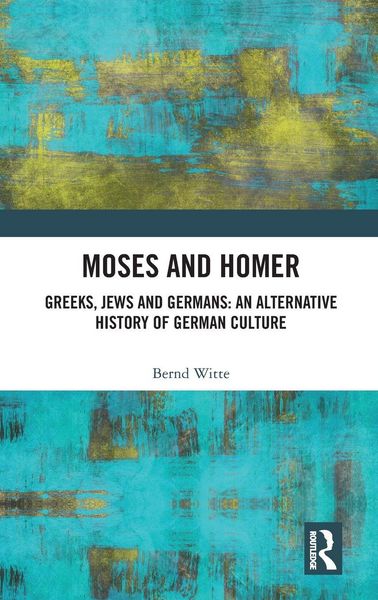
Moses and Homer Greeks, Jews and Germans: An Alternative History of German Culture
282,99 €
inkl. gesetzl. MwSt.,
Beschreibung
Produktdetails
Einband
Gebundene Ausgabe
Erscheinungsdatum
05.06.2026
Abbildungen
schwarz-weiss Illustrationen, Raster,schwarz-weiss
Verlag
Taylor & FrancisSeitenzahl
330
Maße (L/B/H)
23,8/16/2,6 cm
Gewicht
678 g
Übersetzt von
Karl Ivan Solibakke
Sprache
Englisch
ISBN
978-1-03-234137-8
Moses and Homer explores the eradication of the Jewish tradition from German intellectual history between 1770 and 1800 and analyzes the numerous ruptures triggered by the exclusion of the representatives of Judaism from the German-speaking literary world.
The closing decades of the eighteenth century were distinguished by a burgeoning admiration for Ancient Greece in Germany, while at the same time Judaism which had begun to open itself to European Enlightenment was vehemently opposed in literary and intellectual circles. Goethe's and Schiller's aggressive anti-Judaism was levied against the Biblical legacy of God's revelation at Sinai and his legendary mediator Moses. Prompted by Johann Joachim Winckelmann's paean to Homeric culture, German Classics unfolded a new legitimizing discourse in which polytheism served to position the 'productive individual' and 'growing nature' as preeminent categories in modernity. The rationale was to replace monotheism with a religion of nature, a shift that had far-reaching consequences well into the twentieth century. In their distinctive ways, Moses Mendelssohn and Heinrich Heine countered by attempting to salvage the vision of a German-Jewish dialog. Additionally, a broad range of cultural reflexion is examined, including relevant contributions by Hölderlin, Herder, Hegel, Buber, Baeck, Freud, Benn, Kantorowicz, Auerbach und Heidegger. The volume traces the ideological battle waged against monotheism, nurtured by an early rejection of Jewish intellectualism and a steadfast focus on classicism, and its impact on the militant antisemitism of the nineteenth and twentieth centuries. These intellectual developments culminated in the racial politics of the Nazi terror regime. Ultimately, the Shoah effaced the Jewish monotheistic tradition from the cultural memory of contemporary Germans.
This book is of interest to scholars of Antique Classicism, German and Jewish intellectual history, and European antisemitism.
Noch keine Bewertungen vorhanden
Verfassen Sie die erste Bewertung zu diesem Artikel
Helfen Sie anderen Kundinnen und Kunden durch Ihre Meinung.
Kurze Frage zu unserer Seite
Vielen Dank für Ihr Feedback
Wir nutzen Ihr Feedback, um unsere Produktseiten zu verbessern. Bitte haben Sie Verständnis, dass wir Ihnen keine Rückmeldung geben können. Falls Sie Kontakt mit uns aufnehmen möchten, können Sie sich aber gerne an unseren Kund*innenservice wenden.
zum Kundenservice