KI-Beratung Beta

Gutscheinbedingungen

**Gültig bis 09.11.2026 auf tolino shine color (4016621130473), tolino vision color (4016621130183) und tolino vision color weiß (4016621131456) online auf thalia.at, in der Thalia App und in allen Thalia Buchhandlungen in Österreich. In den Buchhandlungen nur gültig auf lagernde Ware. Pro Einkauf einmal einlösbar. Nur gültig gegen Vorlage oder im Onlineshop hinterlegter Bonuscard. Infos zur Einlösung in der Buchhandlung sind auf der Bonuscard-Vorteilspreisseite zu finden. Click & Collect nur bei Onlinevorabzahlung möglich. Keine Einlösung bei Scan & Go-Bezahlung. Keine Barauszahlung. Nicht kombinierbar mit anderen Aktionen und Gutscheinen. Nicht gültig für Geschenkkarten, Versandkosten und Services. Nur solange der Vorrat reicht.

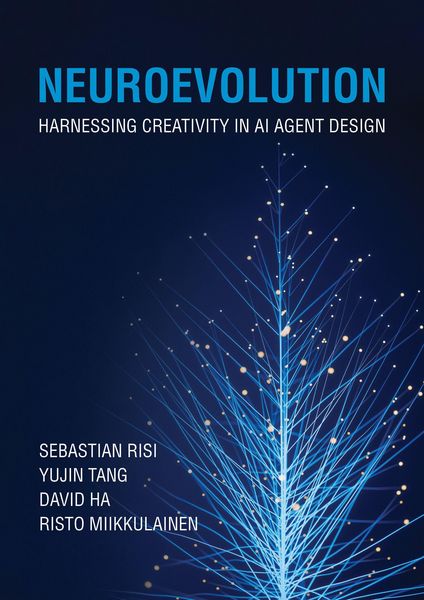
Produktbild: Neuroevolution
Neu

Neuroevolution Harnessing Creativity in AI Agent Design

92,99 €

inkl. gesetzl. MwSt., Versandkostenfrei


Beschreibung

Produktdetails

Einband

Taschenbuch

Erscheinungsdatum

27.10.2026

Abbildungen

Farb. Abb.

Verlag

MIT Press

Seitenzahl

448

Maße (L/B/H)

25,3/17,9/3,5 cm

Gewicht

1010 g

Sprache

Englisch

ISBN

978-0-262-05476-8

Beschreibung

Produktdetails

Einband

Taschenbuch

Erscheinungsdatum

27.10.2026

Abbildungen

Farb. Abb.

Verlag

MIT Press

Seitenzahl

448

Maße (L/B/H)

25,3/17,9/3,5 cm

Gewicht

1010 g

Sprache

Englisch

ISBN

978-0-262-05476-8

Herstelleradresse

Libri GmbH
Europaallee 1
36244 Bad Hersfeld
DE

Email: gpsr@libri.de

Noch keine Bewertungen vorhanden

Verfassen Sie die erste Bewertung zu diesem Artikel

Helfen Sie anderen Kundinnen und Kunden durch Ihre Meinung.

Kundinnen und Kunden meinen

Bewertungen (0)

Die Leseprobe wird geladen.
  • Produktbild: Neuroevolution
  • Foreword
    Online Supplement
    Preface
    1 Introduction
    1.1 Evolving Neural Networks
    1.2 Extending Creative AI
    1.3 Improving the World
    1.4 Plan for the Book
    1.5 Plan for Hands-on Exercises
    1.6 Chapter Review Questions
    2 The Basics
    2.1 Evolutionary Algorithms
    2.1.1 Representation
    2.1.2 Population-Based Search
    2.1.3 Selection
    2.1.4 Variation Operators
    2.1.5 Fitness Evaluation
    2.1.6 Reproduction and Replacement 20
    2.1.7 Termination 21
    2.2 Types of Evolutionary Algorithms 22
    2.2.1 Genetic Algorithm 22
    2.2.2 Evolution Strategy 24
    2.2.3 Covariance-Matrix Adaptation Evolution Strategy 26
    2.2.4 OpenAI Evolution Strategy 29
    2.2.5 Multiobjective Evolutionary Algorithms 31
    2.2.6 Further Evolutionary Computation Techniques 33
    2.2.7 Try These Algorithms Yourself 35
    2.3 Neural Networks 37
    2.3.1 Feedforward Neural Networks 37
    2.3.2 Training Feedforward Neural Networks with Gradient Descent 38
    2.3.3 Recurrent Neural Networks 40
    2.3.4 Long Short-Term Memory 41
    2.3.5 Convolutional Neural Networks 43
    2.3.6 Transformers 45
    2.4 Neuroevolution: An Integrated Approach 47
    2.5 Chapter Review Questions 48
    3 The Fundamentals of Neuroevolution 49
    3.1 Neuroevolution Taxonomy 49
    3.1.1 Fixed-Topology Neuroevolution 50
    3.1.2 Topology and Weight Evolving Artificial Neural Networks 50
    3.1.3 Direct Encoding 51
    3.1.4 Indirect Encoding 51
    3.2 Case study: Evolving a Simple Walking Agent 52
    3.2.1 The Challenge 52
    3.2.2 Fitness Function 53
    3.2.3 Neural Network Architecture 54
    3.2.4 Evolutionary Algorithm 54
    3.2.5 Training for Generality 55
    3.3 Neuroevolution of Augmenting Topologies 56
    3.3.1 Motivation and Challenges 56
    3.3.2 Genetic Encoding and Historical Markings 58
    3.3.3 Speciation and Fitness Sharing 62
    3.3.4 Example: Double Pole Balancing 63
    3.4 Scaling up Neuroevolution 66
    3.4.1 Neuroevolution vs. Deep Learning 66
    3.4.2 Deep Neuroevolution 68
    3.4.3 Taking Advantage of Big Compute 70
    3.5 Chapter Review Questions 71
    4 Indirect Encodings 73
    4.1 Why Indirect Encodings? 73
    4.2 Developmental Processes 75
    4.2.1 Cell-Chemistry Approaches 75
    4.2.2 Grammatical Encodings 77
    4.2.3 Learning Approaches 81
    4.3 Indirect Encoding through Hypernetworks 85
    4.3.1 Compositional Pattern Producing Networks 86
    4.3.2 Case Study: Evolving Virtual Creatures with CPPN-NEAT 90
    4.3.3 HyperNEAT 91
    4.3.4 Multiagent HyperNEAT 95
    4.3.5 Evolvable Substrate HyperNEAT 98
    4.3.6 General Hypernetworks and Dynamic Indirect Encodings 101
    4.4 Self-attention as Dynamic Indirect Encoding 103
    4.4.1 Background on Self-Attention 104
    4.4.2 Self-Attention as a Form of Indirect Encoding 104
    4.4.3 Self-Attention Based Agents 106
    4.5 Chapter Review Questions 110
    5 Utilizing Diversity 111
    5.1 Genetic Diversity 111
    5.2 Behavioral Diversity 113
    5.3 Novelty Search 116
    5.4 Quality Diversity Methods 118
    5.4.1 Motivation and Challenges 119
    5.4.2 Novelty Search with Local Competition 121
    5.4.3 MAP-Elites 122
    5.4.4 Implementing and Enhancing QD Algorithms 126
    5.5 Multiobjectivity 128
    5.6 Ensembling 129
    5.7 Utilizing Population Culture and History 132
    5.8 Chapter Review Questions 136
    6 Neuroevolution of Behavior 139
    6.1 From Control to Strategy 139
    6.2 Discovering Robust Control 143
    6.2.1 Noise, Exploration, and Novelty 143
    6.2.2 Symmetry, Context, and Adaptation 144
    6.2.3 Transfer to Physical Robots 148
    6.3 Discovering Flexible Strategies 150
    6.3.1 Switching between Behaviors 151
    6.3.2 Evolving Cognitive Behaviors 154
    6.3.3 Utilizing Stochasticity, Coevolution, and Scale 156
    6.4 Decision-Making 158
    6.4.1 Successes and Challenges 158
    6.4.2 Surrogate Modeling 159
    6.4.3 Case Study: Mitigating Climate Change through Optimized Land Use 163
    6.4.4 Case Study: Optimizing NPIs for COVID-19 166
    6.4.5 Leveraging Human Expertise 171
    6.5 Chapter Review Questions 176
    7 Neuroevolution of Collective Systems 179
    7.1 Cooperative Coevolution 179
    7.1.1 Evolving a Single Neural Network 180
    7.1.2 Evolving Structured Heterogeneous Networks 182
    7.1.3 Evolving a Team 185
    7.2 Competitive Coevolution 188
    7.2.1 Evolving Single Neural Networks 188
    7.2.2 Evolving Multiple Teams 191
    7.3 Cellular Automata 194
    7.3.1 Evolving Neural Cellular Automata 195
    7.3.2 Growing Functional Machines 196
    7.3.3 Case Study: Growing Game Levels with QD-Evolved NCAs 198
    7.3.4 Evolving Self-Assembling Neural Networks 201
    7.3.5 Combining Evolutionary Creativity with Gradient Descent Precision 206
    7.4 Chapter Review Questions 208
    8 Interactive Neuroevolution 211
    8.1 The NERO Machine Learning Game 211
    8.2 Incorporating Human Knowledge into NERO 216
    8.3 Neuroevolution-enabled Collaboration 220
    8.4 Case Study: Collaborative Interactive Neuroevolution Through Play 222
    8.5 Making Human Contributions Practical 227
    8.6 Chapter Review Questions 229
    9 Open-ended Neuroevolution 231
    9.1 Open-ended Discovery of Complex Behavior 231
    9.1.1 Neutral Mutations with Weak Selection 231
    9.1.2 Extinction Events 233
    9.1.3 Evolvable Representations 234
    9.1.4 Expressive Encodings 237
    9.1.5 Major Transitions 238
    9.1.6 Open-ended Evolution of Intelligence 240
    9.2 Cooperative Coevolution of Environments and Solutions 240
    9.2.1 The Influence of Environments 240
    9.2.2 Body and Brain Coevolution 241
    9.2.3 Coevolution Driven by Interestingness 243
    9.3 Competitive Coevolution of Environments and Solutions 246
    9.3.1 Paired Open-Ended Trailblazer 246
    9.3.2 Learning to Chase-and-Escape
    9.4 Chapter Review Questions
    10 Evolutionary Neural Architecture Search
    10.1 Neural Architecture Search with NEAT
    10.2 NAS for Deep Learning
    10.3 Case Studies: Improving Deep Learning SOTA
    10.3.1 LSTM Designs
    10.3.2 CoDeepNEAT
    10.3.3 AmoebaNet
    10.4 Multiobjective and Multitask NAS
    10.5 Making NAS Practical
    10.6 Beyond Neural Architecture Search
    10.7 Chapter Review Questions 283
    11 Optimization of Neural Network Designs 285
    11.1 Designing Complex Systems 285
    11.2 Bilevel Neuroevolution 286
    11.3 Evolutionary Meta-learning 289
    11.3.1 Loss functions 289
    11.3.2 Activation Functions 292
    11.3.3 Data Use and Augmentation
    11.3.4 Learning Methods
    11.3.5 Utilizing Surrogates
    11.3.6 Synergies
    11.4 Case Study: Meta-learning vs. Human Design
    11.5 Neuroevolution of Neuromorphic Systems
    11.5.1 Neuromorphic Computation
    11.5.2 Evolutionary Optimization 304
    11.5.3 Examples 305
    11.5.4 Future Directions 307
    11.6 Chapter Review Questions 308
    12 Synergies with Reinforcement Learning 311
    12.1 Reinforcement learning vs. Neuroevolution 311
    12.2 Synergistic Combinations 313
    12.2.1 Integrating Population-Based and Reinforcement-Based Search 313
    12.2.2 Evolving Value Networks for RL 314
    12.2.3 Evolving Starting Points for RL 317
    12.3 Evolving Neural Networks to Reinforcement Learn 319
    12.3.1 Evolving Hebbian Learning Rules 320
    12.3.2 Case Study: Hebbian Learning for Physical Robot Transfer 324
    12.3.3 Learning When to Learn through Neuromodulation 327
    12.3.4 Indirectly Encoded Plasticity 329
    12.3.5 Learning to Continually Learn through Networks with External Memory
    12.4 Integrating Evolution, Learning, and Embodiment
    12.5 Chapter Review Questions
    13 Synergies with Generative AI
    13.1 Background on Large Language Models
    13.2 Evolutionary Computing Enhances LLMs
    13.2.1 Evolutionary Prompt Engineering/Adaptation 340
    13.2.2 Evolutionary Model Merging 345
    13.3 LLMs Enhance Evolutionary Computing 349
    13.3.1 Evolution through Large Models 349
    13.3.2 Language Model Crossover 352
    13.3.3 LLMs as Evolution Strategies 357
    13.3.4 AlphaEvolve 359
    13.4 Case Studies: NE-enhanced Generative AI for Game Level Generation 362
    13.4.1 MarioGAN 363
    13.4.2 MarioGPT 365
    13.5 World Models 367
    13.5.1 A Simple World Model for Agents 368
    13.5.2 Using the World Model for Feature Extraction 370
    13.5.3 Training an Agent Inside Its Own World Model 371
    13.6 Chapter Review Questions 373
    14 What Neuroevolution Can Tell Us About Biological Evolution? 375
    14.1 Understanding Neural Structure 375
    14.2 Evolutionary Origins of Modularity 379
    14.3 Understanding Neuromodulation 381
    14.4 Developmental Processes 383
    14.4.1 Synergistic Development 383
    14.4.2 Development through Genetically Directed Learning
    14.5 Constrained Evolution of Behavior
    14.6 Case Study: Understanding Human-like Behavior
    14.7 Case Study: Understanding an Evolutionary Breakthrough
    14.8 Evolution of Language
    14.8.1 Biology of Language
    14.8.2 Evolving Communication
    14.8.3 Evolution of Structured Language 402
    14.9 Chapter Review Questions
    15 Epilogue
    Notes
    References
    Subject Index
    Author Index