Gutscheinbedingungen

**Gültig von 22.06.2026 ab 19 Uhr bis 23.06.2026 24 Uhr auf Spielzeug, Schreibwaren, Filme, Geschenke & Trends, Musik, tolino eReader & Zubehör, Hörbücher und Hörbuch-Downloads (außer Abo), nicht preisgebundene Bücher und Kalender online auf thalia.at und in der Thalia App. Einzelne Artikel können ausgeschlossen sein. Aufgrund der Buchpreisbindung sind deutschsprachige Bücher und eBooks ausgenommen. Zusätzlich ausgenommen sind preisgebundene Artikel, Abos & Flatrates, eBooks, Games, Geschenkkarten/-boxen, Shelfies, Software, Zeitschriften sowie einzelne Artikel von tonies®. Pro Einkauf einmal einlösbar. Click & Collect nur bei Onlinevorabzahlung möglich. Keine Barauszahlung. Nicht kombinierbar mit anderen Aktionen und Gutscheinen. Gutschein wird auf max. 500€ Bestellwert angerechnet. Nicht gültig für Versandkosten und Services.

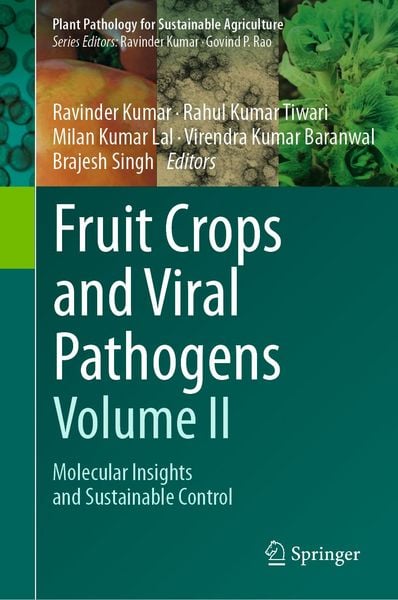
Produktbild: Fruit Crops and Viral Pathogens Volume II
- 10% Neu

Fruit Crops and Viral Pathogens Volume II Molecular Insights and Sustainable Control

10% sparen

195,99 € UVP 219,99 €

inkl. gesetzl. MwSt., Versandkostenfrei


Beschreibung

Produktdetails

Einband

Gebundene Ausgabe

Erscheinungsdatum

26.05.2026

Abbildungen

XXI, 36 illus., 32 illus. in color., farbige Illustrationen, schwarz-weiss Illustrationen

Herausgeber

Ravinder Kumar + weitere

Verlag

Springer Singapore

Seitenzahl

467

Maße (L/B/H)

24,1/16/3,2 cm

Gewicht

896 g

Auflage

1. Auflage

Sprache

Englisch

ISBN

978-981-9572-60-1

Beschreibung

Portrait

Dr. Ravinder Kumar is a Senior Scientist in Plant Pathology at ICAR-Indian Agricultural Research Institute, New Delhi. He earned his M.Sc. and Ph.D. in Plant Pathology from Sardar Vallabhbhai Patel University of Agriculture & Technology, Meerut and previously served at the ICAR-Central Potato Research Institute, Shimla. His research focuses on host-pathogen interactions, plant virus epidemiology, and disease management, with major contributions in molecular characterization, genome sequencing, and diagnostics of plant viruses. He has developed advanced diagnostic tools, including multiplex RT-PCR, real-time PCR, LAMP and RPA. Dr. Kumar has published over 150 research articles and edited 20 books with leading publishers, serving on several international journal editorial boards.


Dr Rahul Kumar Tiwari is currently working on melatonin-mediated mitigation of soil and tuber-borne diseases and physiological disorders in crop plants. He has also worked on the signalling mechanism of pathogens, pathogenomics and the management of hemibiotrophic fungi. He has explored the genetic diversity of pathogenic microbes in field and horticultural crops. Additionally, his area of interest is on multiple aspects of pathophysiological alterations in food crops under the influence of diverse biotic and abiotic stresses. He has published more than 130 publications in reputed journals.


Dr. Milan Kumar Lal is a plant physiologist specializing in abiotic stress and nutritional aspects of potato and other starchy crops. His research focuses on heat, drought, salinity, and heavy metal stress, as well as plant physiological, biochemical, and molecular responses to biotic stresses caused by fungi, viruses, and bacteria. He also has expertise in nutrition and quality traits of starchy crops, including resistant starch, glycemic index, phytonutrients, bioactive compounds, functional fermented foods and beverages, and processing techniques to enhance nutritional value. His work has resulted in over 180 publications in international peer-reviewed journals.


Dr. Virendra Kumar Baranwal is a distinguished plant virologist. He earned his M.Sc. and Ph.D. in Botany (Virology) from Lucknow University and joined the Agricultural Research Service in 1985, and served at CPCRI and NCIPM before joining the Advanced Centre for Plant Virology, IARI, in 1999. He served as Professor (2016-2022) and ICAR-National Professor (2022-2025). He has guided 4 M.Sc. and 20 Ph.D. students and published over 200 peer-reviewed articles. A recipient of the IARI Best Teacher Award, he is a Fellow of NAAS and NASI. His international exposure includes IPM training in Indonesia, DBT-Overseas Associate tenure at The State University of New Jersey, USA, and academic visits to the University of Florida and the University of Queensland. Dr. Baranwal’s major contributions include the development of a microarray chip for the detection of over 1,100 plant viruses, infectious clones of banana-infecting badnaviruses, studies on virus resistance in banana, HTS-based virus and viroid genomics, and rapid field-based diagnostics of plant viruses.

Dr. Brajesh Singh is a Doctor in Botany and currently serves as Director, ICAR-Central Potato Research Institute, Shimla, and Principal Scientist in the Crop Physiology, Biochemistry and Post-Harvest Technology Division. His research interests focus on horticultural crop storage technologies, post-harvest processing, and nutritional quality assessment, with particular emphasis on improving the value and shelf life of potato crops. He is coordinating programmes on genome editing of potato, post-harvest management, and nutritional enhancement, contributing to sustainable productivity and quality improvement. Dr. Singh has an extensive publication record with over 220 peer-reviewed research articles and is the author of four patents, reflecting his strong commitment to innovation, translational research, and advancement of potato science in India. Dr. Singh has an extensive publication record with over 220 peer-reviewed research articles and is the author of four patents, reflecting his strong commitment to innovation, translational research, and advancement of potato science in India.

Produktdetails

Einband

Gebundene Ausgabe

Erscheinungsdatum

26.05.2026

Abbildungen

XXI, 36 illus., 32 illus. in color., farbige Illustrationen, schwarz-weiss Illustrationen

Herausgeber

Verlag

Springer Singapore

Seitenzahl

467

Maße (L/B/H)

24,1/16/3,2 cm

Gewicht

896 g

Auflage

1. Auflage

Sprache

Englisch

ISBN

978-981-9572-60-1

Herstelleradresse

Springer-Verlag KG
Sachsenplatz 4-6
1201 Wien
AT

Email: ProductSafety@springernature.com

Kundinnen und Kunden meinen

0 Bewertungen

Informationen zu Bewertungen

Zur Abgabe einer Bewertung ist eine Anmeldung im Konto notwendig. Die Authentizität der Bewertungen wird von uns nicht überprüft. Wir behalten uns vor, Bewertungstexte, die unseren Richtlinien widersprechen, entsprechend zu kürzen oder zu löschen.

Die Bewertungen sind nach Format, Anzahl Sterne und Datum sortiert.

Verfassen Sie die erste Bewertung zu diesem Artikel

Helfen Sie anderen Kund*innen durch Ihre Meinung

Kundinnen und Kunden meinen

0 Bewertungen filtern

  • Produktbild: Fruit Crops and Viral Pathogens Volume II
  • 1. Economic and Quality Deterioration in Fruit Crops Due to Viral Diseases.- 2. Viral Threats in Commercially Important Tropical and Subtropical Fruit Crops.- 3. Climate Change-Driven Alterations and New Outbreaks of Viral Diseases in Fruit Crops.- 4. Viral Disease Complexes in Fruit Crops: Synergism and Mixed Infections.- 5. Mechanisms of Viral Pathogenesis in Fruit Crops.- 6. Biochemical and Molecular Insights on Virus–Vector Interactions in Fruit Crops.- 7. Viral Suppressors of RNA Silencing in Fruit Crops.- 8. Molecular Characterization and Genome Annotation of Emerging Fruit Viruses.- 9. Utilizing Virome Analysis to Manage Viral Diseases in Fruit Crops.- 10. Rapid and Sensitive On-Site Diagnostic Tools for Fruit Viruses.- 11. Tissue Culture and the Role of Healthy Planting Materials in Preventing Virus Spread.- 12. Quarantine and Certification Programs for Virus-Free Fruit Propagation Material.- 13. Proteomics and Metabolomics in Virus-Infected Fruit Crops.- 14. Multi-Omics Approach for Comprehensive Virus Management.- 15. Understanding Epigenetic Mechanisms in Fruit Virus Resistance.- 16. RNAi and dsRNA-Based Gene Silencing for Virus Management in Fruit Crops.- 17. Virus-Induced Gene Silencing (VIGS) in Functional Genomics of Fruit Crops.- 18. Cross-Protection Strategies Using Mild Viral Strains in Fruit Crops.- 19. Nanotechnology in Managing Viral Diseases in Fruit Crops.- 20. Transforming Post-Harvest Viral Disease Management: A 21st-Century Perspective on Fruit Crops.- 21. Transgenic Approaches for Virus Resistance in Fruit Crops: Progress and Policy.- 22. Current and Emerging Biotech Solutions for Virus Resistance in Perennial Fruit Crops.