Gutscheinbedingungen

**Gültig bis 25.06.2026 auf fremdsprachige Bücher online auf thalia.at und in der Thalia App. Einzelne Artikel können ausgeschlossen sein. Ausgenommen sind preisgebundene Artikel & eBooks. Pro Einkauf einmal einlösbar. Click & Collect nur bei Onlinevorabzahlung möglich. Keine Barauszahlung. Nicht kombinierbar mit anderen Aktionen und Gutscheinen. Gutschein wird auf max. 500€ Bestellwert angerechnet. Nicht gültig für Geschenkkarten, Versandkosten und Services.

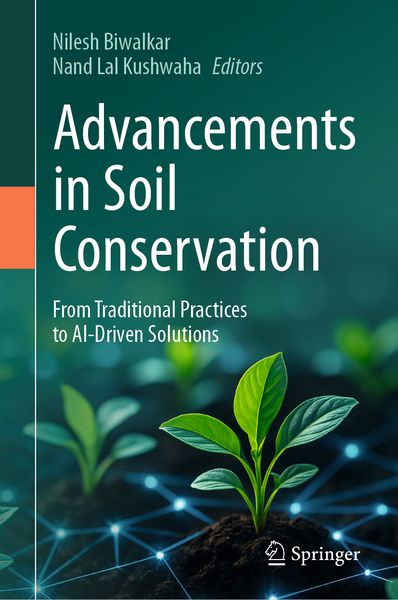
Produktbild: Advancements in Soil Conservation
- 10%

Advancements in Soil Conservation From Traditional Practices to AI-Driven Solutions

10% sparen

195,99 € UVP 219,99 €

inkl. gesetzl. MwSt., Versandkostenfrei


Beschreibung

Produktdetails

Einband

Gebundene Ausgabe

Erscheinungsdatum

10.04.2026

Abbildungen

XVI, 155 illus., 151 illus. in color., schwarz-weiss Illustrationen, farbige Illustrationen

Herausgeber

Nilesh Bilwalkar + weitere

Verlag

Springer

Seitenzahl

641

Maße (L/B/H)

24,1/16/4,1 cm

Gewicht

1142 g

Sprache

Englisch

ISBN

978-3-032-17990-6

Beschreibung

Portrait

Dr. Nilesh Biwalkar is the Principal Investigator of the 'Precision Farming Development Centre (PFDC)' project in Ludhiana. He prepared irrigation plans for Fazilka and Shaheed Bhagat Singh Nagar districts and is part of the steering committee for the Punjab State Irrigation Plan. He also contributed to establishing a semi-automatic submersible pump testing center. With experience teaching 15 courses at Diploma, UG, and PG levels, he has guided 10 students and published over 20 research papers, five bulletins, and 15+ popular articles. He co-authored one book and wrote three book chapters. As Co-PI, he contributed to the World Bank-funded 'DBTE for Agriculture' project and the 'Punjab Smart Farming Solutions' project funded by ARENA, Israel. Currently, he is the Principal Investigator of the 'Precision Farming Development Centre (PFDC)' in Ludhiana. He also prepared irrigation plans for Fazilka and Shaheed Bhagat Singh Nagar districts and serves on the steering committee for Punjab's State Irrigation Plan. He is a team member of Establishment of ‘Semi-automatic submersible pump testing center’. He provided five recommendations on irrigation and fertigation for Potato, Pumpkin, Bittergourd, Guava, and Dendrobium crops. Actively involved in extension activities, he has delivered over 200 lectures in training programs at PAMETI, Skill Development Center, and KVKs. He coordinated more than 30 training programs and attended international training in Israel and Russia. Additionally, he designed check dams, infiltration galleries, and groundwater recharge structures for the Kandi region of Punjab.

Nand Lal Kushwaha is currently pursuing Ph.D. in Soil and Water Conservation Engineering from the Department of Soil and Water Engineering, Punjab Agricultural University (PAU), Ludhiana, Punjab, India (141004). He is a Scientist (Land and Water Management Engineering) at the ICAR-Indian Agricultural Research Institute (ICAR-IARI), New Delhi, India (110012). He received his B. Tech. (Agricultural Engineering) degree from Jawaharlal Nehru Krishi Vishwa Vidyalaya (JNKVV), Jabalpur, Madhya Pradesh, India, in 2013, and his M. Tech. (Soil and Water Engineering) degree from Punjab Agricultural University, Ludhiana, in 2015. Over the past six years, he has focused on developing data-driven solutions for water resource management. He previously served as an Assistant Agricultural Engineer at the National Seeds Corporation Ltd. (Govt. of India) for more than three years, where he explored sensor-based irrigation systems and central pivot irrigation systems for precision water application. He has published over 40 research papers in reputed international journals with Springer, Elsevier, IWA, and Taylor & Francis, garnering more than 2000 citations. He has also published three edited books with Springer Nature and CRC Press (Taylor & Francis, USA), and serves as a reviewer for several peer-reviewed international journals. He is the recipient of the Best Paper Award (2017) for his master’s research from the Indian Society of Agricultural Engineers (ISAE), New Delhi, and the Best Paper Awards (2023 & 2024) from the Soil Conservation Society of India (SCSI), New Delhi. His research interests include AI-driven solutions for soil and water conservation planning, watershed modeling and management, hydrological modeling, and the application of remote sensing and GIS in natural resource management.


Produktdetails

Einband

Gebundene Ausgabe

Erscheinungsdatum

10.04.2026

Abbildungen

XVI, 155 illus., 151 illus. in color., schwarz-weiss Illustrationen, farbige Illustrationen

Herausgeber

Verlag

Springer

Seitenzahl

641

Maße (L/B/H)

24,1/16/4,1 cm

Gewicht

1142 g

Sprache

Englisch

ISBN

978-3-032-17990-6

Herstelleradresse

Springer-Verlag GmbH
Tiergartenstr. 17
69121 Heidelberg
DE

Email: ProductSafety@springernature.com

Kundinnen und Kunden meinen

0 Bewertungen

Informationen zu Bewertungen

Zur Abgabe einer Bewertung ist eine Anmeldung im Konto notwendig. Die Authentizität der Bewertungen wird von uns nicht überprüft. Wir behalten uns vor, Bewertungstexte, die unseren Richtlinien widersprechen, entsprechend zu kürzen oder zu löschen.

Die Bewertungen sind nach Format, Anzahl Sterne und Datum sortiert.

Verfassen Sie die erste Bewertung zu diesem Artikel

Helfen Sie anderen Kund*innen durch Ihre Meinung

Kundinnen und Kunden meinen

0 Bewertungen filtern

  • Produktbild: Advancements in Soil Conservation
  • 1. Global Historical Perspectives of Soil Conservation.- 2-Soil Fundamentals: Ecology, Formation, and Classification.- 3-Soil Erosion and its Control Techniques.- 4-Traditional Soil Erosion Measurement Techniques.- 5-Modelling Approaches for Global Soil Conservation Planning.- 6-Soil Erosion Modelling Using Empirical Models Across Regions.- 7-Soil Erosion Modeling Using Physical Based Models.- 8-Remote Sensing, GIS, and UAVs in Soil Erosion Assessment.- 9-Conservation Agriculture: Techniques from Indigenous Farming Systems Worldwide.- 10-Agroforestry and Its Role in Soil Conservation.- 11-Agroforestry and Its Role in Soil Conservation Across Climates.- 12-Soil conservation through Terracing and contour farming.- 13-Economic Aspects of Soil Conservation.- 14-Artificial Intelligence and Precision Farming: An Overview.- 15-AI-Driven Soil Erosion Prediction Models.- 16-AI-Based Soil Texture classification and its application in soil conservation.- 17-Precision Farming Techniques for Soil Conservation in Diverse Climates.- 18-Application of RS and GIS in Soil Conservation Planning.- 19-Land use land cover change detection analysis for soil conservation.- 20-Integrating AI with Traditional Knowledge: Enhancing Soil Conservation Practices.- 21-Erosion’s Impact on Climate Change, Ecology, and the Economy.- 22-Ethical Considerations and Policy Frameworks for AI in Soil Conservation.- 23-The Future of AI in Soil Conservation and the Way Forward.