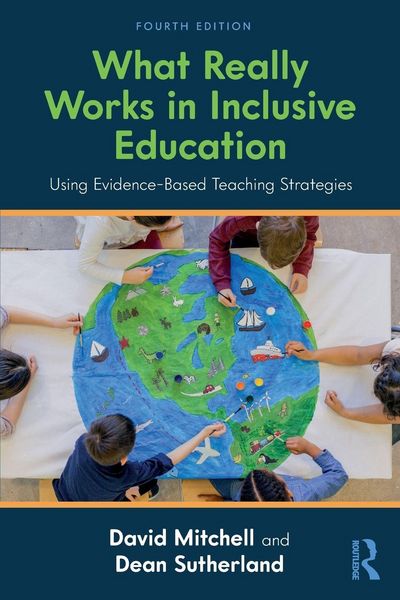
What Really Works in Inclusive Education Using Evidence-Based Teaching Strategies
-
- Hardcover
- Taschenbuch ausgewählt
- eBook
-
Sprache:Englisch
61,99 €
inkl. gesetzl. MwSt.,
Beschreibung
Produktdetails
Einband
Taschenbuch
Erscheinungsdatum
24.07.2026
Abbildungen
schwarz-weiss Illustrationen, Raster,schwarz-weiss, Zeichnungen, schwarz-weiss, Tabellen, schwarz-weiss
Verlag
Taylor & FrancisSeitenzahl
472
Maße (L/B/H)
23,2/15,5/2,7 cm
Gewicht
730 g
Auflage
4. Auflage
Sprache
Englisch
ISBN
978-1-03-299315-7
This fully revised and updated fourth edition of the bestselling What Really Works in Inclusive Education focuses on more than 32 specific, evidence-based teaching strategies for addressing the needs of diverse learners. A significant revision with nine new chapters, this edition takes a whole-child approach to inclusive education. It is a book for all educators of all learners.
The strategies are based on high-quality research drawn from a range of countries and have a strong theoretical rationale, including inclusive education, neuroscience, ecology and a model of learning and teaching. The expert authors also consider behavioural challenges facing learners and how they can be interpreted in an evolutionary context. Key features include:
- Teaching strategies grouped into four approaches to learning: behavioural, social, cognitive and mixed;
- New chapters on diversities among learners, comprehensive mathematics programmes, music, exercise, dance, the natural environment and the future of education;
- Expansion of topics including artificial intelligence, diet and exercise, and multi-tiered systems of support; and
- An extended scope to include those with disabilities, and those from low socio-economic backgrounds, ethnic minorities and LGBTQ+ learners.
To assist readers, it includes examples of strategies being used in schools, recommended videos, suggested discussion topics and learning activities.
This essential text is ideal for classroom teachers, school leaders, teacher educators, educational psychologists, special needs coordinators, educational researchers and students in initial teacher education seeking practical, evidence-based resources for inclusive teaching.
Noch keine Bewertungen vorhanden
Verfassen Sie die erste Bewertung zu diesem Artikel
Helfen Sie anderen Kundinnen und Kunden durch Ihre Meinung.
Kurze Frage zu unserer Seite
Vielen Dank für Ihr Feedback
Wir nutzen Ihr Feedback, um unsere Produktseiten zu verbessern. Bitte haben Sie Verständnis, dass wir Ihnen keine Rückmeldung geben können. Falls Sie Kontakt mit uns aufnehmen möchten, können Sie sich aber gerne an unseren Kund*innenservice wenden.
zum Kundenservice