Gutscheinbedingungen

**Gültig von 22.06.2026 ab 19 Uhr bis 23.06.2026 24 Uhr auf Spielzeug, Schreibwaren, Filme, Geschenke & Trends, Musik, tolino eReader & Zubehör, Hörbücher und Hörbuch-Downloads (außer Abo), nicht preisgebundene Bücher und Kalender online auf thalia.at und in der Thalia App. Einzelne Artikel können ausgeschlossen sein. Aufgrund der Buchpreisbindung sind deutschsprachige Bücher und eBooks ausgenommen. Zusätzlich ausgenommen sind preisgebundene Artikel, Abos & Flatrates, eBooks, Games, Geschenkkarten/-boxen, Shelfies, Software, Zeitschriften sowie einzelne Artikel von tonies®. Pro Einkauf einmal einlösbar. Click & Collect nur bei Onlinevorabzahlung möglich. Keine Barauszahlung. Nicht kombinierbar mit anderen Aktionen und Gutscheinen. Gutschein wird auf max. 500€ Bestellwert angerechnet. Nicht gültig für Versandkosten und Services.

Produktbild: Planetary Awareness in the Anthropocene
Vorbesteller Neu

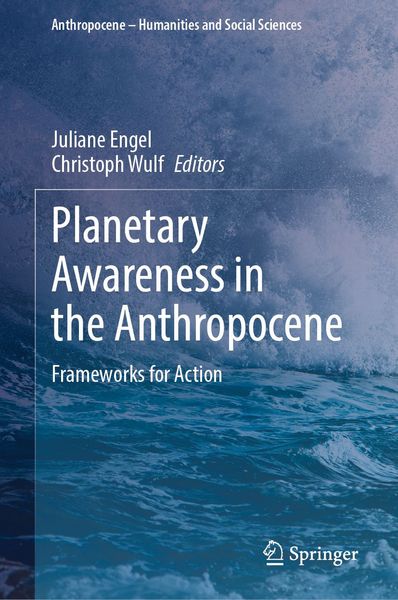
Planetary Awareness in the Anthropocene Frameworks for Action

188,99 €

inkl. gesetzl. MwSt., Versandkostenfrei


Beschreibung

Produktdetails

Einband

Gebundene Ausgabe

Erscheinungsdatum

03.08.2026

Abbildungen

IX, 9 illus., 7 illus. in color., farbige Illustrationen, schwarz-weiss Illustrationen

Herausgeber

Juliane Engel + weitere

Verlag

Springer

Seitenzahl

372

Maße (L/B)

23,5/15,5 cm

Sprache

Englisch

ISBN

978-3-032-17430-7

Beschreibung

Portrait

Juliane Engel is the Founding Director for Transfer of the Center for Critical Computational Studies | C3S at Goethe University Frankfurt. The newly founded center's mission is to establish and activate Critical Computational Literacy (CCL) as a transformative framework. C3S empowers students, citizens, and communities to thoughtfully relate and engage with the algorithmic and data-driven technologies in post digital times. As a Professor of Education at Goethe University, Juliane Engel is focusing on schools and cultural transformation. In systematic and empirical studies, her work examines educational processes and learning considered in the context of dynamics of social transformation, such as processes of cultural pluralization and (post-)digitality, highlighting asymmetries of power. This analysis focuses on the materiality and mediality of processes of subjectification as well as on new forms of agency in post digital realities. She is chair of the Commission for Qualitative Educational and Biographical Research of the German Society for Educational Science (QBBF), where she works on advancing the methodological development of digitized research. She is (co-)founder of an international research group on “becoming planetary” and co-editor of the journal Education in the Anthropocene: Sustainability, Transformation, Cultures. Since 2023, she is member of the Scientific Committee of the book series "Anthropocene – Humanities and Social Sciences".

Christoph Wulf is Professor of Anthropology and Education and a member of the Interdisciplinary Centre for Historical Anthropology, the Collaborative Research Centre (SFB, 1999–2012) ‘Cultures of Performance’, the Cluster of Excellence (2007–2012), ‘Languages of Emotion’ and the Graduate School ‘InterArts’ (2006–2015) at the Freie Universität Berlin. His books have been translated into 20 languages. For his research in anthropology and anthropology of education, he received the title professor honoris causafrom the University of Bucharest. He is Vice-President of the German Commission for UNESCO. Major research areas:historical and cultural anthropology, educational anthropology, imagination, inter-cultural communication, mimesis, aesthetics, epistemology and Anthropocene. Research stays and invited professorships have included the following locations, among others: Stanford, Tokyo, Kyoto, Beijing, Shanghai, Mysore, Delhi, Paris, Lille, Modena, Amsterdam, Stockholm, Copenhagen, London, Vienna, Rome, Lisbon, Basel, Saint Petersburg, Moscow, Kazan and Sao Paulo.

Produktdetails

Einband

Gebundene Ausgabe

Erscheinungsdatum

03.08.2026

Abbildungen

IX, 9 illus., 7 illus. in color., farbige Illustrationen, schwarz-weiss Illustrationen

Herausgeber

Verlag

Springer

Seitenzahl

372

Maße (L/B)

23,5/15,5 cm

Sprache

Englisch

ISBN

978-3-032-17430-7

Herstelleradresse

Libri GmbH
Europaallee 1
36244 Bad Hersfeld
DE

Email: gpsr@libri.de

Kundinnen und Kunden meinen

0 Bewertungen

Informationen zu Bewertungen

Zur Abgabe einer Bewertung ist eine Anmeldung im Konto notwendig. Die Authentizität der Bewertungen wird von uns nicht überprüft. Wir behalten uns vor, Bewertungstexte, die unseren Richtlinien widersprechen, entsprechend zu kürzen oder zu löschen.

Die Bewertungen sind nach Format, Anzahl Sterne und Datum sortiert.

Verfassen Sie die erste Bewertung zu diesem Artikel

Helfen Sie anderen Kund*innen durch Ihre Meinung

Kundinnen und Kunden meinen

0 Bewertungen filtern

  • Produktbild: Planetary Awareness in the Anthropocene
  • Chapter 1.Becoming Planetary (Juliane Engel & Christoph Wulf).- Part 1: Planetary Studies in the Field of the Anthropocene.- Chapter 2.Culture and Politics on a Planetary Scale(Roland Bernecker).- Chapter 3. Our Planet in the Anthropocene. A plea for Geo-anthropology (Christoph Antweiler).- Chapter 4. Becoming Planetary Theory in an Age where Technology is becoming larger than Life (Shoko Suzuki).- Chapter 5. Pluriversal Planetary Education. Challenges in the Anthropocene (Christoph Wulf).- Chapter 6. Biogeophysical Disruptions. The Challenges for Education in Conceptualizing the Anthropocene (Nathanael Wallenhorst).- Chapter 7. Complexity of the Anthropocene. A Systemic and Transdisciplinary Approach (Francois Prouteau).- Part 2: Our shared Planet. Nature, Energy, and Societal Change.- Chapter 8. Respect for Nature in Africa and the Response to Changes brought about by Digital Transformation and Globalization. Implications for Adult Education (Michael Omolewa,  Ruphina Nwachukwu).- Chapter 9. Repairing the World. The Task and Place of Technology in the Anthropocene (Sebastian Agudelo).- Chapter 10. Oikos or Echoes? The hurricanes of the media. (Norval Baitello Junior).- Chapter 11. Planetary Futures. The Transformation Crisis in the Anthropocene (Juliane Engel).- Chapter 12. Micro-Organization and Societal Change in the Anthropocene (David R. Cole).- Chapter 13. Melt into Air: Planetary Becoming amidst Earth`s Energy Imbalance (Joshua Wodak).- Part 3: Transformation: Colonialism, Sovereignty and Universalism.- Chapter 14. Planetary Thinking and the Global South. The Anthropocene, Postcolonialism and Decolonialism(Viviana Polo-Flórez).- Chapter 15. Educational Anthropology and Developing a Planetary Outlook. Interfaces, Challenges and Pathways to the Future.- (Karina Limonta Vieira).- Chapter 16. How to not become a Vampire. Reflections on the Desire of Europeans to learn from Indigenous Knowledge (Bettina Fritzsche).- Chapter 17. Losing Sovereignty. An Educational Reflection on Concepts of Sovereignty inspired by de- and postcolonial Critiques (Nadine Rose).- Chapter 18. Critique of Universalism in Critical Theory and Postcolonial Theory. The Epistemological Potential (Merle Hummrich).- Chapter 19. Comparative Analysis. A Universal Method to inquire into Particularities (Arnd-Michael Nohl).- Chapter 20. Visualizing Climate Change and Education. Planetary Research in the Mirror of Power.- Part 4: Vulnerability and Flourishing. Urbanism, Literacy, and Resilience.- Chapter 21. Urban Dynamics and Global Citizenship Education. Nurturing Interconnectedness and Resilience in the Hyper-Mobile Era (Hongyan Chen).- Chapter 22. Literacy and Social Justice. An Educational Approach that transcends Boundaries (Andrea Bramberger & Sabine Seichter).- Chapter 23."Cultural Resilience" and the Cultivation of a Postdigital Planetary Dissensus.-(Benjamin Jörissen & Leopold Klepacki).- Chapter 24. Cultivating Flourishing Life. Eudaimogenesis as a Paradigm for the Anthropocene (Juliane Noak).- Chapter 25. Becoming Planetary in the Deep South. James Agee’s Memorial to Meek Men (Joan Ramon Resina).