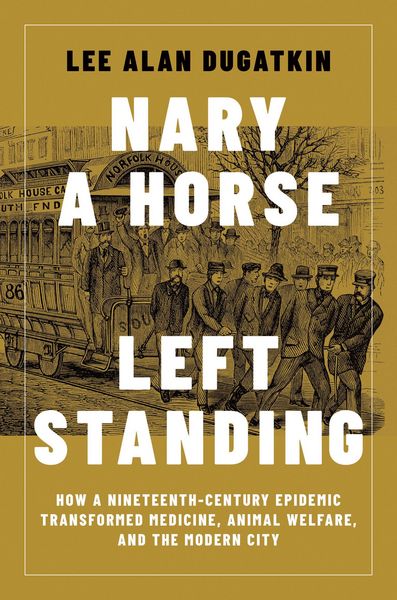
Nary a Horse Left Standing How a Nineteenth-Century Epidemic Transformed Medicine, Animal Welfare, and the Modern City
32,99 €
inkl. gesetzl. MwSt.,
Beschreibung
Produktdetails
Einband
Gebundene Ausgabe
Erscheinungsdatum
15.09.2026
Abbildungen
20 b&w illustrations
Verlag
MIT PressSeitenzahl
264
Maße (L/B/H)
22,9/15,2/2,3 cm
Gewicht
567 g
Sprache
Englisch
ISBN
978-0-262-05454-6
How a devastating outbreak of horse flu in the 1870s ground city life to a halt—but ultimately revolutionized animal rights, medicine, and transportation.
From a veteran science writer, evolutionary biologist, historian of science, and the coauthor of the acclaimed How to Tame a Fox (and Build a Dog).
In the 1870s, horses were the lifeblood of North American cities. New York, Boston, Chicago, and Toronto relied on tens of thousands of workhorses to power daily life. Then, in late 1872 and into 1873, a devastating outbreak of horse flu—known as The Great Epizootic—swept across the continent.
In Nary a Horse Left Standing, Lee Dugatkin chronicles this little-known crisis, revealing how the epidemic disrupted nearly every aspect of urban life. From coast to coast, livelihoods collapsed as horses lay sick, or worse dying, on stable floors, fires raged unchecked without horse-drawn wagons, and city development stalled for lack of horsepower. Just as the Gilded Age was dawning and industrialists were poised to amass fortunes, the flu slowed progress to a crawl.
Yet the tragedy also catalyzed revolutions in medicine, animal rights, and transportation. Veterinary science in the U.S. was still emerging, but detailed medical reports from the epidemic helped validate germ theory and discredit outdated beliefs. The crisis also spotlighted early animal welfare efforts, with fledgling groups like the ASPCA advocating for sick horses forced to work. Finally, the sheer vulnerability of relying on animals for transport spurred a shift toward mechanized systems.
As illuminating as it is humbling, the book brings to life a critical account of a crisis that still speaks to the complex public health and transportation challenges we face today.
Noch keine Bewertungen vorhanden
Verfassen Sie die erste Bewertung zu diesem Artikel
Helfen Sie anderen Kundinnen und Kunden durch Ihre Meinung.
Kurze Frage zu unserer Seite
Vielen Dank für Ihr Feedback
Wir nutzen Ihr Feedback, um unsere Produktseiten zu verbessern. Bitte haben Sie Verständnis, dass wir Ihnen keine Rückmeldung geben können. Falls Sie Kontakt mit uns aufnehmen möchten, können Sie sich aber gerne an unseren Kund*innenservice wenden.
zum Kundenservice