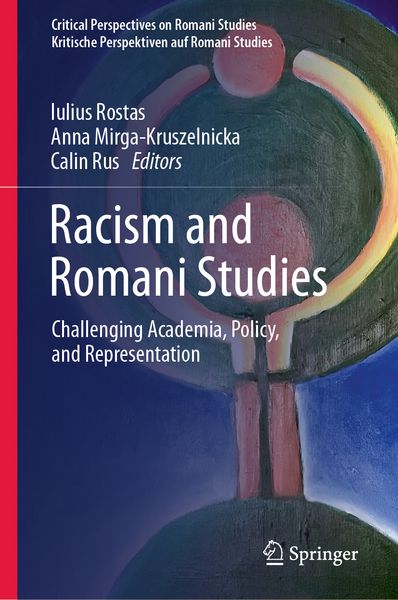
Produktbild: Racism and Romani Studies
- 11%

Racism and Romani Studies Challenging Academia, Policy, and Representation

11% sparen

135,99 € UVP 153,99 €

inkl. gesetzl. MwSt., Versandkostenfrei


Beschreibung

Produktdetails

Einband

Gebundene Ausgabe

Erscheinungsdatum

28.04.2026

Abbildungen

XV, 328 p. 31 illus., 21 illus. in color.

Herausgeber

Iulius Rostas + weitere

Verlag

Springer

Seitenzahl

328

Maße (L/B/H)

24,1/16/2,3 cm

Gewicht

742 g

Auflage

1. Auflage

Sprache

Englisch

ISBN

978-3-032-16825-2

Beschreibung

Portrait


Dr. Iulius Rostas is a Visiting Professor at the Eötvös Loránd University in Budapest (Hungary) and the National University of Political Studies and Administration in Bucharest (Romania). In 2021-2023, he taught courses on racism at the University of Stuttgart and Dortmund University of Applied Sciences. Between 2016 and 2019, he served as Chair of Romani Studies and Assistant Professor at Central European University. Previously, he was an Affiliated Fellow with the Institute for Advanced Studies at CEU and a Visiting Lecturer at Corvinus University of Budapest. Dr Rostas is the editor of “Ten Years After: A History of Roma School Desegregation in Central and Eastern Europe” (CEU Press, 2012) and in 2011 he published “Social Inclusion or Exclusion: the Rights of Persons Living with HIV in Moldova” (Cartier Publishing, 2011). He is the founding Editor-in-Chief of the Critical Romani Studies journal and is a member of the Board of the CEEOL Publishing. In 2019, he authored “A Task for Sisyphus: Why Policies towards Roma in Europe Are Failing” (CEU Press), and in 2025, he co-authored “Ungleiche Teilhabe: Bildungserfahrungen und Perspektiven von Romnja und Sintize in der Stadt Freiburg” published by Springer.


Anna Mirga-Kruszelnicka, PhD, is an anthropologist and a Roma activist, born in Cracow, Poland. She earned her Ph.D. in Social and Cultural Anthropology at the Universitat Autònoma de Barcelona (UAB) in 2016. She is the author of policy evaluations, reports, and articles, co-editor of the “Education for Remembrance of the Roma Genocide: Scholarship, Commemoration and the Role of Youth

 (Libron, 2015) and “Re-thinking Roma Resistance throughout History: Recounting Stories of Strength and Bravery” (ERIAC, 2020) and author of “Mobilizing Romani Ethnicity: Romani Political Activism in Argentina, Colombia, and Spain (CEU Press, 2022). She has been an employee, member, founder, and collaborator of numerous Roma organisations in Poland and Spain. From 2008 to 2012 she was the European project coordinator at the Federation of Roma Associations in Catalonia (FAGIC). From 2013 to 2015 she was an Open Society Foundations Roma Initiatives Fellow, conducting a comparative study of the Roma associative movements in various countries of Latin America and Europe. From 2015 to 2017 she was the coordinator and curator of the Academic Section (aka. Roma Civil Rights Movement Section) in the RomArchive – Digital Archive of the Roma. Between 2017-2018 she was a Post-Doctoral Research Fellow of the Romani Studies Program at the Central European University (CEU) in Budapest. She serves as the deputy director of the European Roma Institute for Arts and Culture (ERIAC) since January 2018, in charge of, among other things, the Barvalipe Roma Online University.


Calin Rus, PhD, is, since 1996, Director at the Intercultural Institute of Timisoara (Romania), one of the first organizations in Romania denouncing, researching and combating anti-Roma racism. He is Associate Professor at the West University of Timisoara and served as vice-president of the International Association of Intercultural Research. Since 2003, he was a lead expert on several Council of Europe projects, including Education of Roma Children in Europe, ROMED, ROMED2, ROMACT, InSchool – Inclusive schools - Making a difference for Roma Children. He is author or co-author of several publications of the Council of Europe, including the Reference Framework of Competences for Democratic Culture (2018). He co-edited “Interculturalism and Discrimination in Romania. Policies, Practices, Identities and Representations” (Lit Verlag, 2006). He is the author of several book chapters on priority education policies focused on Roma (ENS Éditions, 2008, 2011, Palgrave, 2014), as well as co-author of the study “Measures for Roma inclusion in the labour market: from organized hypocrisy to real effectiveness (Intercultural Institute Timisoara, 2014).

Produktdetails

Einband

Gebundene Ausgabe

Erscheinungsdatum

28.04.2026

Abbildungen

XV, 328 p. 31 illus., 21 illus. in color.

Herausgeber

Verlag

Springer

Seitenzahl

328

Maße (L/B/H)

24,1/16/2,3 cm

Gewicht

742 g

Auflage

1. Auflage

Sprache

Englisch

ISBN

978-3-032-16825-2

Herstelleradresse

Springer-Verlag GmbH
Tiergartenstr. 17
69121 Heidelberg
DE

Email: ProductSafety@springernature.com

Noch keine Bewertungen vorhanden

Verfassen Sie die erste Bewertung zu diesem Artikel

Helfen Sie anderen Kundinnen und Kunden durch Ihre Meinung.

Kundinnen und Kunden meinen

Bewertungen (0)

  • Produktbild: Racism and Romani Studies

  • Part I: Introduction.- Chapter 1. The long durée of a concept: some reflections on the concept of antigypsyism.- Part II: Academia and the impact of racism on everyday life of Roma.- Chapter 2.Academic Antigypsyism - The Legacy of the Gellmann.- Chapter 3.‘From Victorian Gypsylorism to Nazi eugenics’: the Europocentric foundations of historical racism in Romani Studies.- Chapter 4. Antigypsyism in Imperial Spain: A Genealogy.- Chapter 5. The Interwar Romanian Eugenics Movement and the Racist Influences on the Roma Minority (Romania) in Contemporary Times.- Part III: Manifestations of antigypsyism.- Chapter 6. The Demonstration of State Power in Visual Representations of Sinti and Roma.- Chapter 7. Institutional Antigypsyism in Municipal Practice Empirical Findings, Conceptual and Methodological Considerations.- Chapter 8. Markus End - Expert Knowledge in Policing An Element of an Institutional Antigypsyism.- Chapter 9. Prevalences of experienced discrimination and harassment in the Finnish Roma adult population in Finland, and the associations with health and wellbeing factors.- Chapter 10. How can geography lessons help to reduce anti-Gypsy stereotypes? The example of Travellers in France.- Chapter 11. Whiteness in Action: Italian Teachers and the Denial of Anti-Romani Racism.- Chapter 12. Not another “gypsy-themed” movie? Traces of Antigypsyism in the period drama Peaky Blinders.- Part IV: Challenging racism.- Chapter 13. What is the position of Roma in ‘racial capitalism’?.- Chapter 14. The Limits of the White Spanish Academy: The Challenge of Writing Romani History as a Romani scholar.- Chapter 15. How to combat racism against Roma in the role of a researcher – The relevance of deconstructive discourses and methodological research design in Romani Studies.- Chapter 16.  The role of inter-professional forums in transforming hostile practices towards Gypsy, Roma and Traveller communities.- Chapter 17. Beyond declarative compliance? Limits of the EU Roma Framework to address antigypsyism on national and European levels.