Gutscheinbedingungen

**Gültig bis 25.08.2026 ab einem Mindestbestellwert von 30€ auf Spielzeug, Schreibwaren, Filme, Geschenke & Trends, Musik, tolino eReader & Zubehör, Hörbücher und Hörbuch-Downloads (außer Abo), nicht preisgebundene Bücher und Kalender online auf thalia.at und in der Thalia App. Einzelne Artikel können ausgeschlossen sein. Aufgrund der Buchpreisbindung sind deutschsprachige Bücher und eBooks ausgenommen. Zusätzlich ausgenommen sind preisgebundene Artikel, Abos & Flatrates, eBooks, Games, Geschenkkarten/-boxen, Shelfies, Software, Zeitschriften sowie einzelne Artikel von tonies®. Pro Einkauf einmal einlösbar. Click & Collect nur bei Onlinevorabzahlung möglich. Keine Barauszahlung. Nicht kombinierbar mit anderen Aktionen und Gutscheinen. Gutschein wird auf max. 500€ Bestellwert angerechnet. Nicht gültig für Versandkosten und Services. Preisgebundene Artikel sind vom Mindestbestellwert ausgeschlossen.

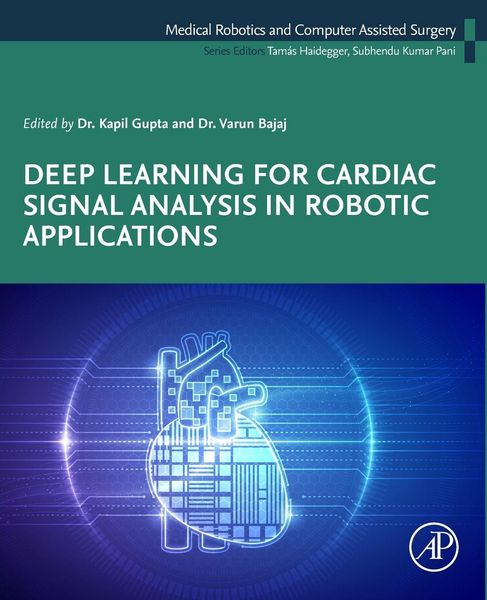
Produktbild: Deep Learning for Cardiac Signal Analysis in Robotic Applica
- 13%

Deep Learning for Cardiac Signal Analysis in Robotic Applica

13% sparen

148,99 € UVP 171,70 €

inkl. gesetzl. MwSt., Versandkostenfrei


Beschreibung

Produktdetails

Einband

Taschenbuch

Erscheinungsdatum

01.05.2026

Herausgeber

Kapil Gupta + weitere

Verlag

Elsevier Science & Technology

Seitenzahl

300

Maße (L/B)

23,5/19,1 cm

Gewicht

450 g

Sprache

Englisch

ISBN

978-0-443-45242-0

Beschreibung

Portrait

Dr. Kapil Gupta earned his Ph.D. from the Indian Institute of Information Technology, Design and Manufacturing (IIITDM), Jabalpur, India. He served as an Assistant Professor in Electronics and Communication Engineering at Oriental College of Technology, Bhopal, from 2013 to 2020. He holds a B.E. with Honors in Electronics and Communication Engineering and an M.Tech. in Nano Technology. His research interests encompass signal processing in biomedical applications, time-frequency analysis, artificial intelligence, and cardiovascular systems. Dr. Gupta has published extensively in reputed journals and serves as a reviewer for IEEE and Elsevier. He has organized numerous national and international conferences and has been involved in various technical committees.
Dr. Varun Bajaj is an Associate Professor in Electronics and Communication Engineering at Maulana Azad National Institute of Technology Bhopal, India, starting January 2024. Previously, he served at the Indian Institute of Information Technology, Design and Manufacturing (IIITDM) Jabalpur from 2014 to 2024, initially as an Assistant Professor and later as an Associate Professor. He earned his Ph.D. in Electrical Engineering from IIT Indore in 2014, following an M.Tech. in Microelectronics and VLSI Design in 2009, and a B.E. in Electronics and Communication Engineering in 2006. Dr. Bajaj holds various editorial roles, including Associate Editor for the IEEE Sensor Journal and Subject Editor-in-Chief for IET Electronics Letters. A Senior Member of IEEE since 2020, he actively reviews for numerous journals and has delivered over 50 expert talks. He has received multiple awards for his research and has been recognized among the top 2% of researchers globally by Stanford University from 2020 to 2023.

Produktdetails

Einband

Taschenbuch

Erscheinungsdatum

01.05.2026

Herausgeber

Verlag

Elsevier Science & Technology

Seitenzahl

300

Maße (L/B)

23,5/19,1 cm

Gewicht

450 g

Sprache

Englisch

ISBN

978-0-443-45242-0

EU-Ansprechpartner

Zeitfracht Medien GmbH
Ferdinand-Jühlke-Straße 7
99095 Erfurt
DE
produktsicherheit@zeitfracht.de

Herstelleradresse

Elsevier Science & Technology
London Wall 125
EC2Y 5AS London
GB
tradeorders@elsevier.com

Noch keine Bewertungen vorhanden

Verfassen Sie die erste Bewertung zu diesem Artikel

Helfen Sie anderen Kundinnen und Kunden durch Ihre Meinung.

Kundinnen und Kunden meinen

Bewertungen (0)

Die Leseprobe wird geladen.
  • Produktbild: Deep Learning for Cardiac Signal Analysis in Robotic Applica
  • Part I: Fundamental of Cardiac Signals and Deep Learning
    1. CARDIO-AI: Compliance and AI Regulation for Deep Learning in ECG and Cardiac Signal Interpretation
    2. Autoencoders in Cardiology: Opportunities and Challenges for Clinical Integration
    3. Attention-Driven Convolutional Autoencoder-LSTM Deep Learning for Arrhythmia Detection and Classification
    4. A Novel Deep Learning Framework for Arrhythmia Detection and Classification in Robotic-Assisted Cardiac Surgery
    5. HTCB-AF : Hybrid-Transformer CNN-BiGRU with Attention-Guided Beat Fusion for Explainable Arrhythmia Detection

    Part II: AI-Enhanced Cardiac Signal Analysis
    6. Automated detection of posterior myocardial infarction using dynamical pattern of optimized 2D plot of dVCG signals and geometrical features
    7. Advancing Diabetes Management: Machine Learning-Based Non-Invasive Glucose Monitoring with Wearable PPG Sensors
    8. Deep Learning for Atrial Fibrillation Detection from ECG Signals
    9. AI-Guided Robotic Cardiac Interventions: Precision and Safety
    10. A Comprehensive Review of Algorithmic Approaches in Generative Artificial Intelligence: Trends, Techniques, and Future Directions

    Part III: Integrating AI with Robotic Cardiac Surgery
    11. Bio-Inspired Machine Learning Classifiers for Breast Cancer Data Analysis: A WEKA-Based Optimization Approach for Robotic Surgery
    12. Deep Learning for ECG-Based Arrhythmia Detection and Classification: Architectures, Challenges, and Clinical Translation
    13. Artificial Intelligence Frameworks for Cardiovascular Diagnosis: From Data Processing to Model Selection, Evaluation, and Clinical Deployment
    14. Robotic Surgery and Cardiac Bio-Signals: Bridging Human-AI Collaboration
    15. Federated Learning and Privacy-Preserving AI for Cardiac Signal Analysis in Robotic Surgery