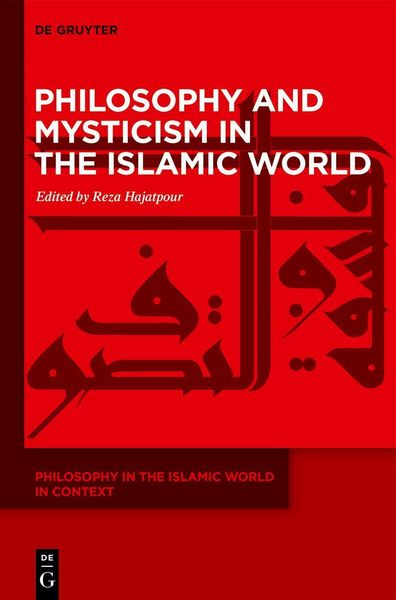
Philosophy and Mysticism in the Islamic World
-
- Einzelkauf Download ausgewählt
-
Sprache:Englisch
-
eBook Format:ePUB
- PDF 139,95 €
- ePUB 139,95 € ausgewählt
139,95 €
inkl. gesetzl. MwSt.Beschreibung
Produktdetails
Format
ePUB
Kopierschutz
Nein
Family Sharing
Nein
Text-to-Speech
Ja
Erscheinungsdatum
07.11.2025
Herausgeber
Reza HajatpourVerlag
De Gruyter OldenbourgSeitenzahl
237 (Printausgabe)
Dateigröße
1407 KB
Auflage
1. Auflage
Sprache
Englisch
EAN
9783112218303
In the quest for true knowledge, mysticism goes one step beyond philosophy. While philosophy and mysticism are considered two distinct disciplines with their own methodological approaches in the history of Islamic thought, their metaphysical concepts reveal significant points of intersection. Their convergence follows an inherent logic. In many Muslim circles, the methodological differences between the two are not regarded as an irreconcilable opposition.
Philosophy seeks knowledge through rational reflection, whereas mysticism deepens these insights by experiencing them in a transcendent state of consciousness. The French orientalist Henry Corbin (d. 1978) argued that Islamic philosophy found its true purpose only after Averroes (Ibn Rushd) and especially with the Isfahan School and ¿adr ad-Din Müammad Shirazi (known as Mulla ¿adra, d. 1640), within the tradition of "spiritual intellect" in Oriental wisdom. This school of thought is also referred to as "Oriental theosophy."
A central question in this context is whether this form of philosophizing, in Corbin's sense, should be understood as a departure from rationalist tradition and a return to a spiritual mode of thinking, or whether, as Pierre Hadot (d. 2010) put it, philosophy is not merely a particular way of viewing the world but rather a way of life. In this understanding, philosophizing does not simply mean speculating, analyzing, or theorizing but rather leading a consciously reflective life.
Whether Islamic philosophy adheres strictly to rational inquiry or transcends rationality to serve the mystical wisdom tradition ultimately depends on how philosophy is perceived within Islam and what role mysticism plays in this context.
This edited volume examines the complex relationship between these two domains of human thought and way of life through concrete examples from the history of Islamic intellectual traditions. It not only elucidates the ways in which philosophy and mysticism are interconnected but also delineates the precise boundaries of their connection. The contributions in this volume explore both dimensions from various perspectives, highlighting their mutual influence and the intricate relationship between philosophy and mysticism.
Noch keine Bewertungen vorhanden
Verfassen Sie die erste Bewertung zu diesem Artikel
Helfen Sie anderen Kundinnen und Kunden durch Ihre Meinung.
Kurze Frage zu unserer Seite
Vielen Dank für Ihr Feedback
Wir nutzen Ihr Feedback, um unsere Produktseiten zu verbessern. Bitte haben Sie Verständnis, dass wir Ihnen keine Rückmeldung geben können. Falls Sie Kontakt mit uns aufnehmen möchten, können Sie sich aber gerne an unseren Kund*innenservice wenden.
zum Kundenservice