Gutscheinbedingungen

**Gültig bis 15.06.2026 auf Spiele & Spielzeug online auf thalia.at, in der Thalia App ab einem Mindestbestellwert von 30€ und in allen Thalia Buchhandlungen in Österreich. In den Buchhandlungen nur gültig auf lagernde Ware. Einzelne Artikel können ausgeschlossen sein. Ausgenommen sind preisgebundene Artikel sowie online auf thalia.at und in der Thalia App einzelne Artikel von tonies®. Pro Einkauf einmal einlösbar. Nur gültig gegen Vorlage oder im Onlineshop hinterlegter Bonuscard. Infos zur Einlösung in der Buchhandlung sind auf der Bonuscard-Vorteilspreisseite zu finden. Click & Collect nur bei Onlinevorabzahlung möglich. Keine Einlösung bei Scan & Go-Bezahlung. Keine Barauszahlung. Nicht kombinierbar mit anderen Aktionen und Gutscheinen. Gutschein wird auf max. 500€ Bestellwert angerechnet. Nicht gültig für Geschenkkarten, Versandkosten und Services.

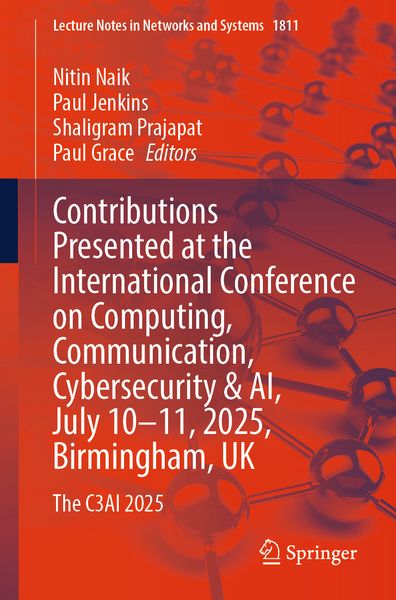
Produktbild: Contributions Presented at the International Conference on Computing, Communication, Cybersecurity & AI, July 10–11, 2025, Birmingham, UK
Band 1811 - 10%

Contributions Presented at the International Conference on Computing, Communication, Cybersecurity & AI, July 10–11, 2025, Birmingham, UK The C3AI 2025

10% sparen

196,99 € UVP 219,99 €

inkl. gesetzl. MwSt., Versandkostenfrei


Beschreibung

Produktdetails

Einband

Taschenbuch

Erscheinungsdatum

17.05.2026

Abbildungen

XIV, 314 illus., 281 illus. in color., schwarz-weiss Illustrationen, farbige Illustrationen

Herausgeber

Nitin Naik + weitere

Verlag

Springer

Seitenzahl

832

Maße (L/B/H)

23,5/15,5/4,3 cm

Gewicht

1413 g

Sprache

Englisch

ISBN

978-3-032-16790-3

Beschreibung

Produktdetails

Einband

Taschenbuch

Erscheinungsdatum

17.05.2026

Abbildungen

XIV, 314 illus., 281 illus. in color., schwarz-weiss Illustrationen, farbige Illustrationen

Herausgeber

Verlag

Springer

Seitenzahl

832

Maße (L/B/H)

23,5/15,5/4,3 cm

Gewicht

1413 g

Sprache

Englisch

ISBN

978-3-032-16790-3

Herstelleradresse

Springer-Verlag KG
Sachsenplatz 4-6
1201 Wien
AT

Email: ProductSafety@springernature.com

Kundinnen und Kunden meinen

0 Bewertungen

Informationen zu Bewertungen

Zur Abgabe einer Bewertung ist eine Anmeldung im Konto notwendig. Die Authentizität der Bewertungen wird von uns nicht überprüft. Wir behalten uns vor, Bewertungstexte, die unseren Richtlinien widersprechen, entsprechend zu kürzen oder zu löschen.

Die Bewertungen sind nach Format, Anzahl Sterne und Datum sortiert.

Verfassen Sie die erste Bewertung zu diesem Artikel

Helfen Sie anderen Kund*innen durch Ihre Meinung

Kundinnen und Kunden meinen

0 Bewertungen filtern

  • Produktbild: Contributions Presented at the International Conference on Computing, Communication, Cybersecurity & AI, July 10–11, 2025, Birmingham, UK
  • Part 1: Cybersecurity track 1.- When cybersecurity becomes cyberbiosecurity: Understanding cyberbiosecurity, its principles, components, importance, and challenges.- Hacking the organism through digital technology: Exploring cyberbiosecurity vulnerabilities, threats, risks and their mitigations.- Dynamic defense strategies for optical communication networks: Mitigating adversarial attacks through multi-scale diagnostics.- Ethical and security implications of generative AI in E-government: A study of data protection, model security and responsible AI.- When generative AI gets hacked: A comprehensive classification of cyberattacks on Large Language Models (LLMs) and their mitigation techniques.- Part 2: AI Track 1.- AI-based fundus screening for automated severity prediction of diabetic retinopathy.- ADR: Interpretability-guided adversarial perturbation removal for 3D point clouds via geometric completion.- An AI-enabled wearable system for tactical sign language recognition and secure data transmission.- X-Swin: A robust hierarchical vision transformer with explainable attention mechanisms for dementia severity classification from structural MRI.- Agentic AI for emergency response and comparative analysis of SmolAgents, LangGraph, AutoGen, Agno AGI and CrewAI for crisis solution.- An AI study investigating the relationship between air quality and COVID-19.- Performance evaluation of female students through SAW-based multi-criteria evaluation and unsupervised clustering.- A novel machine learning techniques for crime report classification to identify Indian penal code sections.- Comparative analysis of Federated Learning (FL), Reinforcement Learning (RL) and Evolution Strategy (ES) in gaming environments.- Part 3: Communication Track 1.- Malware detection - A comparative analysis of RISC-V and ARM architectures.- Secure and energy efficient inference optimisation for consumer GPUs in edge computing environments.- Investigation of security challenges and analysis of evaluation tools for IoT devices.- Lightweight end-to-end message-level encryption in Apache Kafka using ChaCha20 stream Cipher.- An approach towards open-source security solutions for information systems: Profiling attacker's behavior and communication patterns post-compromise.- Towards a real-time webcam feed narrator using multimodal language models and speech synthesis.- Part 4: Computing Track 1.- Gamified learning analytics: Predicting student success in blended education environments through machine learning classification models.- Maali: An intelligent gardening companion for plant care management.- How can ChatGPT help humans improve their capabilities: Understanding the key capabilities of ChatGPT.- The AI engine of creation: Exploring the capabilities of AI Chatbots based on generative AI, large language models and large multimodal models.- AI App behaviour monitor development for children with ALNS.- Justification of a set of parameters for software source code analysis.- Forecasting economic trends with generative AI: A Python framework for policy analysis.- Academic influencer for eLearning systems sponsorship and collaboration platform.- Community detection using enhanced non-weighted fuzzy C-means approach in online social network.- Part 5: Cybersecurity Track 2.- When generative AI prompts bite back: Investigating different types of prompt injection attacks on Large Language Models (LLMs) and their prevention methods.- Weaponising generative AI through data poisoning: Analysing various data poisoning attacks on Large Language Models (LLMs) and their countermeasures.- Literal Genie problem of generative AI: Understanding cyberattacks on generative AI models in the context of Large Language Models (LLMs) and their defence strategies.- Insecure output handling in Large Language Models (LLMs) and approaches to enhance output security, including prevention of LLM-based web application attacks.- Towards real-time anomaly detection and quarantine framework for cybersecurity systems.- A comprehensive threat modeling framework for SaaS-based E-commerce platforms.- A lightweight machine learning framework for DDoS attack detection in SDN.- Intelligent detection system with a machine learning extension to Suricata.- Threat landscape of adversarial attacks on generative AI and Large Language Models (LLMs): Exploring different types of adversarial attacks, associated risks, and mitigation strategies.- Uncovering advanced persistent threats via fuzzy logic-based DNS analysis.- Ransomware detection for securing hybrid learning environments in educational institutions.