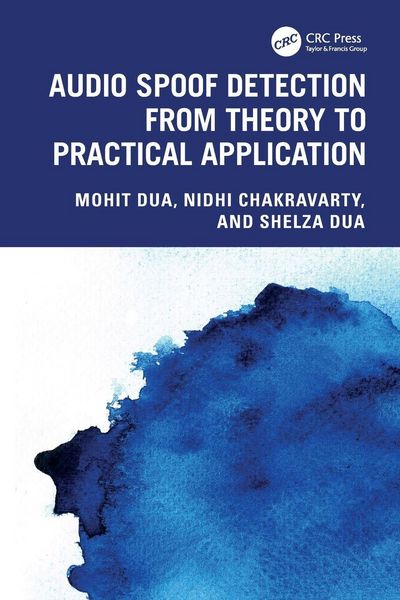
Audio Spoof Detection from Theory to Practical Application
-
- Hardcover
- Taschenbuch ausgewählt
- eBook
-
Sprache:Englisch
68,99 €
inkl. gesetzl. MwSt.,
Beschreibung
Produktdetails
Einband
Taschenbuch
Erscheinungsdatum
21.05.2026
Abbildungen
schwarz-weiss Illustrationen, Raster,schwarz-weiss, Zeichnungen, schwarz-weiss, Tabellen, schwarz-weiss
Verlag
Taylor and FrancisSeitenzahl
242
Maße (L/B/H)
15,4/23,5/1,8 cm
Gewicht
402 g
Sprache
Englisch
ISBN
978-1-03-291264-6
Audio Spoof Detection (ASD) systems play a pivotal role in evaluating whether the input speech signal has been manipulated by an imposter attempting unauthorized access to an authentic user's account or if it genuinely originates from the declared user. Primarily used for person authentication, these systems strive to verify the speaker's claimed identity. Despite substantial technological advancements, recent testing has revealed persistent vulnerabilities to spoofing, commonly referred to as a spoof attack. Various techniques such as mimicry, replay, text to speech (TTS), and voice conversion (VC) are frequently used in ASV systems to execute logical access (LA) or physical access (PA) spoofing attacks. To protect an ASD system from these attacks, many researchers have proposed effective security models as countermeasures. In addition, numerous review papers by different researchers have discussed various countermeasures developed to secure ASD systems. However, there is a notable absence of an authored book that comprehensively addresses this critical research topic, encompassing frontend, backend, dataset, and types of attacks considerations. Therefore, there is an urgent need for a book that can serve as a valuable resource for upcoming researchers, offering insights into securing ASD systems and bridging the existing gap in the literature. Hence, this book represents an effort by the authors in that direction.
Noch keine Bewertungen vorhanden
Verfassen Sie die erste Bewertung zu diesem Artikel
Helfen Sie anderen Kundinnen und Kunden durch Ihre Meinung.
Kurze Frage zu unserer Seite
Vielen Dank für Ihr Feedback
Wir nutzen Ihr Feedback, um unsere Produktseiten zu verbessern. Bitte haben Sie Verständnis, dass wir Ihnen keine Rückmeldung geben können. Falls Sie Kontakt mit uns aufnehmen möchten, können Sie sich aber gerne an unseren Kund*innenservice wenden.
zum Kundenservice