Gutscheinbedingungen

**Gültig bis 06.07.2026 auf fremdsprachige Bücher online auf thalia.at, in der Thalia App ab einem Mindestbestellwert von 30€ und in allen Thalia Buchhandlungen in Österreich. In den Buchhandlungen nur gültig auf lagernde Ware. Einzelne Artikel können ausgeschlossen sein. Ausgenommen sind preisgebundene Artikel & eBooks. Pro Einkauf einmal einlösbar. Nur gültig gegen Vorlage oder im Onlineshop hinterlegter Bonuscard. Infos zur Einlösung in der Buchhandlung sind auf der Bonuscard-Vorteilspreisseite zu finden. Click & Collect nur bei Onlinevorabzahlung möglich. Keine Einlösung bei Scan & Go-Bezahlung. Keine Barauszahlung. Nicht kombinierbar mit anderen Aktionen und Gutscheinen. Gutschein wird auf max. 500€ Bestellwert angerechnet. Nicht gültig für Versandkosten und Services.

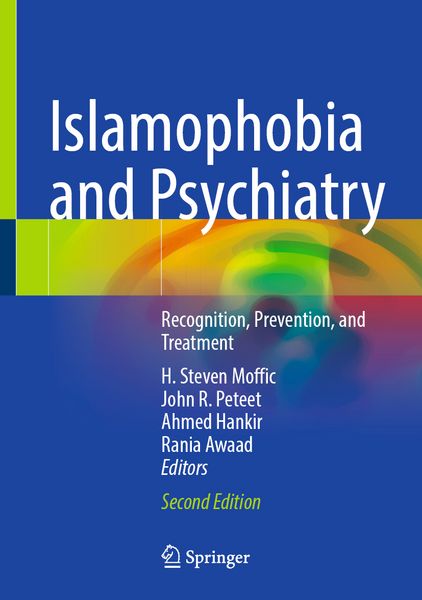
Produktbild: Islamophobia and Psychiatry
- 10%

Islamophobia and Psychiatry Recognition, Prevention, and Treatment

10% sparen

195,99 € UVP 219,99 €

inkl. gesetzl. MwSt., Versandkostenfrei


Beschreibung

Produktdetails

Einband

Gebundene Ausgabe

Erscheinungsdatum

03.04.2026

Abbildungen

XX, 38 illus., 27 illus. in color., schwarz-weiss Illustrationen, farbige Illustrationen

Herausgeber

H. Steven Moffic + weitere

Verlag

Springer

Seitenzahl

561

Maße (L/B/H)

26/18,3/3,5 cm

Gewicht

1411 g

Auflage

Second Edition 2026

Sprache

Englisch

ISBN

978-3-032-16482-7

Beschreibung

Portrait

H. Steven Moffic MD 

Pro Bono Private Community Psychiatrist 

Since academic retirement, he has been a prolific writer and speaker, currently including a weekday column titled “Psychiatric Views on the Daily News” since October 2021, and a weekly video on “Psychiatry and Society” since September 2020, both for Psychiatric Times. He has been the lead editor on a 4-volume series on religions and psychiatry for Springer. Other prior books include The Ethical Way: Challenges & Solutions for Managed Behavioral Healthcare (Jossey-Bass, 1997) and Combating Physician Burnout (APA, 2020). He is viewed as an expert in cultural psychiatry, social psychiatry, religion and psychiatry, psychiatric ethics, and collegial relationships. He has been an advocate and activist for mental health issues related to climate instability, physician burnout, and xenophobia, as well as successfully addressing sensitive and controversial psychiatric issues. For these contributions, Dr. Moffic was awarded the Abraham Halpern Humanitarian Award at the 2024 APA. 


John R. Peteet MD 

Associate Professor of Psychiatry 

Harvard Medical School 

After receiving his M.D. degree at Columbia University, he completed a medical internship at UNC in Chapel Hill, a residency in psychiatry at the Massachusetts Mental Health Center, and a fellowship at the Peter Bent Brigham Hospital, in Boston. For over 40 years he has been a psychiatrist at Brigham and Women’s Hospital and Dana-Farber Cancer Institute, where he is an Associate Professor of Psychiatry at Harvard Medical School. A Distinguished Life fellow of the APA, he has received several teaching awards and published numerous papers in the areas of psychosocial oncology, addiction, and the clinical interface between spirituality/religion and psychiatry. He has authored or co-edited 13 books, including Doing the Right Thing and Depression and The Soul. He is the recipient of the APA’s Oskar Pfister Award and is past chair of the APA’s Caucus on Religion, Spirituality and Psychiatry. 


Ahmed Hankir MD 

Honorary Visiting Professor 

Cardiff University School of Medicine 

Professor Ahmed Hankir MBChB MRCPsych is Honorary Visiting Professor at the School of Medicine, Cardiff University (UK), Assistant Professor at the Schulich School of Medicine and Dentistry at Western University (Canada) and Consultant General Adult Psychiatrist (Canada and UK). Professor Hankir’s research interests include global and Muslim mental health and pioneering and evaluating innovative interventions that reject mental health related stigma. Professor Hankir is the recipient of the 2022 WHO Director General Award for Global Health. 


Rania Awaad MD 

Clinical Professor 

Department of Psychiatry and Behavioral Sciences 

Stanford University School of Medicine 

Dr. Rania Awaad M.D., is a Clinical Professor of Psychiatry at the Stanford University School of Medicine where she is the Director of the Stanford Muslim Mental Health & Islamic Psychology Lab as well as Stanford University’s Affiliate Chaplain and Affiliate Professor of Islamic Studies. In the community, she serves as the President and Co-Founder of Maristan, a holistic mental health nonprofit serving Muslim communities, and the Director of The Rahman Foundation, a non-profit organization dedicated to educating Muslim women and girls. In addition, she is faculty of Islamic Psychology at Cambridge Muslim College and The Islamic Seminary of America. Prior to studying medicine, she pursued classical Islamic studies in Damascus, Syria, and holds certifications (ijaza) in the Qur’an, Islamic Law, and other branches of the Islamic Sciences.

Produktdetails

Einband

Gebundene Ausgabe

Erscheinungsdatum

03.04.2026

Abbildungen

XX, 38 illus., 27 illus. in color., schwarz-weiss Illustrationen, farbige Illustrationen

Herausgeber

Verlag

Springer

Seitenzahl

561

Maße (L/B/H)

26/18,3/3,5 cm

Gewicht

1411 g

Auflage

Second Edition 2026

Sprache

Englisch

ISBN

978-3-032-16482-7

Herstelleradresse

Springer Nature Customer Service Center GmbH
Europaplatz 3
69115 Heidelberg
DE
ProductSafety@springernature.com

Noch keine Bewertungen vorhanden

Verfassen Sie die erste Bewertung zu diesem Artikel

Helfen Sie anderen Kundinnen und Kunden durch Ihre Meinung.

Kundinnen und Kunden meinen

Bewertungen (0)

  • Produktbild: Islamophobia and Psychiatry
  • Editors’ Introduction to Second Edition.- Editors’ Introduction.- Part I. General Issues.- 1. Mental Health in the Islamic Golden Era: The Historical Roots of Modern Psychiatry.- 2. Islamophobia: An Introduction to the Academic Field, Methods, and Approaches.- 3. Islamic Perspectives on Psychological and Spiritual Well-Being and Treatment.- 4. Religiosity and Mental Health in Islam.- 5. The Social Psychology and Neurobiology of Intergroup Conflict.- 6. Art for a Better World.- 7. Symbols and Identity in Islamophobia.- 8. Cultural Literacy.- 9. Psychiatric Cultural Formulation in the Islamophobic Context.- 10. Clinical Assessment Tools for the Culturally Competent Treatment of Muslim Patients.- 11. History of Islamophobia in American Society.- Part II. Psychiatric Implications of Islamophobia.- 12. Transference and Countertransference in Addressing Islamophobia in Clinical Practice.- 13. Islamophobia: A Jungian Analytical Perspective.- 14. The Islamophobic Normative Unconscious: Psychoanalytic Considerations.- 15. Challenges of Islamophobia: Psychiatric Considerations for Effectively Working with Muslim Patients.- 16. Understanding Islamophobia and Its Effects on Clinicians.- 17. Islamophobia from An American Muslim Perspective.- 18. Muslim Psychiatrists in Training Address Islamophobia in Clinical Experiences.- 19. Islamophobia in the United Kingdom: A British Muslim Psychiatrist’s Perspective.- 20. Islamophobia: Social, Religious, and Clinical Considerations from a Jewish Psychiatrist.- 21. Islamophobia: A Christian Psychiatrist’s Perspective.- 22. Islamophobia: A Hindu Psychiatrist’s Perspective.- 23. What Does Islam Say About Burnout and Self-Care?.- 24. Islamophobia, Genocide, and Mental Health: A Palestinian Perspective on Collective Trauma.- Part III. Specific Clinical Challenges.- 25. Addressing the Mental Health Needs off African American Muslims in an Era of Islamophobia.- 26. Islamophobia and Ethical Challenges for LGBT Mental Healthcare.- 27. Islamophobia and the Mental Health of Rohingya Refugees.- 28. The Islamic Approach to Addressing Undue Anxiety.- 29. An Early Career Muslim Psychiatrist and Her Clinical Challenges.- 30. American Islamophobia: Psychological and Clinical Implications.- Part IV. Social Psychiatric Implications.- 31. Muslim Youth in the Face of Islamophobia: Risk and Resilience.- 32. Children, Adolescents, and Islamophobia.- 33. Caring for Muslim Refugees.- 34. A Case Study of the Political Determinants of Division: Muslim Perceptions of British Combat Troops.- 35. Community Resilience.- 36. Islamophobia and Public Mental Health: Lessons Learned from Community Engagement Projects.- 37. Psychological Determinants and Social Influences of Violent Extremism.- 38. Islamophobia in Canada.- 39. The Mental Health of Elders in the Context of Islamophobia.- 40. International Medical Graduates (IMGs) Muslim Women and Islamophobia.- 41. Interventions to Reduce Islamophobia Using the Contact Hypothesis.- 42. Faith Under Fire: The Intersection of Mental Health and Islamophobia in Muslim Student Communities.- 43. Non-Muslim Allies Fighting Islamophobia.- 44. Youth as a Global Arab Culture: Clinical Considerations.- Part V. Islamophobia and Judaism.- 45. Islam and Judaism in Medieval Society and the Life of Maimonides: Its Implications for Modern Islamophobia.- 46. Islamophobia and Antisemitism: Understanding the Roots and Exploring Solutions.- 47. Islamophobia in the Context of the Arab-Israel Conflict.- 48. Islamophobia and Antisemitism: An Interview with a Muslim and a Jewish Psychiatrist.- Part VI.  Perspectives on the Future of Islamophobia.- 49. From Hatred to Healing: A Healing-Centered Framework for the Wounds of Islamophobia.- 50. The FBI TV Series and its Counter-narrative about Islamophobia.- 51. Reciprocal Accommodations: A Social Psychiatric Perspective on Islamophobia in Quebec.- 52. The Future of Islamophobia. Editors’ Conclusions. Editors’ Conclusions to the Second Edition.