KI-Beratung Beta

Gutscheinbedingungen

**Gültig am 20.11.2026 ab einem Mindestbestellwert von 30€ auf Spielzeug, Schreibwaren, Filme, Geschenke & Trends, Musik, tolino eReader & Zubehör, Hörbücher und Hörbuch-Downloads, nicht preisgebundene Bücher und Kalender online auf thalia.at und in der Thalia App. Einzelne Artikel können ausgeschlossen sein. Aufgrund der Buchpreisbindung sind deutschsprachige Bücher und eBooks ausgenommen. Zusätzlich ausgenommen sind Abos & Flatrates, Games, Geschenkkarten/-boxen, Shelfies, Software, Zeitschriften sowie einzelne Artikel von tonies®. Pro Einkauf einmal einlösbar. Click & Collect nur bei Onlinevorabzahlung möglich. Keine Barauszahlung. Nicht kombinierbar mit anderen Aktionen und Gutscheinen. Gutschein wird auf max. 500€ Bestellwert angerechnet. Nicht gültig für Versandkosten und Services. Preisgebundene Artikel sind vom Mindestbestellwert ausgeschlossen.

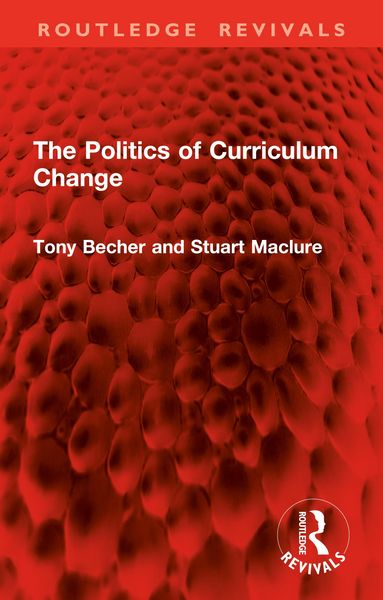
Produktbild: Politics of Curriculum Change

Politics of Curriculum Change

Aus der Reihe Routledge Revivals

44,99 €

inkl. gesetzl. MwSt., Versandkostenfrei


Beschreibung

Curriculum development occupied an increasingly important place on the educational scene in the mid 1960s, foreshadowing much of the national debate initiated by the Prime Minister of Britain in late 1976. The agencies for development take different forms in different countries, but the underlying issues...

Beschreibung

Curriculum development occupied an increasingly important place on the educational scene in the mid 1960s, foreshadowing much of the national debate initiated by the Prime Minister of Britain in late 1976. The agencies for development take different forms in different countries, but the underlying issues are remarkably similar across the globe. It is the basic framework common to all planned curriculum change which The Politics of Curriculum Change (originally published in 1978) is concerned to bring into sharper focus. A major consideration in embarking on or analysing any curriculum programme is the extent to which it reflects public concerns about education. The notion of the 'public curriculum' is a central strand in the authors' argument. It leads naturally into a discussion of mechanisms for control and development, and the political acceptability of new proposals to teachers, parents, pupils, and the public at large. But curriculum change has its internal, as well as its external politics. These are reflected in the contrasting styles of development, varied forms of evaluation, and in the conflicting response of the profession, both to change of the curriculum as a whole, and to a piecemeal subject-by-subject approach. The authors give these working aspects of curriculum development as careful attention as they afford to the larger issues of schooling in society. All in all, this book offers a view which has not hitherto been clearly articulated, but which is essential to understanding what curriculum development is all about. Its authors are in a good position to do this: one had a particularly close involvement with the external, and the other with the internal politics of development, and they previously worked together on an international study of curriculum.

Produktdetails

Einband

Taschenbuch

Erscheinungsdatum

19.01.2026

Verlag Taylor and Francis
Seitenzahl

194

Produktdetails

Einband

Taschenbuch

Erscheinungsdatum

19.01.2026

Verlag Taylor and Francis
Seitenzahl

194

Maße (L/B/H)

21,6/13,8/1,1 cm

Gewicht

248 g

Auflage

1. Auflage

Sprache

Englisch

ISBN

978-1-03-284641-5

Herstelleradresse


Email: info@bod.de

Noch keine Bewertungen vorhanden

Verfassen Sie die erste Bewertung zu diesem Artikel

Helfen Sie anderen Kundinnen und Kunden durch Ihre Meinung.

Kundinnen und Kunden meinen

Bewertungen (0)

Die Leseprobe wird geladen.
  • Produktbild: Politics of Curriculum Change
  • 1. The curriculum and its development 2. A European perspective 3. Patterns of control 4. Agents of change 5. Subject-based development 6. System-based development 7. Fragmentation and integration 8. Responsiveness to change 9. Evaluating curriculum innovation 10. The politics of acceptability 11. The dynamics of the public curriculum