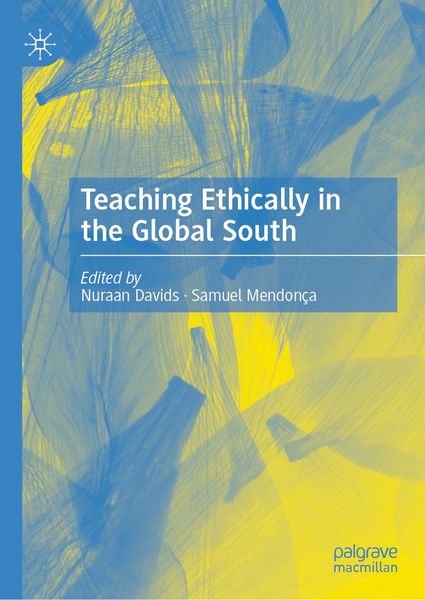
Produktbild: Teaching Ethically in the Global South
- 10% Neu

Teaching Ethically in the Global South

10% sparen

127,99 € UVP 142,99 €

inkl. gesetzl. MwSt., Versandkostenfrei


Beschreibung

Produktdetails

Einband

Gebundene Ausgabe

Erscheinungsdatum

18.07.2026

Abbildungen

XXX, 15 illus., 14 illus. in color., schwarz-weiss Illustrationen, farbige Illustrationen

Herausgeber

Nuraan Davids + weitere

Verlag

Springer

Seitenzahl

317

Maße (L/B)

21/14,8 cm

Sprache

Englisch

ISBN

978-3-032-15567-2

Beschreibung

Portrait

Nuraan Davids is Professor of Philosophy of Education at Stellenbosch University, South Africa. Her research interests include democratic citizenship, Islamic philosophy of education and philosophy in higher education. She is co-cditor of the World Issues in Philosophy and Theory of Higher Education book series.

Samuel Mendonça is Professor of Philosophy and Education at PUC-Campinas, Brazil. He is Visiting Scholar at Teachers College, Columbia University, USA. His research focuses on ethics, philosophy of education, sustainability, decoloniality and democratic education.

Produktdetails

Einband

Gebundene Ausgabe

Erscheinungsdatum

18.07.2026

Abbildungen

XXX, 15 illus., 14 illus. in color., schwarz-weiss Illustrationen, farbige Illustrationen

Herausgeber

Verlag

Springer

Seitenzahl

317

Maße (L/B)

21/14,8 cm

Sprache

Englisch

ISBN

978-3-032-15567-2

Herstelleradresse

Springer International Publishing AG
Gewerbestr. 11
6330 Cham
Schweiz
Url: www.springer.com

Noch keine Bewertungen vorhanden

Verfassen Sie die erste Bewertung zu diesem Artikel

Helfen Sie anderen Kundinnen und Kunden durch Ihre Meinung.

Kundinnen und Kunden meinen

Bewertungen (0)

  • Produktbild: Teaching Ethically in the Global South
  • Introduction: Teaching and ethics - contextual complexities and tensions (Nuraan Davids and Samuel Mendonça).- Part I: Conceptual Understandings of Ethics.- Chapter 1. An introduction to morality and ethics (Mauro Cardoso Simões and Rodolfo Bassani).- Chapter 2. Teaching Ubuntu: pedagogical considerations at a South African University (Precious Simba).- Chapter 3. Loób, Kapwa, and Educational Attunement: reimagining the role of the classroom teacher (Rowena Athena Azada-Palacios and Pamela Joy Capistrano).- Chapter 4.Childhood and ancestry: notes inspired by Ubuntu ethics (Ellen de Lima Souza and Walter Omar Kohan).-Part II: Teaching ethically.- Chapter 5.Ethical quandaries in education: an exposition of moral contests in post-colonial Africa (Agrippa Chingombe and Simon Vurayi).- Chapter 6. The ethical challenge of language in postcolonial educational systems: the case of middle-tier private schools in Pakistan (Saulat Pervez).- Chapter 7. Anticolonial teaching: an ethical approach from the Global South (Rubens Lacerda de Sá).- Chapter 8. Issues of ethics of care in practices in South-East Asian schools (Eisuke Saito).- Part III: Educational Policies and Ethical Practices.- Chapter 9. Historical silences, fissures and divergences: the social sciences curriculum in Brazil (Adélia Miglievich Ribeiro and Aristeu Portela Jr.).- Chapter 10. Developing a decolonial lens to assess ethics education in Pakistan’s National Curriculum (2022 Draft) (Rukhsana Zia and Mai Zaki).- Chapter 11. Ethics, Identity, and Policy in Chinese Early Childhood Education: Shaping Teachers in the New Era (Jingyi Wang, Kiri Gould and Marek Tesar).- Chapter 12. Poverty as a fundamental ethical element of Higher Education (Ana Elisa Spaolonzi de Queiroz Assis, Guilherme Perez Cabral, and Luis Renato Vedovato).- Concluding reflections: Reimagining ethical teaching: postcolonial and decolonial frames for another education (Samuel Mendonça and Nuraan Davids).