KI-Beratung Beta

Gutscheinbedingungen

**Gültig bis 18.11.2026 auf englischsprachige Klassiker (klassiker-32728) online auf thalia.at und in der Thalia App. Einzelne Artikel können ausgeschlossen sein. Ausgenommen sind preisgebundene Artikel & eBooks. Pro Einkauf einmal einlösbar. Click & Collect nur bei Onlinevorabzahlung möglich. Keine Barauszahlung. Nicht kombinierbar mit anderen Aktionen und Gutscheinen. Gutschein wird auf max. 500€ Bestellwert angerechnet. Nicht gültig für Geschenkkarten, Versandkosten und Services.

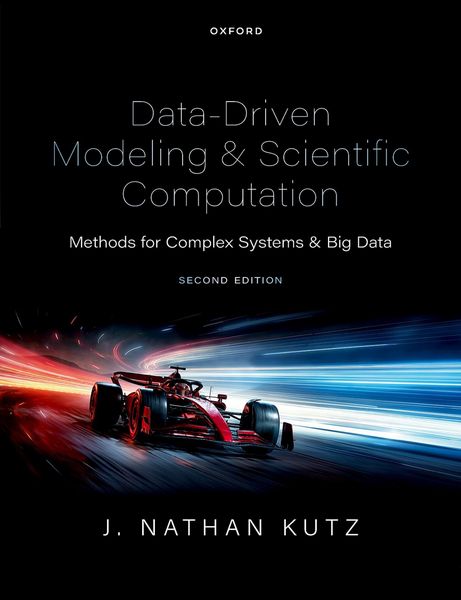
Produktbild: Data-Driven Modeling & Scientific Computation

Data-Driven Modeling & Scientific Computation Methods for Complex Systems & Big Data

228,99 €

inkl. gesetzl. MwSt., Versandkostenfrei


Beschreibung

Data-Driven Modeling & Scientific Computation: Methods for Complex Systems & Big Data is an accessible introductory-to-advanced textbook focusing on integrating scientific computing methods and algorithms with modern data analysis techniques, including basic applications of machine learning in the sciences...

Beschreibung

Data-Driven Modeling & Scientific Computation: Methods for Complex Systems & Big Data is an accessible introductory-to-advanced textbook focusing on integrating scientific computing methods and algorithms with modern data analysis techniques, including basic applications of machine learning in the sciences and engineering. Its overarching goal is to develop techniques that allow for the integration of the dynamics of complex systems and big data. This comprehensive textbook provides a survey of practical numerical solution techniques for ordinary and partial differential equations as well as algorithms for data manipulation, data-driven modelling, and machine learning. Emphasis is on the implementation of numerical schemes to practical problems in the engineering, biological, and physical sciences. The high-level programming language python is used throughout the book to implement and develop mathematical solution strategies. One specific aim of the book is to integrate standard scientific computing methods with the burgeoning field of data analysis, machine learning and Artificial Intelligence (AI). This area of research is expanding at an incredible pace in the sciences due to the proliferation of data collection in almost every field of science. The enormous data sets routinely encountered in the sciences now certainly give a big incentive to develop mathematical techniques and computational algorithms that help synthesize, interpret, and give meaning to the data in the context of its scientific setting. This brings together, in a self-consistent fashion, the key ideas from (i) statistics, (ii) time-frequency analysis and (iii) low-dimensional reductions in order to provide meaningful insight into the data sets one is faced with in any scientific field today, including those generated from complex dynamic systems. This is a tremendously exciting area and much of this part of the book is driven by intuitive examples of how the three areas (i)-(iii) can be used in combination to give critical insight into the fundamental workings of various problems.

Produktdetails

Einband

Gebundene Ausgabe

Erscheinungsdatum

21.08.2026

Abbildungen

240 b/w illustrations

Verlag Oxford Academic

Produktdetails

Einband

Gebundene Ausgabe

Erscheinungsdatum

21.08.2026

Abbildungen

240 b/w illustrations

Verlag Oxford Academic
Seitenzahl

608

Maße (L/B/H)

24,8/19,5/3,6 cm

Gewicht

1447 g

Auflage

2nd edition

Sprache

Englisch

ISBN

978-0-19-892909-3

Herstelleradresse

Libri GmbH
Europaallee 1
36244 Bad Hersfeld
DE

Email: gpsr@libri.de

Noch keine Bewertungen vorhanden

Verfassen Sie die erste Bewertung zu diesem Artikel

Helfen Sie anderen Kundinnen und Kunden durch Ihre Meinung.

Kundinnen und Kunden meinen

Bewertungen (0)

  • Produktbild: Data-Driven Modeling & Scientific Computation
    • Prolegomenon to modern computing
    • Part 1. Basic computations and visualization
    • 1: Python introduction
    • 2: Linear systems
    • 3: Numerical differentiation and integration
    • 4: Curve fitting
    • 5: Basic optimization
    • 6: Advanced curve fitting and machine learning
    • 7: Visualization
    • Part 2. Differential and partial differential equations
    • 8: Initial and boundary value problems of differential equations
    • 9: Finite difference methods
    • 10: Time and space stepping schemes: methods of lines
    • 11: Spectral methods
    • 12: Finite element methods
    • Part 3. Computational methods for data analysis
    • 13: Statistical methods and their applications
    • 14: Time-frequency analysis: Fourier transforms and wavelets
    • 15: Matrix decompositions
    • 16: Independent component analysis
    • 17: Unsupervised machine learning
    • 18: Supervised machine learning
    • 19: Reinforcement learning
    • 20: Spatio-temporal data and dynamics
    • 21: Data assimilation methods
    • Bibliography
    • Index