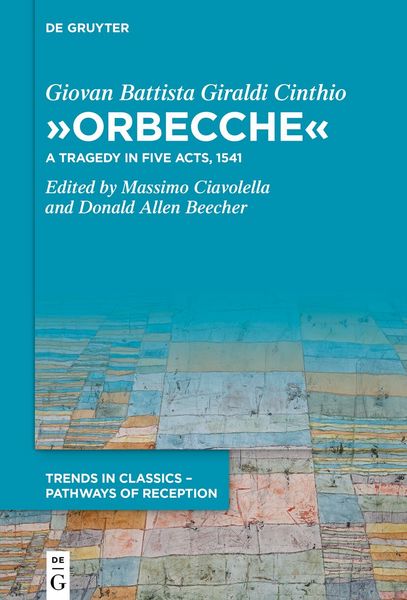
»Orbecche« A Tragedy in Five Acts, 1541
-
- Englisch, Italienisch ausgewählt
93,99 €
inkl. gesetzl. MwSt.,
Beschreibung
Produktdetails
Einband
Gebundene Ausgabe
Erscheinungsdatum
29.12.2025
Abbildungen
1 b/w ill.
Herausgeber
Donald Allen Beecher + weitereVerlag
De GruyterSeitenzahl
266
Maße (B/H)
15,5/23 cm
Gewicht
501 g
Auflage
1
Sprache
Englisch, Italienisch
ISBN
978-3-11-914276-2
Giraldi, in his trend-setting tragedy, Orbecche , first produced in 1541, sought to create a stage-worthy play while honouring the conventions of Seneca and well as the principles of Aristotle and Horace. Yet he found himself defending his choices in his Discorso through novel interpretations of these authorities to accommodate the needs of “modern” audiences. He modified the medieval inclination to concentrate solely upon the moralizing fall of tyrants through Fortuna's dark forces by introducing a victimized heroine seeking her own domestic tranquillity in a secret marriage, thereby drawing the wrath of a tyrant to express his rage upon his own daughter. Hence, the play becomes a domestic tragedy that exchanges political horrors for household violence. In the process, Giraldi considers his options concerning the character of his heroine and the ambiguity of her choices, while preferring a more intimate employment of the chorus, and a less ornamented rhetorical style. Even so, his play falls short of the increased action on stage promised in his Discorso , still relying on language in the place of visible action, the legacy of the Senecan style. Nevertheless, the play becomes a model for all such stage worthy revenge tragedy in the Renaissance, as well as a workshop for dispute among academicians. The Introduction exposes in brief these many historical impingements upon Giraldi from Seneca’s practices, Aristotle's descriptive “prescriptions,” and Horace’s sense of moral utility to the needs of the court audiences in Ferrara for which the play was written.
Meanwhile, as a theatrical experience, despite these tick-box conventions, Giraldi builds characters we come to care about, encourages suspense through their moral dilemmas and, in the end, reveals a generic contest between a chieftain father ready to barter his daughter in a marriage of political convenience, and a daughter determined to exercise her right to choose for love—a combat arguably embedded in the genes and as “archetypal” as any theme can be.
Noch keine Bewertungen vorhanden
Verfassen Sie die erste Bewertung zu diesem Artikel
Helfen Sie anderen Kundinnen und Kunden durch Ihre Meinung.
Kurze Frage zu unserer Seite
Vielen Dank für Ihr Feedback
Wir nutzen Ihr Feedback, um unsere Produktseiten zu verbessern. Bitte haben Sie Verständnis, dass wir Ihnen keine Rückmeldung geben können. Falls Sie Kontakt mit uns aufnehmen möchten, können Sie sich aber gerne an unseren Kund*innenservice wenden.
zum Kundenservice