Gutscheinbedingungen

**Gültig bis 14.09.2026 auf Spielzeug, Schreibwaren, Filme, Geschenke & Trends, Musik, tolino eReader & Zubehör, Hörbücher, nicht preisgebundene Bücher und Kalender in der Thalia App. Einzelne Artikel können ausgeschlossen sein. Aufgrund der Buchpreisbindung sind deutschsprachige Bücher und eBooks ausgenommen. Zusätzlich ausgenommen sind Abos & Flatrates, Games, Geschenkkarten/-boxen, Shelfies, Software, Zeitschriften sowie einzelne Artikel von tonies®. Pro Einkauf einmal einlösbar. Nur gültig mit im Onlineshop hinterlegter Bonuscard. Click & Collect nur bei Onlinevorabzahlung möglich. Keine Barauszahlung. Nicht kombinierbar mit anderen Aktionen und Gutscheinen. Gutschein wird auf max. 500€ Bestellwert angerechnet. Nicht gültig für Versandkosten und Services.

Produktbild: Meta-omics in Crop Improvement
- 10%

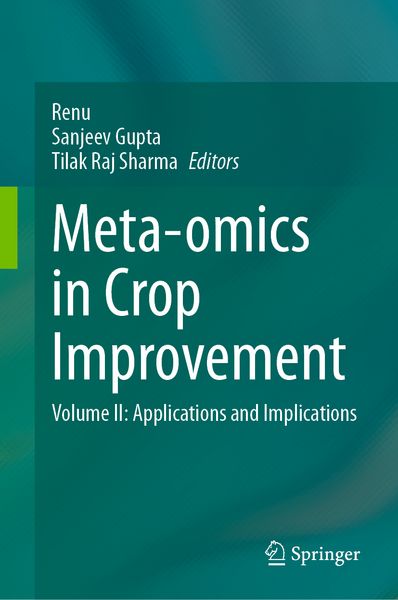
Meta-omics in Crop Improvement Volume II: Applications and Implications

10% sparen

176,99 € UVP 197,99 €

inkl. gesetzl. MwSt., Versandkostenfrei


Beschreibung

Produktdetails

Einband

Gebundene Ausgabe

Erscheinungsdatum

31.01.2026

Abbildungen

XXI, 312 p. 3 illus., 2 illus. in color.

Herausgeber

Renu + weitere

Verlag

Springer Singapore

Seitenzahl

312

Maße (L/B/H)

24,1/16/2,3 cm

Gewicht

729 g

Auflage

1. Auflage

Sprache

Englisch

ISBN

978-981-9558-86-5

Beschreibung

Portrait


Dr. Renu did her M.Sc. in biotechnology from Indian Veterinary Research Institute, Bareilly and PhD in life sciences from Chatrapati Sahuji Maharaj University, Kanpur, India. She was a post-doctoral fellow at Plant Molecular Biology Department, National Institute for Genetic Engineering and Biotechnology (ICGEB affiliated Institute), Tehran, Iran during 2003-2005. Currently she is working as a Principal Scientist, Commercial Crops, Crop Science Division at ICAR Headquarters, New Delhi. She has more than 27 years of research experience and has led numerous projects in frontier areas of microbial biotechnology including microbe-based bioremediation of heavy metal polluted areas; meta-omics; organic farming, etc., resulting in over 151publications including  research papers, articles, books, technical manuals, etc. She is recipient of several awards and is   Fellow of Society for Plant Research (FSPR)(since 2019) and Fellow of Society for applied Biotechnology ( since 2012). 


Dr. Sanjeev Gupta started his career as a scientist in Indian Council of Agricultural Research. Presently, he is the Assistant Director General (Oilseed & Pulses) at Indian Council of Agricultural Research, New Delhi. He has more than 32 years of research experience in grain legume genetics and breeding and developed 18  high yielding cultivars in grain legumes (Mungbean, blackgram and common bean). As a national coordinator on pulses, the efforts made by him led to increase mungbean and urdbean production in the country more than 2.5 times in short span of just past eight years and march towards self-sufficiency in pulses. He has authored nearly 178 research papers published in peer-reviewed internationally recognized journals. He has also edited six books on pulses. He is the Fellow of National Academy of Agricultural Sciences and recipient of several awards for his research and literary contribution.


Dr. Tilak Raj Sharma, a well-known Plant Molecular Biologist, is presently working as ICAR-National Professor-BP Pal Chair at NIPB, Pusa campus, New Delhi. He has been former Deputy Director General (Crop Science), ICAR, New Delhi and also acting DDG (Horticulture Science), Director &Vice Chancellor, ICAR-IARI, New Delhi, ICAR-IARI Assam, ICAR-IARI Jharkhand and Director, ICAR-NIBSM, Raipur. He obtained three post-doctorate trainings in plant molecular biology and genome analysis, one at University of Alberta, Edmonton, Canada and two from Cold Spring Harbor Laboratory, New York, USA. Dr. Sharma is the fellow of all four national academies viz, Indian National Science Academy, Indian Academy of Sciences, National Academy of Sciences and National Academy of Agricultural Sciences. His major research interests are in the areas of genomics and plant disease resistance. He was associated with the decoding of complete genomes of rice, tomato, pigeonpea, jute, mango, tea, guar, wheat, lathyrus and many plant pathogens. Dr. Sharma published more than 225 research papers in many peer reviewed journal including Nature, written two books and has obtained seven Indian patents.

Produktdetails

Einband

Gebundene Ausgabe

Erscheinungsdatum

31.01.2026

Abbildungen

XXI, 312 p. 3 illus., 2 illus. in color.

Herausgeber

Verlag

Springer Singapore

Seitenzahl

312

Maße (L/B/H)

24,1/16/2,3 cm

Gewicht

729 g

Auflage

1. Auflage

Sprache

Englisch

ISBN

978-981-9558-86-5

Herstelleradresse

Springer-Verlag KG
Sachsenplatz 4-6
1201 Wien
AT

Email: ProductSafety@springernature.com

Noch keine Bewertungen vorhanden

Verfassen Sie die erste Bewertung zu diesem Artikel

Helfen Sie anderen Kundinnen und Kunden durch Ihre Meinung.

Kundinnen und Kunden meinen

Bewertungen (0)

  • Produktbild: Meta-omics in Crop Improvement

  • .- Chapter 1: Meta-Omics insights for Crop Improvement     


    .- Chapter 2: Meta-omics Synergy: Advancements, opportunities and significance in wheat improvement     


    .- Chapter 3: Multi-omics and meta-omics approaches for rice improvement     


    .- Chapter 4: Multi and Meta-omics Approaches to Unlock the Complexity of Functional Traits in Legumes    


    .- Chapter 5: Omics-based exploration of potential soil microorganisms for sustaining the productivity of soybean: Prospects and Challenges         


    .- Chapter 6: Integration of omics data and translational genomics for improvement of jute and allied fibre crops towards a sustainable future      


    .- Chapter 7: Metaomics and its integration with Omics: Prospects in Horticulture industry    


    .- Chapter 8: Harnessing Meta-omics assisted approaches for abiotic stress tolerance in legumes crops         


    .- Chapter 9: Metatranscriptomics-Assisted Strategies for Inducing Stress Tolerance and Crop Improvement      


    .- Chapter 10:Metaomics and multiomics approaches to understand desiccation and high temperature tolerance in desert succulents to identify relevant genes and pathways     


    .- Chapter 11:Metagenomics of extreme environments for mining relevant genes and alleles for imparting climate resilience in crops


    .- Chapter 12:Impact of plant metabolomics in crop improvement    


    .- Chapter 13:Omics and Metaomics-Based Approaches for Enhancing Agricultural Applications of Microalgae and Cyanobacteria      


    .- Chapter 14:Machine Learning Integration in Metagenomics: Applications and Challenges.