KI-Beratung Beta

Gutscheinbedingungen

**Gültig am 20.11.2026 ab einem Mindestbestellwert von 30€ auf Spielzeug, Schreibwaren, Filme, Geschenke & Trends, Musik, tolino eReader & Zubehör, Hörbücher und Hörbuch-Downloads, nicht preisgebundene Bücher und Kalender online auf thalia.at und in der Thalia App. Einzelne Artikel können ausgeschlossen sein. Aufgrund der Buchpreisbindung sind deutschsprachige Bücher und eBooks ausgenommen. Zusätzlich ausgenommen sind Abos & Flatrates, Games, Geschenkkarten/-boxen, Shelfies, Software, Zeitschriften sowie einzelne Artikel von tonies®. Pro Einkauf einmal einlösbar. Click & Collect nur bei Onlinevorabzahlung möglich. Keine Barauszahlung. Nicht kombinierbar mit anderen Aktionen und Gutscheinen. Gutschein wird auf max. 500€ Bestellwert angerechnet. Nicht gültig für Versandkosten und Services. Preisgebundene Artikel sind vom Mindestbestellwert ausgeschlossen.

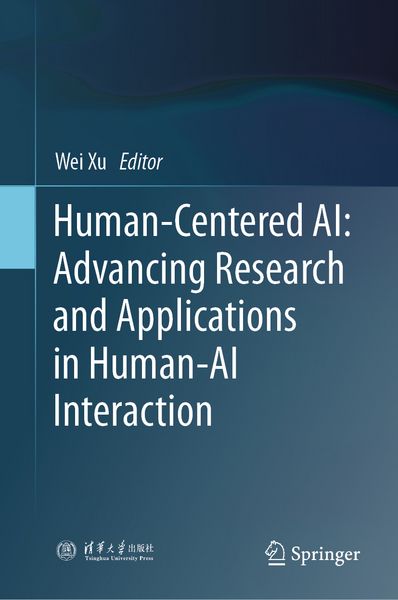
Produktbild: Human-Centered AI: Advancing Research and Applications in Human-AI Interaction
- 11%

Human-Centered AI: Advancing Research and Applications in Human-AI Interaction Advancing Research and Applications in Human-AI Interaction

11% sparen

273,99 € UVP 307,99 €

inkl. gesetzl. MwSt., Versandkostenfrei


Beschreibung

In the rapidly evolving era of artificial intelligence (AI), the ways humans interact with AI systems have undergone fundamental transformation, giving rise to a new interdisciplinary field— Human-AI Interaction . This represents a paradigm shift beyond the traditional field of Human-Computer Interaction,...

Beschreibung

In the rapidly evolving era of artificial intelligence (AI), the ways humans interact with AI systems have undergone fundamental transformation, giving rise to a new interdisciplinary field—
Human-AI Interaction
. This represents a paradigm shift beyond the traditional field of Human-Computer Interaction, demanding innovative approaches to address the unique challenges introduced by AI. This book,
Human-Centered AI: Advancing Research and Applications in Human-AI Interaction,
explores the latest theories, methods, and practices of Human-AI Interaction through the distinctive lens of
Human-Centered AI (HCAI)
. As both a design philosophy and a methodological framework, HCAI places humans at the core of AI development by emphasizing human needs, values, ethics, controllability, capabilities, and experiences. Its goal is to ensure that AI systems empower and augment humans rather than replace or harm them. Positioning Human-AI Interaction within the broader HCAI paradigm, this book advances research and applications in human-AI interaction aimed at realizing HCAI’s goals.


Across 27 chapters covering foundational concepts, technologies, research methods, design methods and standards, modeling, and real-world practice in Human-AI Interaction, this book demonstrates how AI can be seamlessly integrated with human needs to create intelligent, ethical, controllable, and user-friendly systems. Through detailed analysis and empirical studies, we aim to equip readers with theoretical frameworks and practical methodologies to create more human-centered AI solutions in an increasingly complex AI landscape. Whether you are a scholar, designer, or industry practitioner, this book will inspire you and enrich your knowledge, empowering you to advance the development of AI while better serving humanity.

Portrait


Dr. Wei Xu is Chief Scientist at HCAI Labs in California, USA, and an Adjunct Professor. He previously worked as a Senior Research Scientist and served as Principal Engineer in Human Factors and Human-Computer Interaction (HCI) at Intel (USA), where he also chaired the IT HCI Technical Committee, and as a Senior Research Scientist at Boeing (USA). He was a faculty member of the Department of Psychology at Zhejiang University in China. Dr. Xu holds a Ph.D. in Human Factors/HCI and an M.S. in Computer Science, both from Miami University, USA., an M.S. in Engineering Psychology from Zhejiang University, and a B.Eng. in Engineering Physics from China university of Geosciences.


An internationally recognized expert in human factors and HCI, Dr. Xu is an elected Fellow of the International Ergonomics Association (IEA), the Human Factors and Ergonomics Society (HFES, USA), and the International Association for Psychological Science (APS). He serves as Senior Editor of 
IEEE Transactions on Technology and Society
and Associate Editor of 
IEEE Transactions on Human-Machine Systems
. He also sits on the editorial boards of the 
International Journal of Human-Computer Interaction,
 
Theoretical Issues in Ergonomics Science,
and
the Journal of Applied Psychology
. He is a member of the International Organization for Standardization (ISO) Technical Committee on Human-System Interaction (TC159/SC4) and its Standards Drafting Working Group (TC159/SC4/WG6).


With over 35 years of experience spanning academia and leading global IT and aviation companies, Dr. Xu has contributed extensively to research, design, development, and standards development in human factors and HCI. His work has received numerous research and design awards, with applications across multiple aircraft models and computing systems. He has co-developed over 20 human factors/HCI design standards for ISO, Boeing, and Intel, and authored three books—
Engineering Psychology
, 
User Experience: Theory and Practice
, 
Human-AI Interaction,
and a forthcoming book, 
Handbook of Human-Centered AI
. His papers have been published in core journals of human factors/ergonomics, HCI, psychology, aviation, computer science, and AI.


Since 2018, Dr. Xu has focused on the emerging field of 
Human-Centered Artificial Intelligence (HCAI).
 
As one of its pioneers, he proposed the “technology-human factors–ethics (THE) triangle” HCAI framework (2019) and advanced the emerging domain of “human-AI interaction” (2020). He co-authored the influential paper titled “
Six Human-Centered AI Grand Challenges”
 (2022) with Professors Ben Shneiderman, Gavriel Salvendy, and 23 other international scholars. In recent years, he has introduced multiple frameworks in the HCAI field, including Human-AI Joint Cognitive Systems (2021), Human-AI Joint Cognitive Ecosystems (2022), Intelligent Sociotechnical Systems (iSTS) (2022), the HCAI Methodological Framework (HCAI-MF) (2024), the Hierarchical HCAI  (hHCAI) approach (2024), the “User Experience 3.0” paradigm framework for HCAI (2024), Human-Centered Human-AI Collaboration (HC-HAC) (2024), and the HCAI Maturity Model (HCAI-MM) (2025). He participated in the development of two ISO standards for AI systems: 
Ergonomics Issues of Robotic, Intelligent, and Autonomous Systems
 (ISO 9241-810) (2020) and 
Ergonomics of Human-Intelligent Systems Interaction
(ISO 9241-812) (2024).

Produktdetails

Einband

Set mit diversen Artikeln

Erscheinungsdatum

22.05.2026

Abbildungen

XVIII, 1033 p. 229 illus., 181 illus. in color. In 2 volumes, not available separately.

Herausgeber Wei Xu

Produktdetails

Einband

Set mit diversen Artikeln

Erscheinungsdatum

22.05.2026

Abbildungen

XVIII, 1033 p. 229 illus., 181 illus. in color. In 2 volumes, not available separately.

Herausgeber Wei Xu
Verlag Springer Singapore
Seitenzahl

1033

Maße (L/B/H)

24,1/16/6,9 cm

Gewicht

1823 g

Auflage

1. Auflage

Sprache

Englisch

ISBN

978-981-9555-84-0

Herstelleradresse

Springer-Verlag GmbH
Europaplatz 3
69115 Heidelberg
DE

Email: ProductSafety@springernature.com

Noch keine Bewertungen vorhanden

Verfassen Sie die erste Bewertung zu diesem Artikel

Helfen Sie anderen Kundinnen und Kunden durch Ihre Meinung.

Kundinnen und Kunden meinen

Bewertungen (0)

  • Produktbild: Human-Centered AI: Advancing Research and Applications in Human-AI Interaction

  • Part I. Introduction
    .- Chapter 1. Human-Centered Human-AI Interaction (HC-HAII): A Human-Centered AI Perspective.-
    Part II. Conceptual Foundations
    .- Chapter 2. Computational Modeling of Human Cognition and Behavior.- Chapter 3. Human State Recognition in Human-AI Interaction.- Chapter 4. Data and Knowledge Dual-driven AI.- Chapter 5. AI-based Human Intelligence Enhancement.- Chapter 6. Human Factors in Human-AI Interaction.- Chapter 7. Meaningful Human Control in AI.-
    Part III. Human-AI Interaction Technology and Research
    .- Chapter 8. Brain-Computer Interface and Brain-Computer Fusion.- Chapter 9. Human-Centered Human-AI Collaboration (HCHAC).- Chapter 10. Multimodal Interaction with Wearable Computing Devices.- Chapter 11. Human-AI Interaction in the Metaverse and Virtual Reality.- Chapter 12. Human-AI Interaction in Assistive Technology.-
    Part IV. Human-AI Interaction in Computing
    .- Chapter 13. Human-centered Explainable AI.- Chapter 14. Human-centered Perceptual Computing.- Chapter 15. Designing Nudges and Trust: Toward Ethical and Human-Centered AI.- Chapter 16. Recommender Systems: A Human-centered AI Perspective.- Chapter 17. Social Computing: A Human-centered AI Perspective.-
    Part V. Human-AI Interaction Design
    .- Chapter 18. Human AI Interaction Design Standards.- Chapter 19. Interaction Models and Design Paradigms of Human-AI Interaction.- Chapter 20. Machine Behavior Design and Management.- Chapter 21. Human-centered Approach for AI-based Rehabilitation Technology and Accessibility Design.-
    Part VI. Human-AI Interaction in Practice
    .- Chapter 22. Human-centered Collaborative Automated Driving.- Chapter 23. Patient-centered Intelligent Healthcare.- Chapter 24. Child-centered AI-assisted Autism Diagnosis and Treatment.- Chapter 25. Human-centered Design of Educational Metaverses with Virtual-Real Fusion.- Chapter 26. Pilot-centered Intelligent Civil Aircraft Cockpit.- Chapter 27. Human-centered Intelligent Manufacturing.