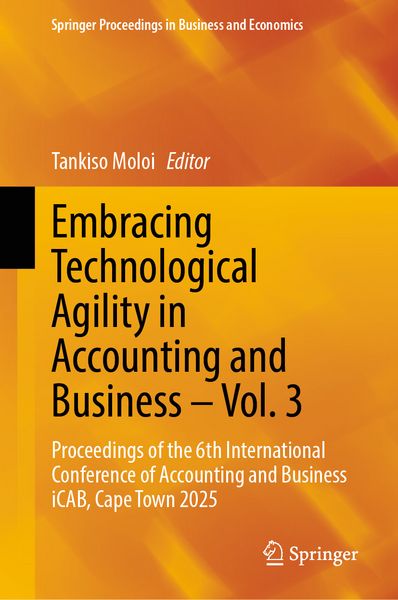
Produktbild: Embracing Technological Agility in Accounting and Business – Vol. 3
- 12%

Embracing Technological Agility in Accounting and Business – Vol. 3 Proceedings of the 6th International Conference of Accounting and Business iCAB, Cape Town 2025

12% sparen

221,99 € UVP 252,99 €

inkl. gesetzl. MwSt., Versandkostenfrei


Beschreibung

Produktdetails

Einband

Gebundene Ausgabe

Erscheinungsdatum

07.04.2026

Abbildungen

XVII, 52 illus., 47 illus. in color., farbige Illustrationen, schwarz-weiss Illustrationen

Herausgeber

Tankiso Moloi

Verlag

Springer

Seitenzahl

448

Maße (L/B/H)

24,1/16/3,1 cm

Gewicht

861 g

Sprache

Englisch

ISBN

978-3-032-13387-8

Beschreibung

Portrait

Prof. Tankiso Moloi is the Executive Dean, College of Business and Economics, University of Johannesburg, South Africa. He has written numerous articles and book chapters in finance and accounting, including research on artificial intelligence in accounting, economics, and finance.

Produktdetails

Einband

Gebundene Ausgabe

Erscheinungsdatum

07.04.2026

Abbildungen

XVII, 52 illus., 47 illus. in color., farbige Illustrationen, schwarz-weiss Illustrationen

Herausgeber

Tankiso Moloi

Verlag

Springer

Seitenzahl

448

Maße (L/B/H)

24,1/16/3,1 cm

Gewicht

861 g

Sprache

Englisch

ISBN

978-3-032-13387-8

Herstelleradresse

Springer-Verlag KG
Sachsenplatz 4-6
1201 Wien
AT

Email: GPSR Kontakt

Kundinnen und Kunden meinen

0 Bewertungen

Informationen zu Bewertungen

Zur Abgabe einer Bewertung ist eine Anmeldung im Konto notwendig. Die Authentizität der Bewertungen wird von uns nicht überprüft. Wir behalten uns vor, Bewertungstexte, die unseren Richtlinien widersprechen, entsprechend zu kürzen oder zu löschen.

Die Bewertungen sind nach Format, Anzahl Sterne und Datum sortiert.

Verfassen Sie die erste Bewertung zu diesem Artikel

Helfen Sie anderen Kund*innen durch Ihre Meinung

Kundinnen und Kunden meinen

0 Bewertungen filtern

  • Produktbild: Embracing Technological Agility in Accounting and Business – Vol. 3
  • Chapter 1. Corporate Decarbonisation and Financial Performance: Evidence From South Africa.- Chapter 2. Financial Support for Renewable Energy in Rural Communities in South Africa.- Chapter 3. Sustainability Performance Measurement Framework for Public Entities in Ghana: A Delphi Approach.- Chapter 4. Predicting the South African Stock Market Using the Hybrid of LSTM-Arfima Model.- Chapter 5. Accounting Students’ Ethical Behaviour in Creating an Awareness of Students’ Individual and Group Potential Business Values.- Chapter 6. From Numbers to Insights: A Systematic Review of Innovative 4IR Approaches to Teaching Accounting for Non-Finance Students.- Chapter 7. Artificial Intelligence Systems to Instill Digital Acumen and Enhance Employability in Accounting Students: A Selection Model.- Chapter 8. Regulatory Gaps and Reforms in South Africa’s Oversight - Political Financing, Terrorist Funding and Cybercrime.- Chapter 9. An Examination of the Contingent Factors Driving Climate-Related Disclosures in Listed Firms in Nigeria.- Chapter 10. Sustainable Reporting in the Fourth Industrial Revolution (4IR).- Chapter 11. Towards a Just Climate Adaptation Framework in Aotearoa New Zealand: Ensuring Transparency and Fair Fund Allocation.- Chapter 12. Cybersecurity Education for Accounting Students: Perspectives From Professional Bodies.- Chapter 13. Harnessing Big Data Analytics for Sustainable Innovation in Green Guesthouses.- Chapter 14. Evolution of Teaching and Learning in South African Higher Education.- Chapter 15. Integrating the Triple Bottom Line in Sustainable Development: Assessment of Carbon Pollution and Climate Change Disclosure.- Chapter 16. Bridging Theory and Practice: South African Revenue Service Electronic Filing System for Graduate Readiness.- Chapter 17. Artificial Intelligence in Sustainability Reporting: A Conceptual Framework for Enhanced Transparency and Accountability.- Chapter 18. Embracing Technological Innovation in Business Education: Faculty Perspectives on Experiential Learning for Sustainability.- Chapter 19. Blended Learning and Academic Engagement: The Case of Accounting Students at a South African University.- Chapter 20. Exploring the Nexus Among Al-Generated Advertising Bias, Deepfake Technology, and Consumer Trust: The Moderating Role of Technological Literacy.- Chapter 21. Predictive Service Allocation for Informal Automotive Mechanics Using Machine Learning: A Case Study From the Big Five Startup.- Chapter 22. Navigating the Digital Shift: Challenges Faced by Financial Accounting III Students in Online Curriculum Delivery.- Chapter 23. Exploring Eco-Innovations in Nigeria: A Pathway to Sustainable Development.- Chapter 24. The Role of Digital Transformation in Bridging the Gender Pay Gap: A Bibliometric Review of Global Trends.- Chapter 25. The Role of Innovation in Achieving the United Nations’ Sustainable Development Goals (SDGS) in Africa: A Systematic Review.- Chapter 26. An Empirical Investigation Between Financial Literacy, Financial Technology and Financial Behaviour of High School Teachers in an Emerging Economy.- Chapter 27. Developing Pervasive Skills in a Postgraduate Accountancy Programme Outside the Box.- Chapter 28. Adapting to the Future: Integrating Disruptive Technologies Into Accounting and Financial Management at a Business School.- Chapter 29. From Compliance to Strategy: Drivers, Barriers, Practices and Outcomes Influencing ESG Risk Integration in Sub-Saharan Africa.