KI-Beratung Beta

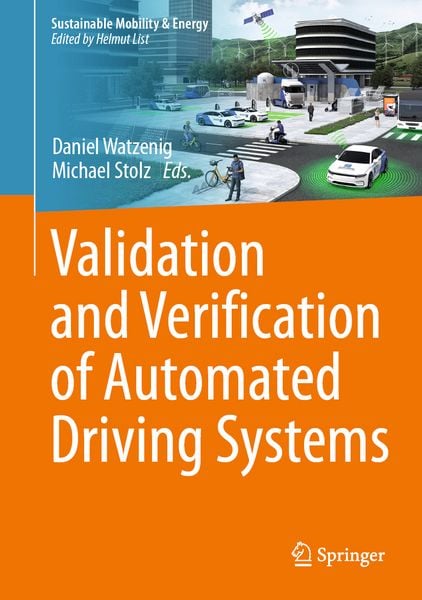
Produktbild: Validation and Verification of Automated Driving Systems
- 11%

Validation and Verification of Automated Driving Systems

11% sparen

136,99 € UVP 153,99 €

inkl. gesetzl. MwSt., Versandkostenfrei


Beschreibung

Produktdetails

Einband

Gebundene Ausgabe

Erscheinungsdatum

30.04.2026

Abbildungen

XV, 241 p. 154 illus., 142 illus. in color.

Herausgeber

Daniel Watzenig + weitere

Verlag

Springer

Seitenzahl

241

Maße (L/B/H)

24,6/17,3/1,9 cm

Gewicht

668 g

Sprache

Englisch

ISBN

978-3-032-13268-0

Beschreibung

Portrait


Michael Stolz
received the M.Sc. degree in mechanical engineering (2002) and the PhD. degree in electrical engineering (2013) from Graz University of Technology, Graz, Austria. He was in the automotive industry as a development engineer for ten years (one year as the skill team leader in the field of automated driving).He was a part of the Automated Driving Research Team with the Institute of Automation and Control, Graz University of Technology, as a postdoctoral project assistant and is now with the Institute of Computer Graphics and Vision at Graz University of Technology. He is also within Virtual Vehicle Research GmbH as a key researcher responsible for project planning and technical guidance of funded projects in the field of automated driving and artificial intelligence. His main research interests include automated driving, automotive control systems, embedded control, control-system architecture, algorithms for path planning and control, simulation, synchronization, optimization in control, and validation of automated driving.


Daniel Watzenig
was born in Austria and holds a doctorate in electrical engineering. He received the venia docendi (habilitation) in electrical measurement science and signal processing from Graz University of Technology, Austria. He currently serves as Chief Technology Officer (CTO) and Head of the Electronics Systems and Software Department at Virtual Vehicle Research, Graz. In addition, he was appointed Full Professor of Multi-Sensor Perception of Autonomous Systems at the Institute of Visual Computing, Faculty of Computer Science and Biomedical Engineering, Graz University of Technology. His research interests include sensing and control of autonomous vehicles, sensor fusion, reinforcement learning, and decision-making under uncertainty. Professor Watzenig is the author or co-author of more than 200 peer-reviewed publications, book chapters, patents, and articles. He is the Editor-in-Chief of the SAE International Journal on Connected and Automated Vehicles (SAE JCAV). He has been a guest lecturer at Stanford University, USA, since 2019, teaching multi-sensor perception for autonomous systems. In 2023, he also began teaching robotics classes as a guest lecturer at Tongji University in Shanghai, China. He is the founder of the Autonomous Racing Graz Team and, since 2024, has served as Vice Chair and Executive Committee Member of the IEEE Austria Section. He is also an IEEE Distinguished Lecturer in the field of autonomous vehicles, a Board Member of the INSIDE Industry Association (European Initiative on Intelligent Digital Systems), and a Member of the Academic Advisory Council of PAVE (Partners for Automated Vehicle Education). Since 2019, he has acted as a consultant and appointed expert in military robotics for the Defense Technology Agency of the Austrian Armed Forces.

Produktdetails

Einband

Gebundene Ausgabe

Erscheinungsdatum

30.04.2026

Abbildungen

XV, 241 p. 154 illus., 142 illus. in color.

Herausgeber

Verlag

Springer

Seitenzahl

241

Maße (L/B/H)

24,6/17,3/1,9 cm

Gewicht

668 g

Sprache

Englisch

ISBN

978-3-032-13268-0

Herstelleradresse

Springer-Verlag KG
Sachsenplatz 4-6
1201 Wien
AT

Email: ProductSafety@springernature.com

Noch keine Bewertungen vorhanden

Verfassen Sie die erste Bewertung zu diesem Artikel

Helfen Sie anderen Kundinnen und Kunden durch Ihre Meinung.

Kundinnen und Kunden meinen

Bewertungen (0)

  • Produktbild: Validation and Verification of Automated Driving Systems

  • Challenges and Approaches in the Validation of CCAM.- Standards: The language enabling cooperation in CCAM V&V.- Validation of Perception Sensor Models - Challenges and Solutions.- Novel Classification Scheme for Perception Sensors Incorporated into Simulation Validation Process for AD.- Safety assurance of AI-enabled sensing and perception subsystem used in autonomous vehicles.- Scenario-Based Safety Assessment of Automated Driving Systems.- Credible Safety Validation Toolchain for Automated Driving Functions.