Gutscheinbedingungen

**Gültig bis 25.06.2026 auf fremdsprachige Bücher online auf thalia.at und in der Thalia App. Einzelne Artikel können ausgeschlossen sein. Ausgenommen sind preisgebundene Artikel & eBooks. Pro Einkauf einmal einlösbar. Click & Collect nur bei Onlinevorabzahlung möglich. Keine Barauszahlung. Nicht kombinierbar mit anderen Aktionen und Gutscheinen. Gutschein wird auf max. 500€ Bestellwert angerechnet. Nicht gültig für Geschenkkarten, Versandkosten und Services.

Produktbild: Multifunctional Marine Polysaccharides
- 10%

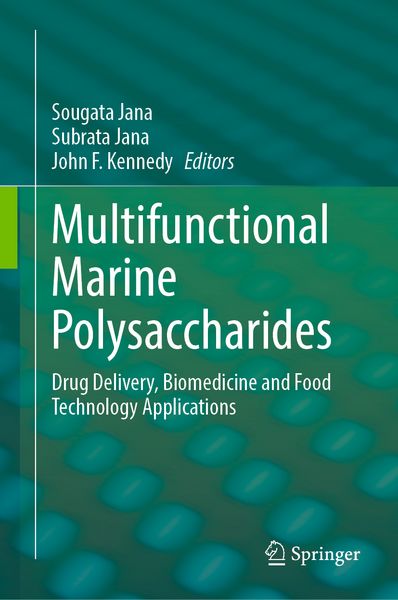
Multifunctional Marine Polysaccharides Drug Delivery, Biomedicine and Food Technology Applications

10% sparen

176,99 € UVP 197,99 €

inkl. gesetzl. MwSt., Versandkostenfrei


Beschreibung

Produktdetails

Einband

Gebundene Ausgabe

Erscheinungsdatum

03.01.2026

Abbildungen

XVI, 49 illus., 46 illus. in color., farbige Illustrationen, schwarz-weiss Illustrationen

Herausgeber

Sougata Jana + weitere

Verlag

Springer Singapore

Seitenzahl

583

Maße (L/B/H)

24,1/16/3,8 cm

Gewicht

1055 g

Auflage

1. Auflage

Sprache

Englisch

ISBN

978-981-9541-25-6

Beschreibung

Portrait

Dr. Sougata Jana is a B.Pharm (Gold Medalist) from West Bengal University of Technology (WBUT), an M.Pharm (Pharmaceutics) from Biju Patnaik University of Technology (BPUT), and holds a Ph.D. from Maulana Abul Kalam Azad University of Technology (MAKAUT), West Bengal (formerly WBUT), India. He received the M.N. Dev Memorial Award in 2005 from the IPA Bengal Branch for securing the highest marks in the state. He has over 17 years of experience in pharmacy, including teaching, research, and health services.

He has received several accolades, including the Best Poster Presentation Award at the 21st West Bengal State Science and Technology Congress (2014) and the Outstanding Paper Award at the 1st Regional Science and Technology Congress (2016), Bardhaman Division. Dr. Jana is a life member of the Association of Pharmaceutical Teachers of India (APTI) and an Associate of the Institution of Chemists (AIC), India. He has successfully guided 17 postgraduate students and focuses his research on drug delivery systems, including the modification of synthetic and natural biopolymers, microparticles, nanoparticles, semisolids, and interpenetrating network (IPN) systems for controlled drug delivery.

Dr. Subrata Jana is a Professor in the Department of Chemistry at Indira Gandhi National Tribal University (Central University), Amarkantak, Madhya Pradesh, India. His research focuses on the design and synthesis of artificial receptors for the recognition of anions, cations, and N-methylated protein residues. He also collaborates with pharmaceutical scientists on biodegradable polymer-based drug delivery systems.Dr. Jana earned his Ph.D. in Organic Chemistry from the Indian Institute of Engineering Science and Technology (IIEST), Shibpur, and completed postdoctoral research with Prof. Fraser Hof at the University of Victoria, Canada, and Dr. Kenneth J. Woycechowsky at the University of Utah, USA. His research centers on supramolecular host–guest chemistry and molecular sensing.

Prof. John F. Kennedy is Director of Chembiotech Research, Advanced Science and Technology Institute, Worcestershire, UK. A bio-organic chemist, biochemist, and biotechnologist, his work spans carbohydrate and protein chemistry, biotechnology, and materials science. He has held numerous academic and professional roles, including Director of the Birmingham Carbohydrate and Protein Technology Group, Professor of Applied Chemistry at Glyndŵr University, and Deputy Chairman and Treasurer of Cellucon Conferences and The Cellucon Trust.

Prof. Kennedy is a Fellow of several professional bodies, including the Royal Society of Chemistry, the Institute of Biology, and the Institute of Food Science and Technology. He has served as Consultant Biochemist to the UK Department of Health and Social Security, Director of Biochemistry at Lea Castle Hospital, and expert witness to the legal profession. His editorial roles include Editor-in-Chief of Carbohydrate Polymers (1988–2011), International Journal of Biological Macromolecules (1998–2025), and Carbohydrate Polymer Technologies and Applications (2011–2014), among others.

Produktdetails

Einband

Gebundene Ausgabe

Erscheinungsdatum

03.01.2026

Abbildungen

XVI, 49 illus., 46 illus. in color., farbige Illustrationen, schwarz-weiss Illustrationen

Herausgeber

Verlag

Springer Singapore

Seitenzahl

583

Maße (L/B/H)

24,1/16/3,8 cm

Gewicht

1055 g

Auflage

1. Auflage

Sprache

Englisch

ISBN

978-981-9541-25-6

Herstelleradresse

Springer-Verlag GmbH
Tiergartenstr. 17
69121 Heidelberg
DE

Email: ProductSafety@springernature.com

Kundinnen und Kunden meinen

0 Bewertungen

Informationen zu Bewertungen

Zur Abgabe einer Bewertung ist eine Anmeldung im Konto notwendig. Die Authentizität der Bewertungen wird von uns nicht überprüft. Wir behalten uns vor, Bewertungstexte, die unseren Richtlinien widersprechen, entsprechend zu kürzen oder zu löschen.

Die Bewertungen sind nach Format, Anzahl Sterne und Datum sortiert.

Verfassen Sie die erste Bewertung zu diesem Artikel

Helfen Sie anderen Kund*innen durch Ihre Meinung

Kundinnen und Kunden meinen

0 Bewertungen filtern

  • Produktbild: Multifunctional Marine Polysaccharides
  • Chapter 1. Introduction of Marine Polysaccharides: Preparation, characterization, Evaluation and applications.- Chapter 2. Plant-derived marine polysaccharides in oral drug delivery.- Chapter 3. Marine based polysaccharide in injectable drug delivery.- Chapter 4. Marine Seaweed polysaccharide in antiviral activities.- Chapter 5. Marine animal polysaccharide in targeted drug delivery.- Chapter 6. Marine based polysaccharides in nose to brain drug delivery.- Chapter 7. Marine algae polysaccharides in anticancer drug delivery.- Chapter 8. Marine algal polysaccharides in management of Liver disease.- Chapter 9. Marine polysaccharidic matrix as inhalational drug carrier.- Chapter 10. Antioxidant potentials of Marine derived polysaccharides.- Chapter 11. Marine polysaccharides for management of wound healing.- Chapter12. Marine seaweed polysaccharides based scaffolds in tissue regeneration.- Chapter 13. Marine animal polysaccharides scaffolds in tissue engineering applications.- Chapter 14. Marine polysaccharides in theranostic applications.- Chapter 15. 3D printed marine polysaccharides in biological applications.- Chapter 16. Marine polysaccharide in food processing and preservation.- Chapter 17. Marine polysaccharide in delivery of bioactive molecules.- Chapter 18. Plant-based marine polysaccharides in food applications.- Chapter 19. Animal based Marine polysaccharide in food packaging.- Chapter 20. Marine based polysaccharide in food: Safety and Regulation.