Gutscheinbedingungen

**Gültig bis 06.07.2026 auf fremdsprachige Bücher online auf thalia.at, in der Thalia App ab einem Mindestbestellwert von 30€ und in allen Thalia Buchhandlungen in Österreich. In den Buchhandlungen nur gültig auf lagernde Ware. Einzelne Artikel können ausgeschlossen sein. Ausgenommen sind preisgebundene Artikel & eBooks. Pro Einkauf einmal einlösbar. Nur gültig gegen Vorlage oder im Onlineshop hinterlegter Bonuscard. Infos zur Einlösung in der Buchhandlung sind auf der Bonuscard-Vorteilspreisseite zu finden. Click & Collect nur bei Onlinevorabzahlung möglich. Keine Einlösung bei Scan & Go-Bezahlung. Keine Barauszahlung. Nicht kombinierbar mit anderen Aktionen und Gutscheinen. Gutschein wird auf max. 500€ Bestellwert angerechnet. Nicht gültig für Versandkosten und Services.

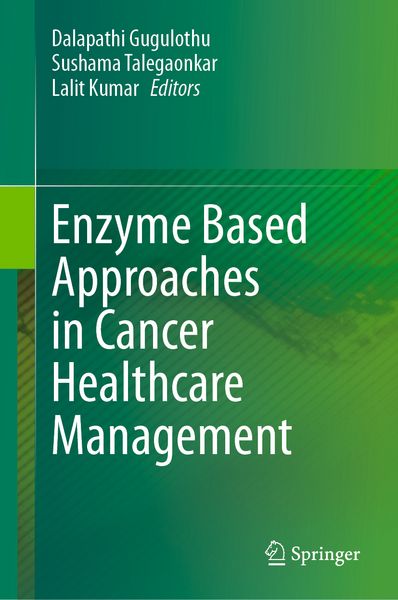
Produktbild: Enzyme Based Approaches in Cancer Healthcare Management
- 10%

Enzyme Based Approaches in Cancer Healthcare Management

10% sparen

196,99 € UVP 219,99 €

inkl. gesetzl. MwSt., Versandkostenfrei


Beschreibung

Produktdetails

Einband

Gebundene Ausgabe

Erscheinungsdatum

08.01.2026

Abbildungen

XVII, 67 illus., 62 illus. in color., farbige Illustrationen, schwarz-weiss Illustrationen

Herausgeber

Dalapathi Gugulothu + weitere

Verlag

Springer Singapore

Seitenzahl

460

Maße (L/B/H)

24,1/16/3,2 cm

Gewicht

879 g

Auflage

1. Auflage

Sprache

Englisch

ISBN

978-981-9550-70-8

Beschreibung

Portrait

Dr. Dalapathi Gugulothu completed his PhD and M.Pharm from the Institute of Chemical Technology, Mumbai, India and earned his B.Pharm from Kakatiya University, Warangal, Telangana, India. He is currently serving at the Delhi Institute of Pharmaceutical Sciences and Research, part of the Delhi Pharmaceutical Sciences and Research University, New Delhi. His research focuses on a variety of advanced topics, including siRNA delivery, nanotoxicology, targeted drug delivery systems, nanofibers, exosomes, gastroretentive drug delivery systems, orodispersible drug delivery systems and lyophilization cycle development. He has presented numerous research papers at national and international conferences, earning multiple awards for his work. He Gugulothu has been granted three Indian patents and has authored numerous research & review articles, as well as six book chapters. Additionally, he has successfully completed a research project funded by the Science and Engineering Research Board, Department of Science & Technology and recently working on another research project funded by SERB-DST. He has also been awarded travel grants from DBT & DST to attend conferences, reflecting his active engagement and contributions to the field of pharmaceutical sciences.

Dr. Sushama Talegaonkar is working in the Department of Pharmaceutics, School of Pharmaceutical Sciences, Delhi Pharmaceutical Sciences & Research University (DPSRU), New Delhi. With over 24 years of teaching and research experience, she has been recognized among the top two percent of world scientists in the global list compiled by Stanford University for five consecutive years: 2020, 2021, 2022, 2023, 2024. She holds three Indian patents and has filed six others. She has published over 220 research papers in high-impact international journals and 30 in national journals, with an h-index of 59, an i10-index of 160 and more than 14,000 Google Scholar citations. She has co-authored six books and contributed 30 chapters to international reference volumes. Her accolades include the “Prof C J Shishoo Award” by APTI, the “UGC Research Award” (2014–2016) and the prestigious Motan Devi Dandiya Biennial Prize for best publication in Pharmaceutical Sciences for the period 2010-11, among others. Her research focuses on developing a wide variety of smart and functionalized nano drug delivery systems for targeted anticancer drug delivery. She has completed research projects amounting to more than rupees one crore, funded by prominent agencies such as UGC, AICTE, DBT and SERB.

Dr. Lalit Kumar is currently working in the Department of Pharmaceutics at the National Institute of Pharmaceutical Education & Research, Hajipur, Bihar, India. He completed his PhD in nanoparticulate drug delivery systems and has made significant contributions to pharmaceutical research. He has authored around 150 peer-reviewed journal articles, over 35 book chapters, 2 books and holds 3 granted Indian patents, with 8 more applications under review. His research focuses on developing nanocarriers for targeted drug delivery to tumors, the colon, the brain, the breast and the lungs. He has successfully completed over ten research projects, collectively funded with more than ₹1.5 crore by agencies such as All India Council of Technical Education, New Delhi; the Karnataka State Government Vision Group of Science & Technology, Bengaluru; the Science & Engineering Research Board (SERB), New Delhi; and the Indian Council of Medical Research, New Delhi. His work has been recognized with several awards, including the Prof. M.L Khorana Memorial Prize in 2018 and the Dr. T.M.A. Pai Gold Medal in 2019 and 2023. He has been named among the top 2% of world scientists by Stanford University in 2023, 2024 & 2025. He is also a life member of six scientific organizations. As a reviewer for more than 80 peer-reviewed journals, he received Publon’s Top 1% Reviewer Award (2017–2019) under the “Pharmacy, Pharmacology and Toxicology” category.

Produktdetails

Einband

Gebundene Ausgabe

Erscheinungsdatum

08.01.2026

Abbildungen

XVII, 67 illus., 62 illus. in color., farbige Illustrationen, schwarz-weiss Illustrationen

Herausgeber

Verlag

Springer Singapore

Seitenzahl

460

Maße (L/B/H)

24,1/16/3,2 cm

Gewicht

879 g

Auflage

1. Auflage

Sprache

Englisch

ISBN

978-981-9550-70-8

Herstelleradresse

Springer-Verlag KG
Sachsenplatz 4-6
1201 Wien
AT

Email: GPSR Kontakt

Noch keine Bewertungen vorhanden

Verfassen Sie die erste Bewertung zu diesem Artikel

Helfen Sie anderen Kundinnen und Kunden durch Ihre Meinung.

Kundinnen und Kunden meinen

Bewertungen (0)

  • Produktbild: Enzyme Based Approaches in Cancer Healthcare Management
  • Section I: Non-Glycolytic and Glycolytic Enzymes in Cancer Progression and Targeted Therapy.- Chapter 1. Hexokinase (HK).- Chapter 2. Glucose-6-Phosphate Isomerase (G6PI).- Chapter 3. Phosphofructokinase-1 (PFK-1).- Chapter 4. Aldolase: Functions in Glycolysis and Epithelial-Mesenchymal Transition (EMT).- Chapter 5. Glyceraldehyde-3-Phosphate Dehydrogenase (GA3PDH): Role in Membrane Transport and Plasminogen Binding.- Section II: Enzymes Involved in Tumor-Driven Angiogenesis.- Chapter 6. Receptor Tyrosine Kinase (RTK).- Chapter 7. Nitric Oxide Synthase (NOS).- Chapter 8. Matrix Metalloproteinase (MMP).- Chapter 9. Thymidine Phosphorylase.- Chapter 10. Cathepsin Proteases.- Section III: Epigenetics and Enzyme Inhibition.- Chapter 11. DNA Methyltransferases (DNMTs) – DNMT1, DNMT2, DNMT3A, DNMT3B, DNMT3L.- Chapter 12. Restoring Tumor Suppression Activity: Mimicking Molecules (TargomiRs and MRX34), and Synthetic RNAs (MTL-CEBPA).- Chapter 13. Inhibiting Oncogene Expression through Molecules that Degrade mRNAs: MRG-106 and Dovitinib .- Chapter 14. Histone and Histone Family: Histone Modification, Histone Acetyltransferases, Histone Methyltransferases, Methyl-Histone Recognition Proteins, Histone Demethylases, and Histone Deacetylation Inhibitors (HDACi).- Section IV: Advanced Therapeutic Approaches.- Chapter 15. Bispecific Antibodies in Cancer Therapy.- Chapter 16. Nanotechnology in Targeting Enzymes in Cancer Therapy.