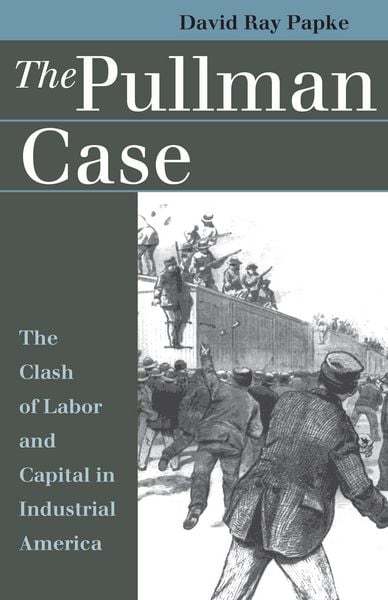
The Pullman Case The Clash of Labor and Capital in Industrial America
-
- Taschenbuch
- eBook ausgewählt
-
Form:Einzelkauf Download
-
Sprache:Englisch
30,40 €
inkl. gesetzl. MwSt.Beschreibung
Produktdetails
Format
ePUB
Kopierschutz
Nein
Family Sharing
Nein
Text-to-Speech
Ja
Erscheinungsdatum
30.04.1999
Verlag
University Press Of KansasSeitenzahl
132 (Printausgabe)
Dateigröße
1550 KB
Sprache
Englisch
EAN
9780700622443
When the American Railway Union went on strike against the Pullman Palace Car Company in 1894, it set into motion a chain of events whose repercussions are still felt today. The strike pitted America's largest industrial union against twenty-four railroads, paralyzed rail traffic in half the country, and in the end was broken up by federal troops and suppressed by the courts, with union leader Eugene Debs incarcerated. But behind the Pullman case lay a conflict of ideologies at a watershed time in our nation's history.
David Ray Papke reexamines the events and personalities surrounding the 1894 strike, related proceedings in the Chicago trial courts, and the 1895 Supreme Court decision, In re Debs, which set important standards for labor injunctions. He shows how the Court, by upholding Debs's contempt citation, dealt fatal blows to broad-based unionism in the nation's most important industry and to any hope for a more evenhanded form of judicial involvement in labor disputesthus setting the stage for labor law in decades to come.
The Pullman case was a defining moment in the often violent confrontation between capital and labor. It matched wealthy industrialist George Pullman against Debs and gave a stage to Debs's fledgling attorney Clarence Darrow. Throughout the trial, capital and labor tried to convince the public of the justice of their cause: Debs decrying the company's treatment of workers and Pullman raising fears of radical unionists. Papke provides an analytically concise and highly readable account of these proceedings, offering insight into the strengths and weaknesses of the law at the peak of industrial capitalism, showcasing Debs's passionate commitment to workers' rights, and providing a window on America during a period of rapid industrialization and social transformation.
Papke shows that the law was far from neutral in defending corporate interests and suggests what the Pullman case, by raising questions about both the legitimacy of giant corporations and the revolutionary style of industrial unions, can teach us about law and legal institutions in our own time. His book captures the passions of industrial America and tells an important story at the intersection of legal and cultural history.
Noch keine Bewertungen vorhanden
Verfassen Sie die erste Bewertung zu diesem Artikel
Helfen Sie anderen Kundinnen und Kunden durch Ihre Meinung.
Kurze Frage zu unserer Seite
Vielen Dank für Ihr Feedback
Wir nutzen Ihr Feedback, um unsere Produktseiten zu verbessern. Bitte haben Sie Verständnis, dass wir Ihnen keine Rückmeldung geben können. Falls Sie Kontakt mit uns aufnehmen möchten, können Sie sich aber gerne an unseren Kund*innenservice wenden.
zum Kundenservice