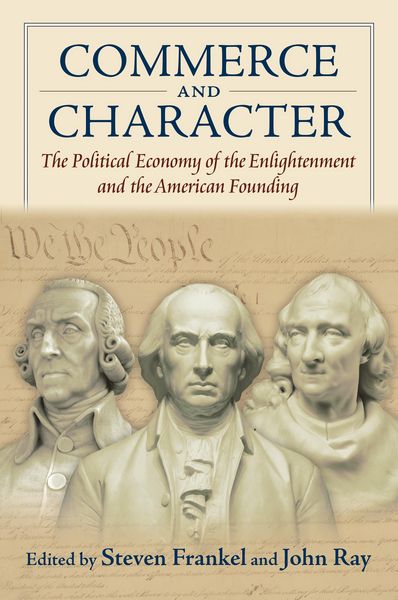
Commerce and Character The Political Economy of the Enlightenment and the American Founding
-
- Taschenbuch
- eBook ausgewählt
-
Form:Einzelkauf Download
-
Sprache:Englisch
29,30 €
inkl. gesetzl. MwSt.Beschreibung
Produktdetails
Format
ePUB
Kopierschutz
Nein
Family Sharing
Nein
Text-to-Speech
Ja
Erscheinungsdatum
20.05.2025
Herausgeber
Steven Frankel + weitereVerlag
University Press Of KansasSeitenzahl
296 (Printausgabe)
Dateigröße
1199 KB
Sprache
Englisch
EAN
9780700638321
Nine leading scholars explore some of the most important minds behind the new political economy of the American Founding and engage with the foundational work of Ralph Lerner.
In his 1979 article, Commerce and Character: The Anglo-American as New-Model Man, Ralph Lerner argued that the American Founders and the political theorists of the commercial republic were charting a new basis for society that broke with the old order, which was preoccupied with intangible goods to an extent we now hardly ever see. The king had his glory, the nobles their honor, the Christians their salvation, the citizens of pagan antiquity their ambition to outdo others in serving the public good. By contrast, the commercial republic was a regime based on the belief that human behavior is best understood as driven by physical wants and tangible goods. A government grounded on this understanding of humanity would be a more stable system and thus more conducive to human flourishing. Lerner's article thus interpreted the Founding as a revolution in political philosophy that must be understood against the backdrop of the Enlightenment.
Commerce and Character brings together nine distinguished scholars who explore individual Enlightenment or American thinkers who made important philosophical or political contributions to the new political economy of modern republicanism. The contributing authors include Ann Charney Colmo, Ryan Hanley, John C. Koritansky, Peter McNamara, Peter Onuf, Clifford Orwin, Paul Rahe, Colleen Sheehan, and Michael Zuckert. Each contributor uses Lerner's essay as the jumping-off point, and at the end, Lerner provides a detailed response to each of his interlocutors where he carefully examines each chapter and reconsiders his arguments a half century later.
Noch keine Bewertungen vorhanden
Verfassen Sie die erste Bewertung zu diesem Artikel
Helfen Sie anderen Kundinnen und Kunden durch Ihre Meinung.
Kurze Frage zu unserer Seite
Vielen Dank für Ihr Feedback
Wir nutzen Ihr Feedback, um unsere Produktseiten zu verbessern. Bitte haben Sie Verständnis, dass wir Ihnen keine Rückmeldung geben können. Falls Sie Kontakt mit uns aufnehmen möchten, können Sie sich aber gerne an unseren Kund*innenservice wenden.
zum Kundenservice