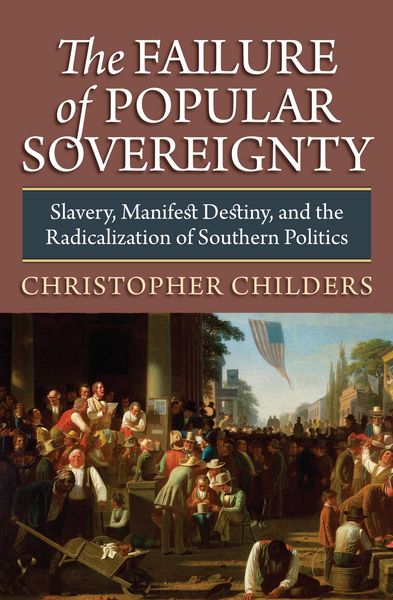
The Failure of Popular Sovereignty Slavery, Manifest Destiny, and the Radicalization of Southern Politics
34,00 €
inkl. gesetzl. MwSt.Beschreibung
Produktdetails
Format
ePUB
Kopierschutz
Nein
Family Sharing
Nein
Text-to-Speech
Ja
Erscheinungsdatum
08.11.2012
Verlag
University Press Of KansasSeitenzahl
(Printausgabe)
Dateigröße
3800 KB
Sprache
Englisch
EAN
9780700639779
As the expanding United States grappled with the question of how to determine the boundaries of slavery, politicians proposed popular sovereignty as a means of entrusting the issue to citizens of new territories. Christopher Childers now uses popular sovereignty as a lens for viewing the radicalization of southern states' rights politics, demonstrating how this misbegotten offspring of slavery and Manifest Destiny, though intended to assuage passions, instead worsened sectional differences, radicalized southerners, and paved the way for secession.
In this first major history of popular sovereignty, Childers explores the triangular relationship among the extension of slavery, southern politics, and territorial governance. He shows how, as politicians from North and South redesigned popular sovereignty to lessen sectional tensions and remove slavery from the national political discourse, the doctrine instead made sectional divisions intractable, placed the territorial issue at the center of national politics, and gave voice to an increasingly radical states' rights interpretation of the federal compact.
Childers explains how politicians offered the idea of local control over slavery as a way to appease the Southor at least as a compromise that would not offend the states' rights constitutional scruples of southerners. In the end, that strategy backfired by transforming the South into a rigid sectional bloc dedicated to the protection and perpetuation of slaverya political time bomb that eventually exploded into Civil War.
Tracing the doctrine of popular sovereignty back to its roots in the early American republic, Childers describes the dichotomy between believers in local control in the territories and national control as first embodied in the 1787 Northwest Ordinance. Noting that the slavery extension issue had surfaced before but obviously not been resolved, he shows how the debate over this issue played out over time, complicated the relationship between the federal government and the territories, and radicalized sectional politics. He also provides new insight into such topics as Arkansas and Florida statehood, the early phases of California's statehood bid, and the emergence of John C. Calhoun's common property doctrine.
Laced with new insights, Childers's study offers a coherent narrative of the formative moments in the slavery debate that have been seen heretofore as discrete events. His work stands at the intersection of political, intellectual, and constitutional history, unfolding the formative moments in the slavery debate to expand our understanding of the peculiar institution in the early republic.
Noch keine Bewertungen vorhanden
Verfassen Sie die erste Bewertung zu diesem Artikel
Helfen Sie anderen Kundinnen und Kunden durch Ihre Meinung.
Kurze Frage zu unserer Seite
Vielen Dank für Ihr Feedback
Wir nutzen Ihr Feedback, um unsere Produktseiten zu verbessern. Bitte haben Sie Verständnis, dass wir Ihnen keine Rückmeldung geben können. Falls Sie Kontakt mit uns aufnehmen möchten, können Sie sich aber gerne an unseren Kund*innenservice wenden.
zum Kundenservice