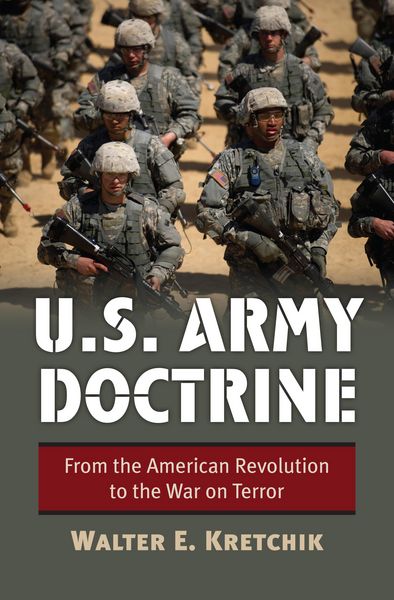
U.S. Army Doctrine From the American Revolution to the War on Terror
-
- Einzelkauf Download ausgewählt
-
Sprache:Englisch
38,10 €
inkl. gesetzl. MwSt.Beschreibung
Produktdetails
Format
ePUB
Kopierschutz
Nein
Family Sharing
Nein
Text-to-Speech
Ja
Erscheinungsdatum
15.08.2014
Verlag
University Press Of KansasSeitenzahl
408 (Printausgabe)
Dateigröße
3028 KB
Sprache
Englisch
EAN
9780700620463
From the American Revolution to the global war on terror, U.S. Army doctrine has evolved to regulate the chaos of armed conflict by providing an intellectual basis for organizing, training, equipping, and operating the military. Walter E. Kretchik analyzes the service's keystone doctrine over three centuries to reveal that the army's leadership is more forward thinking and adaptive than has been generally believed.
The first comprehensive history of Army doctrine, Kretchik's book fully explores the principles that have shaped the Army's approach to warfare. From Regulations For the Order and Discipline of the Troops of the United States in 1779 to modern-day field manuals, it reflects the fashioning of doctrine to incorporate the lessons of past wars and minimize the uncertainty and dangers of battle.
Kretchik traces Army doctrine through four distinct eras: 1779-1904, when guidelines were compiled by single authors or a board of officers in tactical drill manuals; 1905-1944, when the Root Reforms fixed doctrinal responsibility with the General Staff; 1944-1962, the era of multiservice doctrine; and, beginning in 1962, coalition warfare with its emphasis on interagency cooperation. He reveals that doctrine has played a significant role in the Army's performance throughout its history-although not always to its advantage, as it has often failed to anticipate accurately the nature of the next war and still continues to be locked in a debate between advocates of conventional warfare and those who emphasize counterinsurgency approaches.
Each chapter presents individuals who helped define and articulate Army doctrine during each period of its history-including George Washington and Baron von Steuben in the eighteenth century, Emory Upton and Arthur Wagner in the nineteenth, and Elihu Root and William DePuy in the twentieth. Each identifies the first principles set down in manuals covering such topics as tactics, operations, and strategy; size, organization, and distribution of forces; and the promise and challenges of technological innovation. Each also presents specific cases that analyze how effectively the Army actually applied a particular era's doctrine.
Doctrine remains the basis of instruction in the Army school system, ensuring that all officers and enlisted soldiers share a common intellectual framework. This book elucidates that framework for the first time.
Noch keine Bewertungen vorhanden
Verfassen Sie die erste Bewertung zu diesem Artikel
Helfen Sie anderen Kundinnen und Kunden durch Ihre Meinung.
Kurze Frage zu unserer Seite
Vielen Dank für Ihr Feedback
Wir nutzen Ihr Feedback, um unsere Produktseiten zu verbessern. Bitte haben Sie Verständnis, dass wir Ihnen keine Rückmeldung geben können. Falls Sie Kontakt mit uns aufnehmen möchten, können Sie sich aber gerne an unseren Kund*innenservice wenden.
zum Kundenservice