Gutscheinbedingungen

**Gültig am 28.06.2026 auf Spielzeug, Schreibwaren, Filme, Geschenke & Trends, Musik, tolino eReader & Zubehör, Hörbücher und Hörbuch-Downloads (außer Abo), nicht preisgebundene Bücher und Kalender online auf thalia.at und in der Thalia App. Einzelne Artikel können ausgeschlossen sein. Aufgrund der Buchpreisbindung sind deutschsprachige Bücher und eBooks ausgenommen. Zusätzlich ausgenommen sind preisgebundene Artikel, Abos & Flatrates, eBooks, Games, Geschenkkarten/-boxen, Shelfies, Software, Zeitschriften sowie einzelne Artikel von tonies®. Pro Einkauf einmal einlösbar. Click & Collect nur bei Onlinevorabzahlung möglich. Keine Barauszahlung. Nicht kombinierbar mit anderen Aktionen und Gutscheinen. Gutschein wird auf max. 500€ Bestellwert angerechnet. Nicht gültig für Versandkosten und Services.

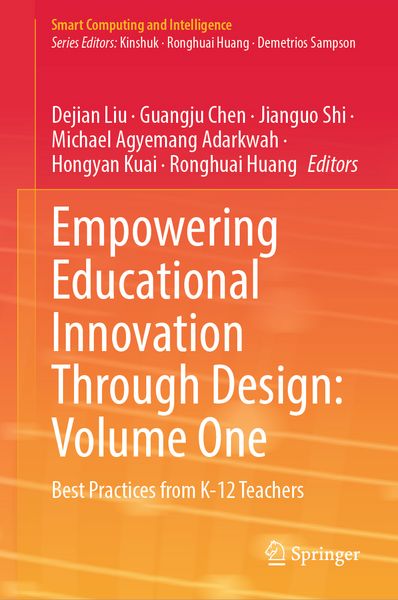
Produktbild: Empowering Educational Innovation Through Design: Volume One

Empowering Educational Innovation Through Design: Volume One Best Practices from K-12 Teachers

181,99 €

inkl. gesetzl. MwSt., Versandkostenfrei


Beschreibung

Produktdetails

Einband

Gebundene Ausgabe

Erscheinungsdatum

24.04.2026

Abbildungen

XVII, 183 illus., 148 illus. in color., schwarz-weiss Illustrationen, farbige Illustrationen

Herausgeber

Dejian Liu + weitere

Verlag

Springer Singapore

Seitenzahl

366

Maße (L/B/H)

24,1/16/2,7 cm

Gewicht

738 g

Auflage

1. Auflage

Sprache

Englisch

ISBN

978-981-9546-20-6

Beschreibung

Portrait

Dr. Dejian Liu is the Chairman and Executive Director of NetDragon Websoft Inc., and Co-Dean of the Smart Learning Institute of Beijing Normal University, China. He also serves on the Governing Board of the UNESCO (United Nations Educational, Scientific and Cultural Organization) Institute for Information Technologies in Education (IITE), and as the Chairman of the Judging Committee for the Global Competition on Design for Future Education (GCD4FE). Dr. Liu also pioneered 'Design Methodology', an innovative design theory grounded in advanced design concepts and practical cyberlearning experiences worldwide. In 2017, he taught the course 'Next Generation Design: Methods and Heuristics' to students from the Harvard Graduate School of Education. 

Dr. Guangju Chen is the Former Vice President of Beijing Normal University (BNU), and President of Beijing Normal University Zhuhai (BNUZ), China. He is also the Deputy Dean of the Smart Learning Institute of BNU, and Chairman of the Steering Committee, Global Competition on Design for Future Education (GCD4FE).

Dr. Jianguo Shi is the Executive Vice President of the Research Institute of China Educational Equipment Industry Association, and an specially-appointed Expert at the Smart Learning Institute, Beijing Normal University, China. He has served as a middle school mathematics teacher, a mathematics curriculum researcher, and Director of the Educational Technology Center of Zhejiang Province. He has been engaged in research and practice on educational technology equipment and educational informatization for many years. In recent years, he has published 40 academic papers in educational technology journals, and has won the Second Prize for National Basic Education Teaching Achievements twice.

Dr. Michael Agyemang Adarkwah is a Research Associate at the Institute for Education and Culture,  the Chair of Adult Education, Friedrich Schiller University Jena, Germany, and was a Postdoctoral Researcher at the Smart Learning Institute, Beijing Normal University (BNU), China. He serves as an Editor of the book series Assessment of Educational Technology (AET), a Senior Editor for Frontiers of Digital Education, and an Associate Editor for SN Social Sciences, the Journal of Applied Learning and Teaching (JALT), and the Journal of University Teaching and Learning Practice (JUTLP).

Ms. Hongyan Kuai is the Director of the Design and Learning Lab, Smart Learning Institute of Beijing Normal University, China, and her research focuses on educational technology and educational design. For over a decade, she has participated in the planning and organizing of the Global Competition on Design for Future Education (in its eighth edition as of 2025), which has attracted over 10,000 college students and K-12 teachers from more than 35 countries and regions. She has also planned and organized various academic events such as the Global Smart Education Conference (now in its tenth edition as of 2025), student forum on the global future education, and the annual Academic Week on Smart Learning. 

Dr. Ronghuai Huang is a Professor of Education at Beijing Normal University, China. He is the Co-Dean of the Smart Learning Institute of Beijing Normal University, the Director of the National Engineering Research Center of Cyberlearning and Intelligent Technology, and the Director of the Educational Informatization Strategy Research Base in Beijing, under the Ministry of Education of the People's Republic of China. Additionally, he serves as the UNESCO Chair on Artificial Intelligence in Education. Professor Huang has undertaken over 100 vertical and horizontal research projects at national and provincial levels, published more than 40 academic books worldwide, and authored over 400 academic papers in Chinese and English.
Produktdetails

Einband

Gebundene Ausgabe

Erscheinungsdatum

24.04.2026

Abbildungen

XVII, 183 illus., 148 illus. in color., schwarz-weiss Illustrationen, farbige Illustrationen

Herausgeber

Verlag

Springer Singapore

Seitenzahl

366

Maße (L/B/H)

24,1/16/2,7 cm

Gewicht

738 g

Auflage

1. Auflage

Sprache

Englisch

ISBN

978-981-9546-20-6

Herstelleradresse

Springer-Verlag KG
Sachsenplatz 4-6
1201 Wien
AT

Email: GPSR Kontakt

Kundinnen und Kunden meinen

0 Bewertungen

Informationen zu Bewertungen

Zur Abgabe einer Bewertung ist eine Anmeldung im Konto notwendig. Die Authentizität der Bewertungen wird von uns nicht überprüft. Wir behalten uns vor, Bewertungstexte, die unseren Richtlinien widersprechen, entsprechend zu kürzen oder zu löschen.

Die Bewertungen sind nach Format, Anzahl Sterne und Datum sortiert.

Verfassen Sie die erste Bewertung zu diesem Artikel

Helfen Sie anderen Kund*innen durch Ihre Meinung

Kundinnen und Kunden meinen

0 Bewertungen filtern

Weitere Artikel finden Sie in

  • Produktbild: Empowering Educational Innovation Through Design: Volume One
  • Foreword.- Preface.- Introduction to the Global Competition on Design for Future Education.- Features of the Book.- Content.- Part 1 Highlighting Educational Product Designs.- Chapter 1 The Data Brain of Small Seeds: A Comprehensive Evaluation System for Students in Large-Scale Schools.- Chapter 2 Construction and Practice of Internet-Enhanced Management Platform for Student Mental Well-being.- Chapter 3 Code Mission: Designing an Educational Tool for Programming Education.- Chapter 4 Integrated Reading: Construction and Implementation of Online, Offline, and Autonomous Reading System.- Chapter 5 AI-Enhanced Education: Creation and Application of Interdisciplinary Instructional Agent.- Part 2 Featuring Educational Solution Designs.- Chapter 6 Ethno-STEAM and Klenang Sasak: A Design-Based Solution for Rural Schools.- Chapter 7 Unity in Diversity: Innovative Practices for Inclusive Education.- Chapter 8 AIGC-Integrated Art Course: Pathway to Cultivate High-Quality Artistic Talents.- Chapter 9 Food Museum: Curriculum and Venue Development for Food Education in Kindergartens.- Chapter 10 Crafting and Deploying a Metaverse Curriculum Leveraging the WorldWide Telescope.- Chapter 11 Magic Space: The Construction and Practical Study of a Comprehensive Learning Space in Schools.- Chapter 12 Teaching Accuracy in English Writing through Process-Oriented Data Feedback Technology.- Chapter 13 Designing a Creative “Smart+” P.E. Class Break Using Educational Neuroscience.- Chapter 14 Developing Health Education Resources for Tibetan Farmers’ and Herdsmen’s Children Using Digital Technology Applications.- Part 3 Showcase of Educational Service Designs.- Chapter 15 Intelligent After-School Extended Care Programme for Primary School Students.- Chapter 16 Innovative Practices in Cultivating a Sense of Social Responsibility among Rural Students: Taking A Touch of Blue as an Example.- Chapter 17 Indigenized Implementation of Service-Learning in Secondary Schools.- Part 4 Insight into Educational Mechanism Designs.- Chapter 18 Design and Implementation of Multi-Course Blended Teaching in Smart Education.- Chapter 19 Exploring the Collaborative Model of School-Family-Community for Cultivating Creative Talents.- Chapter 20 The Sharing of Educational Resources between Urban and Rural Schools Enabled by Real-scene Classroom.- Part 5 Exploring Educational Policy Designs.- Chapter 21 Enhancing Learning Style Transformation through the Design and Application of Subject-Based Classrooms.