KI-Beratung Beta

Gutscheinbedingungen

**Gültig bis 11.11.2026 auf Spielzeug, Schreibwaren, Filme, Geschenke & Trends, Musik, tolino eReader & Zubehör, Hörbücher und Hörbuch-Downloads, nicht preisgebundene Bücher und Kalender online auf thalia.at und in der Thalia App. Einzelne Artikel können ausgeschlossen sein. Aufgrund der Buchpreisbindung sind deutschsprachige Bücher und eBooks ausgenommen. Zusätzlich ausgenommen sind Abos & Flatrates, Games, Geschenkkarten/-boxen, Shelfies, Software, Zeitschriften sowie einzelne Artikel von tonies®. Pro Einkauf einmal einlösbar. Click & Collect nur bei Onlinevorabzahlung möglich. Keine Barauszahlung. Nicht kombinierbar mit anderen Aktionen und Gutscheinen. Gutschein wird auf max. 500€ Bestellwert angerechnet. Nicht gültig für Versandkosten und Services.

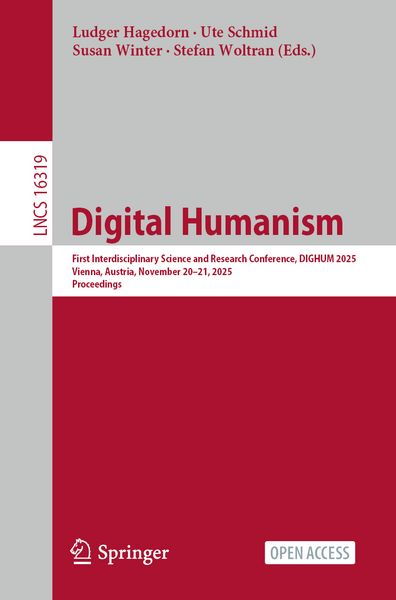
Produktbild: Digital Humanism
Band 16319

Digital Humanism First Interdisciplinary Science and Research Conference, DIGHUM 2025, Vienna, Austria, November 20–21, 2025, Proceedings

39,99 €

inkl. gesetzl. MwSt., Versandkostenfrei


Beschreibung

Produktdetails

Einband

Taschenbuch

Erscheinungsdatum

14.11.2025

Abbildungen

XVI, 546 p. 62 illus., 50 illus. in color.

Herausgeber

Ludger Hagedorn + weitere

Verlag

Springer

Seitenzahl

546

Maße (L/B/H)

23,5/15,5/3,1 cm

Gewicht

844 g

Sprache

Englisch

ISBN

978-3-032-11107-4

Beschreibung

Produktdetails

Einband

Taschenbuch

Erscheinungsdatum

14.11.2025

Abbildungen

XVI, 546 p. 62 illus., 50 illus. in color.

Herausgeber

Verlag

Springer

Seitenzahl

546

Maße (L/B/H)

23,5/15,5/3,1 cm

Gewicht

844 g

Sprache

Englisch

ISBN

978-3-032-11107-4

Herstelleradresse

Springer-Verlag KG
Sachsenplatz 4-6
1201 Wien
AT

Email: ProductSafety@springernature.com

Noch keine Bewertungen vorhanden

Verfassen Sie die erste Bewertung zu diesem Artikel

Helfen Sie anderen Kundinnen und Kunden durch Ihre Meinung.

Kundinnen und Kunden meinen

Bewertungen (0)

  • Produktbild: Digital Humanism


  • .- Digital Humanism Reshaping Computer Science


    .- Heuristic Search and Constraint Verification for Value-Centric Electrification Planning.


    .- A System Prototype for Food Sales Forecasting and Optimization to Reduce Food Waste for Short-Shelf-Life Products.


    .- Schedules Need to be Fair Over Time.


    .- A Bayesian View of the Result Model.


    .- Towards Fair AI Systems: An Insurance Case Study to Identify and Mitigate Discrimination.


    .- TiBaLLi: Internet Inclusion Through Artificial Intelligence.


    .- Normative Challenges in Europe’s Digital Infrastructure: A Transdisciplinary Exploration of Smart Meter Data Sharing.


    .- Catastrophic Computation. On the Impossibility of Sustainable Artificial Intelligence.


    .- Adaptive Alignment of Human Values in Cyber-Physical Supply Chains.


    .- Digital Humanism: Ethical and Legal Aspects


    .- Beyond the Digital Judge: Legal Reasoning in Compliance Checking and Compliance Choices.


    .- Visual Neuroprosthetics, Digital Humans and the Law of Evidence.


    .- Understanding the Humanist Notion of Trust in the Age of Generative AI.


    .- What if the Avatar Can Read My Mind? Possibilities and Ethical Pitfalls of Human-Virtual Reality Interaction Integrating Artificial Intelligence.


    .- Start Using Justifications When Explaining AI Systems to Decision Subjects.


    .- Bridging Ethics and Regulation: How VBE Facilitates Compliance with the EU AI Act in High-Risk and General Purpose AI.


    .- Realizing Ethical-aware Business Processes.


    .- A Two-Axis Framework to Map Reasons for Neurotechnology Use.


    .- Digital Humanism in Political and Social Sciences


    .- Narrated Future: How Narratives Shape Our Digital Present.


    .- Climate Disasters and Risks in Online Expressions in South Africa.


    .- Parliaments in the Digital Age – A Proposal for a Theoretical Framework.


    .- Micro-Degree Artificial Intelligence and Society.


    .- Why Digital Humanism Needs a Social Psychology – and How You Can Use Digital Data to Study Social Identities in Socio-Technical Systems.


    .- Between Principle and Practice: Evaluating the EU AI Act through the Lens of Digital Humanism.


    .- Readiness-Centered AI in Practice: Findings from a Pilot Chatbot for Digital Skilling of Older Adults in Low-Readiness Contexts.


    .- On the Digital Literacy Pedagogical Strategies to Curb Disinformation in the Global South(s).


    .- Linguistic Diversity and Digitalization: An Ambivalent Relationship.


    .- Unsustainable Imaginaries of Data Economies: Exploring the Concept of Waste for EU Digital Policy.


    .- The Commons Approach: An Agenda to (Re)Open Artificial Intelligence.


    .- Are They Aware When AI Is Used? And What Do They Think That AI Should Be Used For? – Insights into the Digital Skills Austria III Study.


    .- Privacy Merchants and Data Protection in the Age of Big Data and Artificial Intelligence.


    .- Breaking Disciplinary Silos: Digital Humanism Across Disciplines


    .- Reclaiming Agency through Cyber Humanism: A European Agenda for AI, Education and Culture.


    .- Breaking Disciplinary Silos: The Case of Software Engineering.


    .- Economies of Labor in the Age of AI: The Case of YouTube.


    .- AI Research Is Not Magic, It Has to Be Reproducible and Responsible: Challenges in the AI Field from the Perspective of Its PhD Students.


    .- Thinking Along the Lines Generated by GenAI? A Systematic Mapping Study on Academic Writing.


    .- The Architecture of Academic Overproduction: Toward Post-AI Scholarship.


    .- Designing Deliberative Digital Communication Platforms.


    .- Who Wants to Live Forever? AI-Centricity as Ex-Centricity of Death.


    .- Paperwork vs. Paperplay.


    .- Vulnerability as a Design Ethics for Digital Humanism.


    .- Unpacking the Tensions of Empowerment in Digital-Self Tracking: A Digital Humanism Perspective.